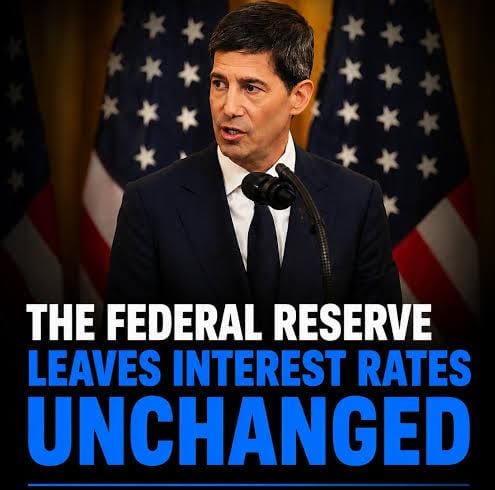
The Federal Open Market Committee announced today that the Fed keeps rate steady at 3.75%, leaving the benchmark federal funds rate target range unchanged at 3.50%–3.75%. The decision reflects policymakers' assessment that economic growth remains solid while inflation remains somewhat elevated, requiring a measured stance to maintain price stability.
WASHINGTON — The Federal Open Market Committee (FOMC) decided on Wednesday to hold the federal funds rate unchanged at a target range of 3.50% to 3.75%. Issued following its policy meeting in Washington, D.C., the official FOMC statement indicates that central bank officials are opting for patience while evaluating recent economic growth, energy price fluctuations, and shifting labor market conditions. The decision highlights the central bank's ongoing effort to return inflation to its 2% long-term target while preventing unnecessary disruption to employment and broader financial conditions.
Economic Assessment and Inflation Outlook
In its formal policy statement, the central bank noted that recent indicators suggest economic activity has continued to expand at a solid pace. Job gains have moderated, yet the national unemployment rate remains relatively stable, keeping overall labor supply and demand in reasonable balance.
However, inflation metrics continue to register somewhat above the target threshold. According to policymakers, headline consumer prices have been influenced by global commodity volatility and trade cost dynamics. Because core Personal Consumption Expenditures (PCE) inflation has shown stickiness in certain service sectors, committee members emphasized that the Fed keeps rate steady at 3.75% to ensure inflation expectations remain firmly anchored.
The central bank reiterated that it will continue reducing its holdings of Treasury securities and agency debt, maintaining its balance sheet runoff protocol alongside its interest rate targets.
Market Impact Across Sectors and Consumers
The decision to maintain current policy rates carries direct consequences for financial markets, household borrowing, and corporate capital spending.
Consumer Credit & Mortgages: With the federal funds rate fixed, prime lending rates across commercial banks will remain constant. Borrowers seeking fixed-rate home mortgages, auto loans, or personal credit lines will see immediate rate stability, though credit costs remain higher than pre-tightening averages.
Corporate Investment: Fixed interest rate benchmarks allow corporate treasurers to plan debt refinancing and capital expenditures with greater predictability. Analysts note that businesses in capital-intensive sectors, including technology and green infrastructure, benefit from rate stability after previous volatility.
Equities and Debt Markets: Stock indices traded flat to slightly higher following the policy release, as market participants had broadly anticipated that the Fed keeps rate steady at 3.75%. Bond yields stabilized across short-term Treasury maturities as investors adjusted expectations for any future monetary adjustments later in the year.
Official Sources Section
According to official releases from the Federal Reserve Board, the policy vote was supported by a majority of FOMC members following a review of economic data, industrial output metrics, and labor force statistics. Government economic releases, including data from the U.S. Bureau of Labor Statistics and the U.S. Department of Commerce, were cited during committee deliberations regarding inflation trends and domestic output growth.
Quote Section
"According to officials at the central bank, the Committee seeks to achieve maximum employment and inflation at the rate of 2 percent over the longer run," the FOMC statement stated. "In considering any adjustments to the target range for the federal funds rate, the Committee will carefully assess incoming data, the evolving outlook, and the balance of risks."
Why It Matters
The decision that the Fed keeps rate steady at 3.75% signals a holding pattern for domestic and international financial conditions. For households, it means credit card annual percentage rates (APRs) and home equity loans will not spike, though savings yields at commercial banks will also remain capped at current levels. For global central banks and international markets, the policy hold maintains the relative strength of the U.S. dollar, stabilizing international trade pricing and capital flows across emerging and developed economies alike.
Key Facts at a Glance
Benchmark Target Range: Unchanged at 3.50% to 3.75%.
Policy Mandate: Dual focus on achieving maximum employment and 2% long-run inflation.
Balance Sheet: Quantitative tightening continues through systematic balance sheet reduction.
Economic Stance: Described economic expansion as "solid" despite ongoing elevated price risks.
Frequently Asked Questions
Why did the Federal Reserve keep rates unchanged today?
The FOMC left interest rates unchanged because economic activity remains solid while inflation stays moderately elevated above the 2% target. Holding rates constant allows policymakers to evaluate incoming economic data before deciding on future policy adjustments.
How does this decision affect mortgage and credit card rates?
Because the Fed keeps rate steady at 3.75%, prime lending rates across major commercial banks will remain unchanged. Credit card APRs and variable-rate loans will stay near current levels, while fixed mortgage rates will continue to track 10-year Treasury yields.
What is the current target range for the federal funds rate?
The target range for the federal funds rate remains set at 3.50% to 3.75% following the latest policy statement.
Source: Official statements issued by the Federal Reserve Board, the Federal Open Market Committee (FOMC), and published reports from the U.S. Bureau of Labor Statistics.