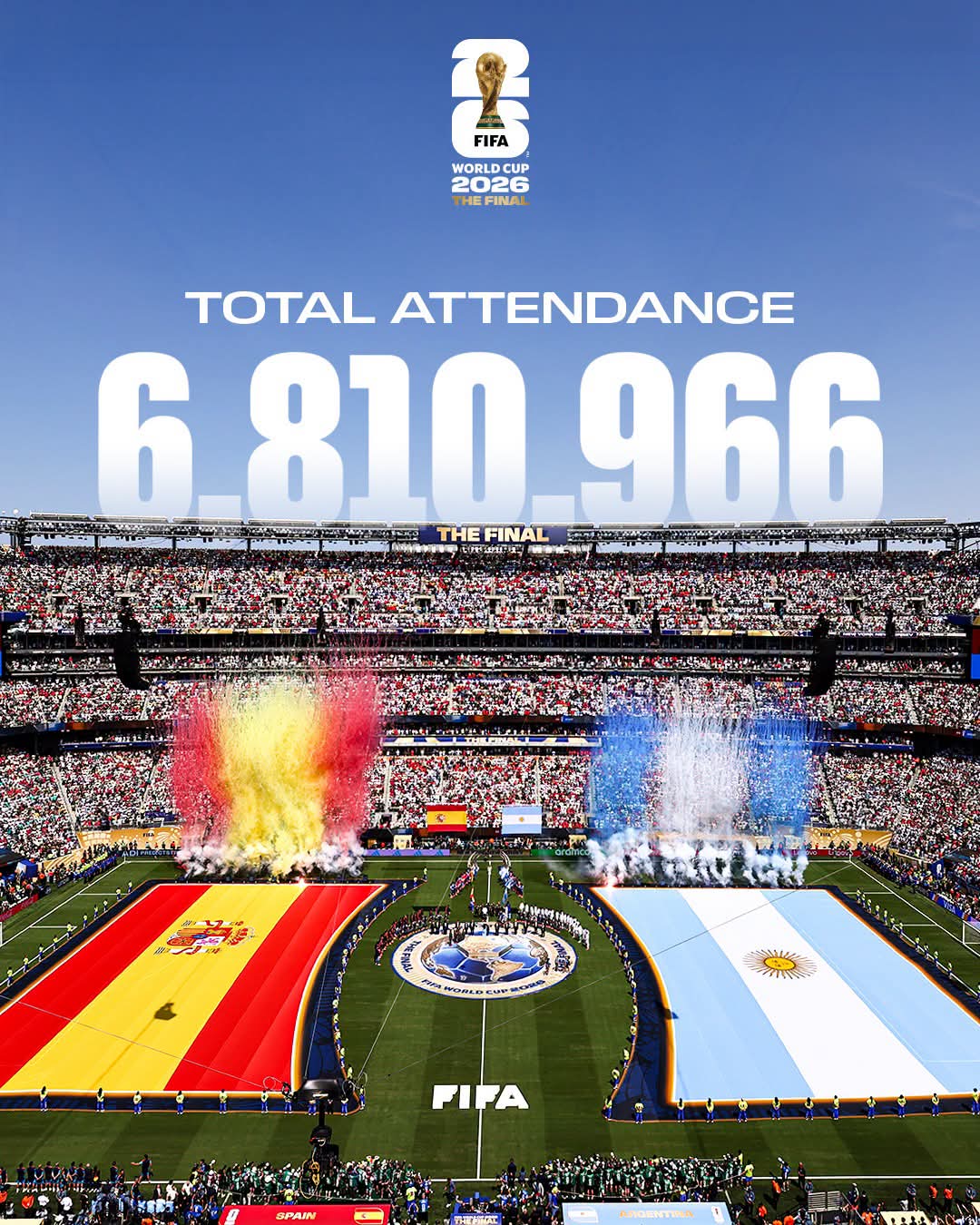
The FIFA World Cup 2026 officially broke the record for the highest single-edition attendance in history, drawing 6,810,966 fans across North America. Driven by an expanded 48-team, 104-match format, stadiums operated at an unprecedented 99.7% capacity, cementing the tournament as a massive commercial success.
NEW YORK — The FIFA World Cup 2026 has officially set the absolute record for the highest attendance in football history, pulling massive global crowds across Canada, Mexico, and the United States. Following the tournament's conclusion at MetLife Stadium on Sunday, July 19, 2026, where Spain defeated Argentina 1-0 in extra time, final administrative audits verified that total attendance reached an unprecedented 6,810,966 spectators. This milestone completely eclipses the previous historical single-edition record of 3.59 million fans established during the 1994 iteration, which was also hosted in the United States.
The sudden surge in ticket consumption and international traveling supporters is highly significant for the sporting world today. By successfully scaling the competitive bracket to 48 nations and 104 matches, football's global governing body has demonstrated that modern stadium logistics and multi-country hosting formats can sustain near-flawless occupancy metrics without diminishing live matchday demand.
Stadium Occupancy Hits All-Time Structural Peak
Data tracking released directly by organizers shows that the 16 state-of-the-art North American host venues operated at a historic 99.7% capacity throughout the month-long tournament schedule. This means almost every available ticket printed for public, commercial, or hospitality entry was successfully utilized. The final average crowd calculation reached an impressive 65,490 spectators per match.
The single largest gate attendance was logged at the historic Estadio Azteca (Mexico City Stadium), which drew 80,824 fans during each of its scheduled assignments, generating a localized venue total of 404,120 spectators. Meanwhile, AT&T Stadium in Dallas, Texas, welcomed a capacity crowd of 70,649 fans during its knockout phases, a push that officially pushed the all-time historic cumulative attendance of the men's tournament past the 50 million mark since its 1930 inception.
Expanded Group Phasing Drives Commercial Engagement
The core mechanism enabling the breakthrough attendance figures was the expanded tournament matrix. Moving up from the traditional 64-match blueprint utilized since 1998, the current edition distributed 104 matches across three distinct regional zones: Western, Central, and Eastern. This model naturally distributed football fans across vast geographical spaces, alleviating infrastructure blocks while ensuring local hospitality markets benefited evenly.
The introduction of debutant and returning nations—such as Uzbekistan, Jordan, Haiti, and Curaçao—brought thousands of fresh international travelers to the continent. Beyond the ticket-holding stadium boundaries, independent calculations validated that more than 8.5 million fans engaged directly with the official FIFA Fan Festivals set up across primary host cities.
Massive Multi-Sector Impact for Host Nations
For regional transport grids, airline carriers, municipal hotel chains, and local investment funds, the record-breaking attendance delivered major financial rewards. Hospitality suites accounted for substantial revenue streams, with over 607,350 custom hospitality packages sold globally. Analysts highlight that 40% of these purchasers were business-to-business (B2B) corporate transactions, signaling a growing trend toward high-end corporate sports tourism.
The massive numbers of fans also placed unprecedented demand on local digital telecommunications. Network data released by engineering firms confirmed that 13 million gigabytes of digital data were routed through local stadium fiber arrays, supported by more than 100,000 miles of newly laid infrastructure.
Official Sources Section
All performance statistics, match tallies, seat occupancy percentages, and official financial overviews are published openly by the FIFA Official Media Centre. Ground transportation details and venue data tracks are verified via compliance files kept by the structural organizing units of the host nations.
Quote Section
Why It Matters
The final metrics recorded by the FIFA World Cup 2026 show that expanding major sporting events can be highly successful if supported by modern, large-capacity infrastructure. For future tournament hosts, the 2026 edition provides a clear blueprint for using existing stadium setups to maximize commercial returns, maintain high gate receipts, and engage millions of global fans simultaneously across digital, broadcast, and live fan park environments.
Key Facts at a Glance
Historic Attendance: The tournament recorded an all-time high of 6,810,966 live spectators inside stadium gates.
Unparalleled Occupancy: Venues across Canada, Mexico, and the United States operated at an exceptional 99.7% capacity rate.
Match Average: Individual fixtures pulled in an average crowd of 65,490 fans throughout the expanded format.
Fan Zone Success: Over 8.5 million supporters gathered at designated FIFA Fan Festivals outside the physical stadiums.
Digital Footprint: Stadium infrastructure successfully handled 13 million gigabytes of data transmissions during live games.
FAQ Section
What was the final total attendance for the FIFA World Cup 2026?
The verified final attendance across all host venues reached 6,810,966 fans, making it the most-attended single edition in sports history.
Why did the 2026 tournament easily break previous attendance records?
The milestone was achieved because the tournament expanded to 48 teams, increasing the total number of matches from 64 to 104, and used large NFL and Liga MX stadiums with high seating capacities.
Which individual stadium drew the largest single-match crowds?
Estadio Azteca in Mexico City drew the largest crowds, seating a full capacity of 80,824 spectators across its five scheduled matches.
Sources: FIFA Media Portal. The Associated Press.