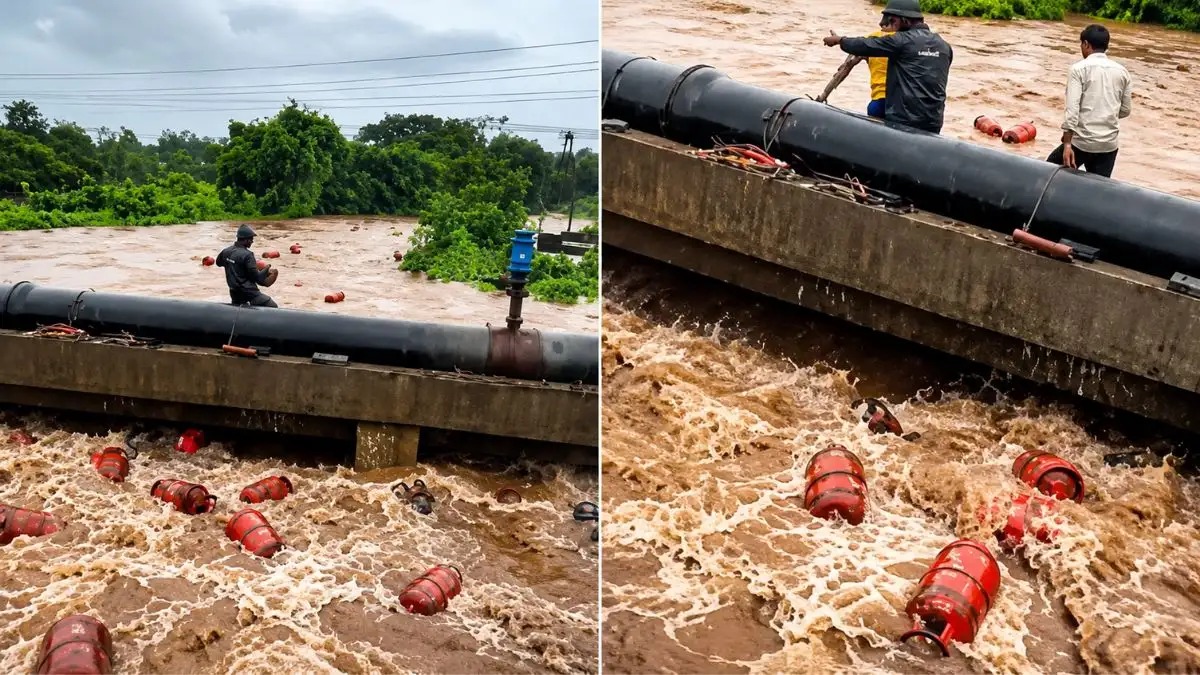
Heavy monsoon flooding inundated the HPCL Patalganga LPG Bottling Plant in Maharashtra's Raigad district, sweeping nearly 3,000 gas cylinders into the Patalganga River. Authorities have successfully recovered roughly 2,000 units and issued strict public alerts warning local residents against touching or collecting any floating canisters downstream.
RAIGAD — Continuous torrential monsoon rainfall across Maharashtra’s coastal belt has triggered a major industrial containment crisis in the Raigad district. Severe flash floods breached the safety perimeters of the Hindustan Petroleum Corporation Limited (HPCL) Patalganga LPG Bottling Plant, sweeping approximately 3,000 liquefied petroleum gas (LPG) cylinders directly into the surging Patalganga River.
The incident, which occurred on July 8, 2026, has forced local state administrators to activate an emergency public safety grid across multiple downstream villages. Disaster response teams are monitoring water channels amid fears of structural valve failures or hazardous leaks affecting riverside communities.
Flash Floods Inundate Panvel Bottling Complex
The operational breach occurred following unprecedented localized cloudbursts across the Khalapur and Panvel talukas, forcing the Patalganga River far past its danger thresholds. The rapid influx of floodwater quickly overwhelmed the drainage systems at the industrial park, completely submerging the open storage yards of the Hindustan Petroleum Corporation Limited facility located within the MIDC Chavane industrial layout.
According to preliminary engineering briefs, the sheer velocity of the water current broke through the facility's localized structural retainers. This caused thousands of stacked consumer gas cylinders—consisting of a mix of freshly filled commercial units and unpressurized empty returns—to bob loose and float downstream into the main river channel.
Viral eyewitness footage captured by local residents showed massive clusters of the characteristic red metal canisters bobbing rapidly down the swollen brown river, navigating through submerged trees and residential boundaries.
Downstream Public Alert Issued by District Administration
As the floating canisters drifted past rural settlements, regional law enforcement noticed unsafe salvage attempts by local villagers. Reports surfaced of individuals using makeshift ropes or wading into turbulent currents to pull the stray cylinders ashore for personal use.
The dangerous trend prompted immediate, strict interventions from the district collectorate. Emergency loudspeaker networks were deployed to warn riverside populations that handling displaced industrial pressurized vessels carries severe ignition risks.
The regional disaster management team has set up distinct logistical recovery targets:
Mobilizing local fishermen and mechanized police boats to track the path of the debris field.
Creating temporary intercept booms at slower river bends to trap the floating units safely.
Establishing emergency collection depots at local tahsildar offices where citizens can safely surrender retrieved property.
Official Sources Section
Emergency responses and containment updates are being coordinated via the Raigad District Collectorate, working directly alongside the National Disaster Management Authority (NDMA) and corporate safety teams from HPCL. Plant status records and environmental safety logs are being reported in communication with the Ministry of Petroleum and Natural Gas.
Quote Section
"There is absolutely no guarantee whether the cylinders carried away by the river contain gas or are in a structurally safe condition," stated Raigad District Collector Kishan Jawale in an urgent public broadcast. "Picking them up out of curiosity or for personal use, opening them, or taking them home could be extremely dangerous. Citizens should not put themselves at risk under any circumstances."
According to officials from the local disaster management room, "Out of the estimated 3,000 displaced units, search teams have successfully located and secured approximately 2,000 cylinders by the morning of July 9. Nighttime visibility issues temporarily slowed down our efforts, but operations have resumed at full scale to trace the remaining assets downstream."
Why It Matters
For local lakeside and riverside communities, the incident introduces severe, immediate physical hazards, as damaged valves could leak flammable gas into low-lying residential zones. For industrial asset managers, the event highlights a critical need to re-evaluate the flood-resilient design of open storage yards for hazardous materials situated near active river basins.
Key Facts at a Glance
Total Displaced Volume: Roughly 3,000 LPG cylinders were swept away from the HPCL bottling complex.
Primary Location: The HPCL Patalganga LPG Bottling Plant situated at MIDC Chavane in Panvel, Maharashtra.
Recovery Progress: Emergency rescue teams have successfully retrieved around 2,000 floating canisters.
Official Mandate: A strict advisory bans citizens from touching, retrieving, or keeping any washed-up cylinders.
Frequently Asked Questions
Are the floating gas cylinders dangerous to touch?
Yes. Displaced cylinders may have suffered structural or valve damage during the flash flood, creating a serious risk of high-pressure gas leaks or accidental explosions if handled improperly.
What should I do if I spot a stray gas cylinder near the riverbank?
Residents are strictly advised to keep their distance and immediately report the precise location to local revenue officials, the police, or nearby HPCL distribution networks rather than trying to move it themselves.
Will this incident cause an LPG cylinder shortage in the region?
According to plant management officials, the lost stock represents a small fraction of regional inventories, and alternative bottling hubs are being utilized to prevent any consumer delivery disruptions.
Source: Official public safety advisories issued by the Raigad District Collectorate, plant incident reports filed by Hindustan Petroleum Corporation Limited, and flood warning bulletins published by the National Disaster Management Authority.