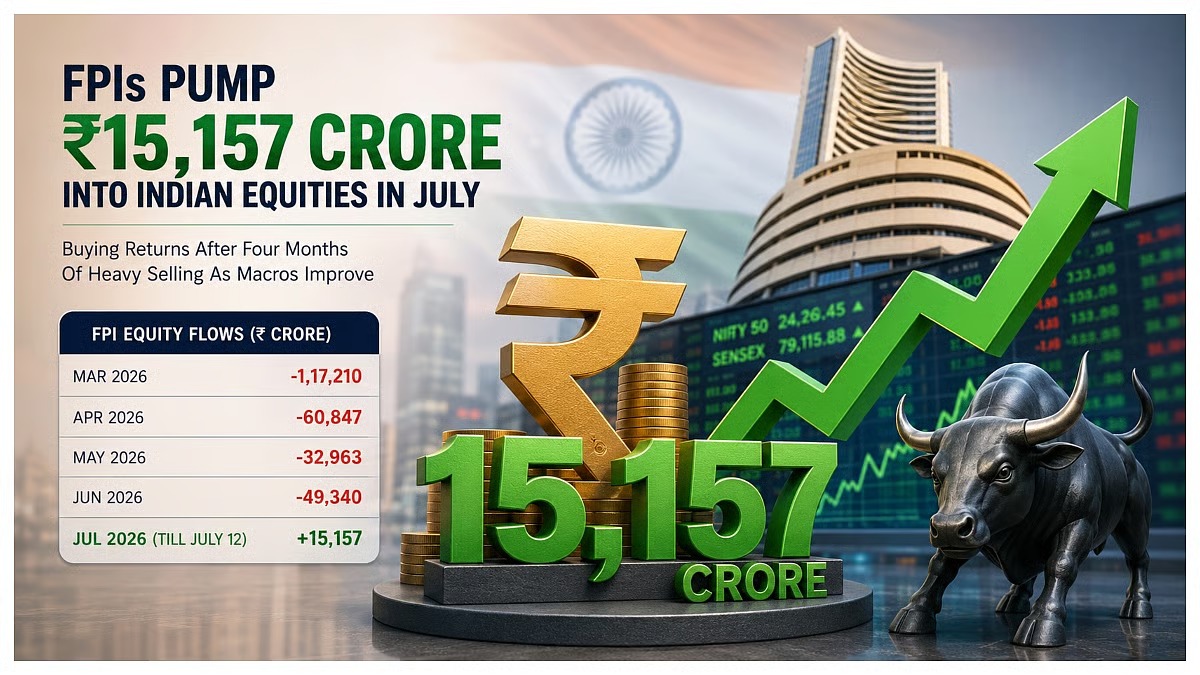
Foreign Portfolio Investors (FPIs) have turned net buyers of Indian equities in July 2026, injecting ₹15,157 crore after four months of record outflows. The reversal is driven by improved macroeconomic indicators, currency stability, and a better global risk environment, alongside continued robust inflows into the Indian debt market.
Foreign Portfolio Investors have reversed a four-month selling trend, injecting over ₹15,157 crore into Indian stocks as macroeconomic confidence rebounds.
NEW DELHI — After four consecutive months of significant outflows, Foreign Portfolio Investors (FPIs) have staged a comeback in the Indian equity market. Data from the Central Depository Services (India) Ltd (CDSL) confirms that foreign investors have turned net buyers, pouring more than ₹15,157 crore into Indian equities so far in July 2026.
This shift marks a decisive turnaround for the domestic market, which had faced relentless selling pressure throughout the spring. From March through June 2026, foreign institutional outflows totaled over ₹2.5 lakh crore, driven by global uncertainty and shifting risk appetites. The July influx suggests a renewed institutional appetite for high-quality Indian assets, supported by domestic macroeconomic stability and a stabilizing rupee.
Drivers of the Market Reversal
Market analysts attribute the return of FPIs to a combination of improving domestic fundamentals and a broader shift in global risk sentiment.
"The reversal in July reflects an improved global risk appetite, easing concerns over energy prices following the de-escalation of geopolitical tensions earlier this month, and renewed confidence in India's macroeconomic fundamentals," said Himanshu Srivastava, Principal Manager of Research at Morningstar Investment Research India.
Additionally, VK Vijayakumar, Chief Investment Strategist at [suspicious link removed], pointed to the relative attractiveness of the Indian market compared to its regional peers. He noted that weaknesses in the semiconductor trade and FPIs retreating from markets like South Korea have redirected capital flows toward India. Furthermore, the government’s recent adjustments to debt taxation and the overall resilience of the Indian growth story have provided a stable backdrop that continues to attract both equity and debt-focused foreign capital.
Debt Market Continues to See Interest
While the equity market’s rebound has garnered headlines, foreign interest in Indian debt remains robust. According to recent depository data, FPIs invested ₹6,625 crore in debt securities through the Fully Accessible Route (FAR) and an additional ₹3,228 crore through the general route during the same period in July. The consistent inflow into the debt segment highlights the confidence foreign investors place in India's sovereign and corporate debt instruments, aided by the relative stability of the Indian rupee.
Impact on Stakeholders
Investors: The return of foreign buying acts as a vital support for market benchmarks, which have faced volatility throughout the first half of 2026.
Businesses: Improved capital inflows provide better access to liquidity for large-cap firms and help stabilize valuations that had seen significant consolidation during the preceding four-month sell-off.
The Economy: Consistent FPI interest serves as a vote of confidence in India’s long-term economic trajectory, helping maintain stability in the foreign exchange reserves.
Official Sources and Regulatory Context
The latest figures are compiled from reports submitted by custodians to SEBI and national depositories. Industry observers caution, however, that while the July reversal is encouraging, the sustainability of these inflows will remain tethered to global macroeconomic developments and the ongoing resilience of India’s domestic growth targets.
"According to officials," the investment environment is currently being monitored for potential impacts from global interest rate cycles and regional geopolitical stability. Market participants are also keeping a close watch on the implementation of new fee structures for foreign investors, which the Securities and Exchange Board of India recently transitioned to a rupee-denominated mechanism to simplify compliance.
Why It Matters
The shift from net selling to net buying is significant for the broader market index, which often reacts sharply to the liquidity provided by FPIs. For retail investors, the return of foreign institutional money is frequently interpreted as a signal that valuations have reached attractive levels, providing a foundation for market stability as the country enters the second half of the year.
Key Facts at a Glance
Equity Inflow: FPIs have invested ₹15,157 crore in Indian equities during July 2026.
Reversal Trend: This follows four consecutive months of massive net outflows, including a record ₹1.17 lakh crore withdrawal in March 2026.
Debt Interest: FPIs continue to diversify into debt, adding ₹9,853 crore across FAR and general routes this month.
Year-to-Date Context: Despite July's recovery, net outflows for 2026 remain elevated at approximately ₹2.6 lakh crore.
FAQ
Why did FPIs start buying again in July?
The return is driven by better domestic macroeconomic indicators, a stable rupee, and a global improvement in risk appetite following the de-escalation of certain geopolitical tensions.
Are foreign investors moving away from other markets?
Analysts suggest that weakness in regional markets like South Korea, particularly in the semiconductor sector, has prompted some re-allocation of capital toward India.
Is the trend likely to continue?
While the July inflow is a positive sign, analysts warn that long-term sustainability depends on evolving global developments and whether India can maintain its economic growth resilience.
Source: CDSL FPI Investment Data, NSDL FPI Reports, Morningstar Investment Research India, [suspicious link removed]