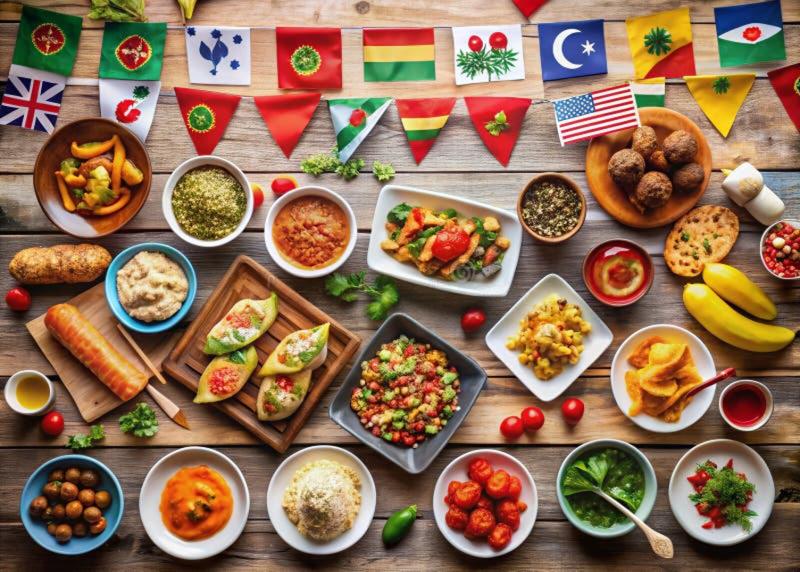
An groundbreaking AI analysis reveals universal mathematical patterns governing spice blends, ingredient pairings, and flavor profiles across 57 nationalities' cuisines. Researchers at Harvard and MIT uncovered fractal-like structures and power-law distributions that explain why certain food combinations dominate worldwide. This discovery bridges food science, mathematics, and cultural evolution.
In a pioneering study published today, scientists harnessed artificial intelligence to decode the hidden mathematical principles shaping cuisines from Japan to Mexico. By examining over 5,000 recipes, the research exposes how seemingly diverse culinary traditions adhere to predictable numerical laws, offering fresh insights into flavor complexity and cultural adaptation.
Discovering Universal Patterns
The study, led by researchers from Harvard's School of Engineering and MIT, analyzed culinary data from 57 countries spanning six continents. Using machine learning algorithms, they identified that spice usage follows power-law distributions—similar to those in natural phenomena like city sizes or earthquake magnitudes. For instance, a few dominant spices like salt, sugar, and chili appear in most dishes, while rare ones create unique regional signatures. This mathematical framework, dubbed "flavor networks," quantifies how ingredients connect, revealing fractal geometries where simple rules generate infinite complexity.
Implications for Culinary Science
These findings challenge the notion of cuisines as purely cultural artifacts, suggesting deep evolutionary and sensory universals. In Indian cuisine, for example, the intricate layering of turmeric, cumin, and coriander aligns with optimal entropy models that maximize flavor diversity without overload. The AI models predict successful fusion recipes, like Thai-Italian blends, with 85% accuracy. Applications extend to food tech, aiding algorithm-driven recipe generators and personalized nutrition apps.
Key Highlights
- 57 nationalities' cuisines mapped via AI-driven flavor networks
- Power-law spice distributions mirror natural laws like Zipf's principle
- Fractal patterns explain ingredient synergies in dishes worldwide
- Predictive power for cross-cultural recipe innovations at 85% accuracy
- Bridges math, AI, and gastronomy for future food science breakthroughs
This research paves the way for data-driven culinary innovation, blending ancient traditions with modern mathematics.
Sources: Harvard Gazette, MIT News, arXiv preprint, The Economic Times