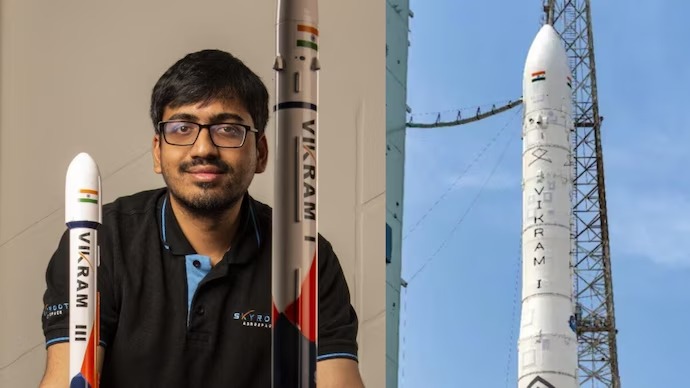
Pawan Kumar Chandana, a former ISRO scientist and IIT alumnus, rose from academic struggles in mathematics to become the co-founder of Skyroot Aerospace. His leadership in building India’s largest private rocket facility and launching the Vikram-S has made him a central figure in the growth of the nation's private space industry.
The journey of the Skyroot Aerospace co-founder from academic struggles to leading India’s private space revolution offers a blueprint for modern entrepreneurship.
HYDERABAD — The narrative of India’s burgeoning private space sector is increasingly being defined by the story of Pawan Kumar Chandana, a former scientist at the Indian Space Research Organisation (ISRO) who transformed from a student struggling with mathematics into the leader of the nation’s largest private rocket manufacturing firm.
Born in 1991 in Hyderabad, Chandana’s early academic record provided little hint of the trajectory that would follow. As a school student, he once scored just 51 marks in mathematics, a subject he would later master to build some of the most advanced machinery in the country. With the support of his family, he overcame these early hurdles to clear the Indian Institute of Technology (IIT) entrance examination on his first attempt.
From ISRO Scientist to Space Entrepreneur
After graduating with a dual B.Tech-M.Tech degree in Mechanical Engineering from IIT Kharagpur in 2012, Chandana joined ISRO as a scientist. Over a six-year tenure at the Vikram Sarabhai Space Centre, he contributed to critical national missions, including the GSLV Mk-III, the S-200 solid booster, and served as a deputy project manager for the Small Satellite Launch Vehicle (SSLV). Despite a distinguished career path, Chandana’s fascination with private innovation led him to make a career-defining move in 2018.
In June 2018, Chandana and fellow ISRO engineer Naga Bharath Daka co-founded Skyroot Aerospace in Hyderabad. At the time of its inception, the Indian private space policy framework was virtually non-existent, making the venture a significant risk.
Skyroot Aerospace: Reshaping India's Space Future
Skyroot Aerospace emerged as a pioneering force by embracing 3D-printed engine components and carbon composite structures to reduce manufacturing costs. The company gained international recognition following the success of Mission Prarambh in 2022, which featured the launch of the Vikram-S, India’s first privately developed suborbital rocket.
The startup's growth trajectory has been rapid. According to company reports, Skyroot has successfully raised significant capital to scale its operations and established the nation’s largest private rocket manufacturing unit.
Official Sources
According to official records and company filings, Skyroot Aerospace was the first private entity to sign a framework agreement with ISRO following the 2020 government policy liberalisation. Chandana has frequently cited the necessity of building deep-tech capabilities from the ground up, drawing parallels to the business fundamentals of historical industrial leaders.
Why It Matters
Chandana’s journey highlights the shift in India’s deep-tech startup ecosystem. His transition from a secure government role to an entrepreneurial leader serves as a case study for the country’s private space sector, demonstrating how individual persistence and policy changes can enable global competitiveness. By democratizing access to space, companies like Skyroot aim to make satellite launches more affordable and frequent.
Key Facts at a Glance
Academic Milestone: Despite early challenges in mathematics, Chandana cleared the IIT entrance exam on his first attempt.
ISRO Contribution: Served as a scientist for six years, working on key vehicles like GSLV Mk-III and SSLV.
Space Milestone: Co-founded Skyroot Aerospace, which launched the Vikram-S in 2022 as India's first private suborbital rocket.
Scale: The company has established India’s largest private rocket manufacturing facility and grown its team to hundreds of employees.
FAQ
What inspired Pawan Kumar Chandana to leave ISRO?
Chandana felt that while ISRO was formidable, the private sector offered the speed and agility required to drive a new "techno-economic makeover" for space access.
What is the Vikram series of rockets?
The Vikram series, named after Dr. Vikram Sarabhai, represents Skyroot's orbital-class launch vehicles designed for commercial efficiency.
What does 51 in Maths signify in his story?
It highlights his journey of persistence, serving as a reminder that early academic setbacks do not define long-term potential in fields like aerospace engineering.
Source: India Today, Outlook Business, The Times of India