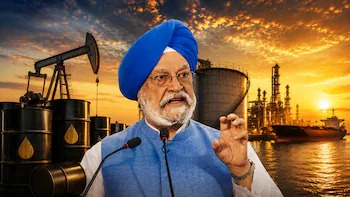
Union Minister Hardeep Singh Puri stated that reductions in petrol and diesel prices will only be considered if global crude oil rates stabilize at lower levels for several weeks. Due to a two-month procurement lag, Indian refiners are still processing high-cost crude bought during the West Asia conflict.
NEW DELHI — Union Minister for Petroleum and Natural Gas Hardeep Singh Puri stated on Thursday, July 2, 2026, that a downward revision in retail petrol and diesel prices will only become a "legitimate question" if international crude oil prices stabilize at lower levels for a sustained period. Speaking at a press conference in the capital, Puri clarified that despite global Brent crude benchmarks retreating to a four-month low of approximately $70 per barrel, state-run oil marketing companies (OMCs) are still processing expensive inventory purchased at the peak of the recent West Asia conflict. The announcement injects consumer clarity into the retail energy matrix, linking domestic pricing directly to global market consolidation over the coming months.
Technical Lags and Historic OMC Loss Transcripts
The domestic fuel pricing deferral is heavily tied to the forward-purchasing structures maintained by Indian refiners. In standard commercial operations, national oil firms procure crude shipments at least two months in advance of processing. Consequently, the fuel currently being dispensed across retail stations is derived from expensive crude cargoes locked in during April and early May 2026, when escalating regional hostilities pushed benchmark Brent futures toward $110 per barrel.
Furthermore, the minister highlighted the severe financial strain absorbed by the country's oil marketing infrastructure during the market shock. OMCs registered collective losses and under-recoveries totaling ₹74,781 crore ($8.9 billion USD) for the period leading up to June 30, 2026, due to selling essential fuels below actual production costs to shield the public from external economic shocks.
A granular structural review indicates that aggregate under-recoveries reached ₹1.89 lakh crore in the June-end quarter, heavily weighed down by a ₹1.45 lakh crore shortfall in the highly subsidized diesel segment and a ₹24,148 crore gap in Liquefied Petroleum Gas (LPG) operations.
Energy Security Buffers and Biofuel Integration Directives
To systematically insulate the domestic economy from future maritime blockades and geopolitical shocks, the Ministry of Petroleum and Natural Gas is executing an aggressive plan to expand the nation's strategic oil reserves. India’s collective inventory held across regional pipelines, commercial refineries, port terminals, and specialized underground caverns currently covers roughly 76 to 80 days of national consumption. Capitalizing on the current price dip, the government is moving to acquire cheaper global volumes to fill its backup repositories.
Concurrently, Minister Puri actively defended India's accelerating green energy mandates, addressing social media concerns regarding E20 (20% ethanol-blended) petrol. He dismissed online criticism as an incorrect narrative, presenting a comprehensive 15-page alternative energy report to verify the mechanical safety of the mix.
Backed by technical approvals from the Society of Indian Automobile Manufacturers (SIAM) and the Automotive Research Association of India (ARAI), the ministry clarified that while E20 blends may cause a minor adjustment in baseline fuel economy, they improve engine acceleration and prevent damaging engine knock. Additionally, statutory insurance groups have confirmed that the use of E20 fuel has no impact on active vehicle insurance compliance or damage claims.
Official Sources Section
The financial assessments, price calculations, reserve statistics, and alternative energy targets documented in this briefing are verified by:
Executive Statements
"If crude prices remain at these levels for the next few weeks, cutting petrol and diesel prices will be a legitimate question that everybody asks. But what the situation will be then, it is not right for me to speculate. International oil prices have come down but companies are still processing crude bought at the height of the West Asia crisis."
— Hardeep Singh Puri, Union Minister for Petroleum and Natural Gas
According to officials close to the state refinery planning boards, any immediate margin space gained from cheaper $70 oil imports will first be used to offset the massive under-recoveries built up during the early parts of the fiscal year.
Why It Matters
The implementation of this coordinated fuel pricing policy impacts several economic layers:
For Logistics Businesses: Continued flat domestic fuel rates ensure predictable short-term freight cost planning, protecting companies from sudden operational budget changes.
For Retail Consumers: While retail prices will not drop immediately, the government's intervention keeps prices steady, protecting families from the extreme fuel price spikes seen in neighboring countries.
For Automotive Manufacturers: Clear policy backing for E20 infrastructure gives automakers the long-term confidence to scale up production of compliant engines.
Key Facts at a Glance
Sustained Target: Retail price rollbacks depend entirely on global crude oil prices staying low for the next two to three months.
Financial Impact: State-run oil marketing firms absorbed a substantial financial loss of ₹74,781 crore to protect domestic consumers.
Procurement Gap: Retail fuel currently being sold was refined from high-cost crude shipments purchased two months ago during peak regional hostilities.
Backup Expansion: India is utilizing the drop in oil prices to expand its strategic petroleum reserves beyond its current 80-day capacity.
FAQ Section
Why are domestic petrol and diesel prices not falling immediately alongside global crude?
Indian refiners buy their crude supplies about two months in advance. As a result, fuel stations are currently selling fuel refined from expensive crude bought during the peak of the West Asia crisis, rather than the cheaper oil available today.
When can Indian consumers expect a formal reduction in retail fuel rates?
The Ministry of Petroleum and Natural Gas noted that a price cut will be considered if international crude oil prices remain stable around the $70 per barrel mark for the next few weeks, allowing refiners to process cheaper incoming shipments.
Will using E20 ethanol-blended petrol harm my vehicle's engine or void my insurance policy?
No. Thorough testing by SIAM and ARAI shows that E20 fuel increases engine acceleration and reduces knocking. Furthermore, major insurance providers have formally clarified that using the new fuel blend does not affect vehicle policy coverage.
Source: Ministry of Petroleum and Natural Gas, Press Trust of India, Society of Indian Automobile Manufacturers, ANI Press Corporation.