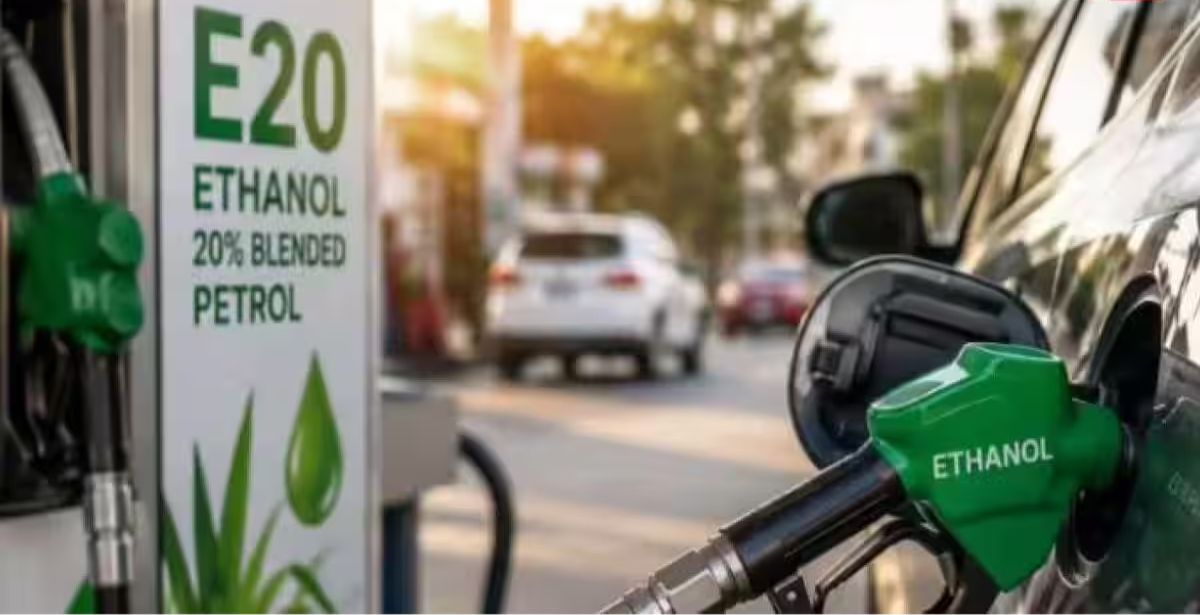
The government clarified that E20 petrol is not priced lower than pure petrol because domestic ethanol procurement costs remain elevated when crude trades near $70 a barrel. The blending initiative functions as an energy security policy to curb foreign exchange outflows rather than a mechanism for immediate retail price cuts.
New Delhi details why ethanol-blended fuel remains uncheaper, emphasizing national energy security over immediate retail discounts.
As India advances its green energy objectives, a recurring question continues to puzzle motorists: if ethanol is a domestically produced alternative, why isn't E20 petrol priced lower than conventional fuel? Addressing Parliament in a written reply on Monday, July 27, 2026, Minister of State for Petroleum and Natural Gas Suresh Gopi clarified that the nation's ambitious ethanol blending programme is designed primarily as a strategic economic shield against global oil shocks rather than an immediate instrument for retail price cuts.
Deconstructing the Economics of Feedstock and Procurement Costs
According to official clarifications issued by the Ministry of Petroleum and Natural Gas, the baseline economics of ethanol do not automatically translate to cheaper pump prices under current market conditions.
Guaranteed Farmer Remuneration: To support agricultural supply chains, the government procures feedstock like maize-based ethanol at administrative rates averaging around ₹71.86 per litre, excluding GST, transport, and handling expenses.
Crude Oil Benchmarks: When global Brent crude trades near $70 per barrel, producing and blending E20 can match or even exceed the cost of acquiring refined pure petrol.
Threshold Dynamics: Official estimates indicate that domestic ethanol only becomes a cheaper alternative when international crude oil prices spike dramatically to between $120 and $130 per barrel.
Logistical Challenges and Ecosystem Investments
The government also dismissed suggestions of maintaining parallel retail supply chains for pure petrol, E10, and E20, noting that operating separate infrastructure across more than 100,000 retail fuel outlets nationwide would multiply operational costs and complicate quality control. Furthermore, public sector banks have financed nearly ₹1 lakh crore toward building domestic ethanol processing plants, storage facilities, and transport networks. Reverting or restructuring this framework would strand massive capital investments while undercutting the agricultural communities that rely on the program.
Why It Matters
For citizens, motorists, and investors, understanding the mechanics of E20 petrol clarifies that the blending mandate functions as an insurance policy for national energy security rather than an immediate cost-saving measure. By substituting imported oil with homegrown fuel, India has saved over ₹1.97 lakh crore in foreign exchange, insulating the broader economy from severe international supply disruptions.
Key Facts at a Glance
Blending Standard: E20 indicates petrol blended with 20% domestically sourced ethanol by volume.
Procurement Rates: Maize-based ethanol is bought from producers at approximately ₹71.86 per litre before auxiliary taxes and logistics.
Production Capacity: India's total ethanol production capacity has scaled to roughly 2,000 crore litres annually.
Strategic Savings: The program has successfully substituted over 316 lakh tonnes of crude oil imports.
Frequently Asked Questions
Why isn't E20 petrol priced lower than pure petrol at fuel stations?
Ethanol procurement costs are maintained at remunerative rates to support farmers. When international crude hovers around $70 a barrel, producing E20 can equal or exceed the cost of regular petrol.
When does ethanol become cheaper than crude oil?
Government evaluations show that domestic ethanol becomes economically advantageous when global crude prices climb significantly higher, typically reaching $120 to $130 per barrel.
Can fuel stations offer pure petrol alongside E20 as a consumer choice?
The government noted that maintaining separate distribution networks, pipelines, and storage for multiple base fuels across more than one lakh retail outlets is logistically impractical and cost-prohibitive.
Source: Ministry of Petroleum and Natural Gas, The Economic Times, NDTV Profit, INDmoney