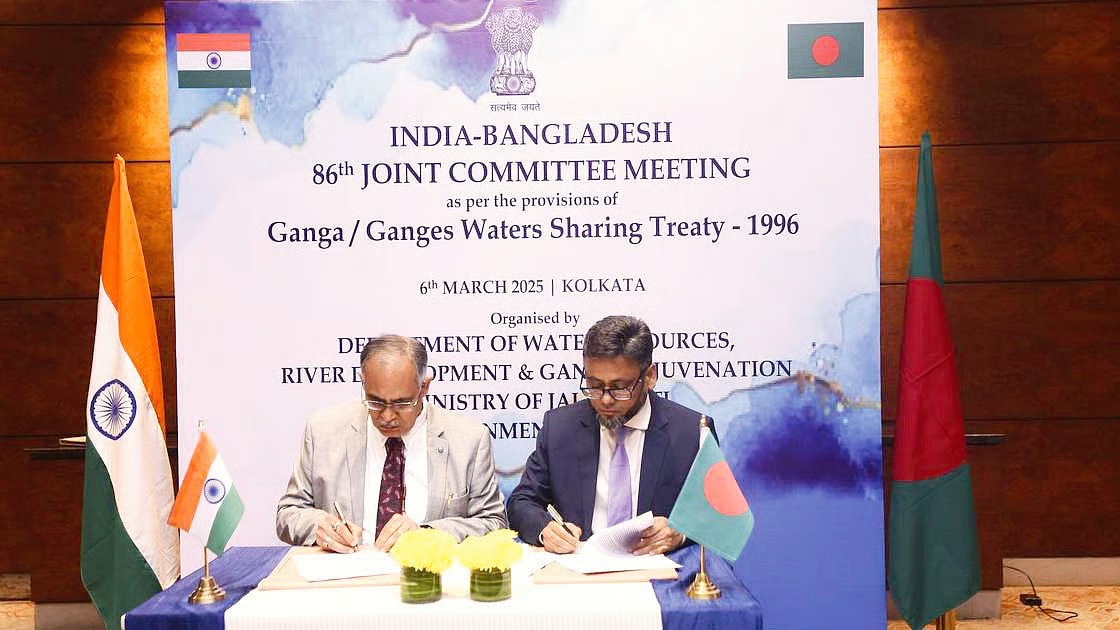
The Ganga Water Treaty is a 30-year pact signed in 1996 between India and Bangladesh to share dry-season flows of the Ganga at Farakka, and it is set to expire in December 2026. How Delhi and Dhaka choose to renew or reshape it will directly affect water security, regional politics, and long-term India-Bangladesh ties in a climate-stressed South Asia.
The Ganga Water Treaty, Explained
Signed on 12 December 1996, the Ganga/Ganges Water Sharing Treaty governs how India and Bangladesh share the river’s lean-season flow at the Farakka Barrage in West Bengal, a critical point where water is diverted to keep the Hooghly River and Kolkata Port navigable. The agreement was framed as a confidence-building measure after years of mistrust over upstream diversions and perceived inequities.
How The Water Is Actually Shared
During the dry season, from 1 January to 31 May, the treaty allocates Ganga waters in 10-day blocks using a formula tied to actual flows at Farakka. If flows fall below 70,000 cusecs, India and Bangladesh split the water 50:50; between 70,000–75,000 cusecs, Bangladesh gets a guaranteed 35,000 cusecs and India receives the rest, while above 75,000 cusecs, India is assured 75,000 cusecs and Bangladesh gets the balance. A joint committee from both countries monitors daily flows and submits annual reports to keep calculations transparent.
Treaty Impact Highlights
- Ganga sharing covers the critical lean season at Farakka, when water scarcity bites hardest.
- Framework built on 40 years of flow data (1949–1988) to smooth seasonal volatility.
- Emergency consultations kick in if flows drop below 50,000 cusecs in any 10-day window.
- Joint Committee mechanism has helped avoid constant public flare-ups over day-to-day variations.
- Treaty sits within a wider network of 54 shared rivers and multiple MoUs, including Kushiyara sharing.
- Expiry in December 2026 has triggered fresh negotiations and political debate in both countries.
What Comes After 2026
The treaty expires in December 2026, and talks on its renewal have already begun amid rising climate stress, erratic monsoons, and growing water demand on both sides. Bangladesh wants stronger minimum guarantees and climate-resilient provisions, while India is under pressure from domestic stakeholders, especially West Bengal, to secure more water for its own developmental needs. How both capitals balance these demands will decide whether the next agreement is seen as a model of “water for peace” or a fresh source of political friction.
How It Will Shape Future India-Bangladesh Ties
Water has become a strategic lever in an otherwise close partnership built on trade, connectivity, security cooperation, and cross-border infrastructure. A fair, predictable, and climate-aware renewal of the Ganga Water Treaty would strengthen trust, enable deeper cooperation on other rivers like Teesta, and undercut anti-India narratives in Bangladesh. A contentious or delayed deal, by contrast, risks fuelling domestic politics in Dhaka and Kolkata, complicating India’s neighbourhood-first policy just as both countries navigate volatile regional geopolitics.