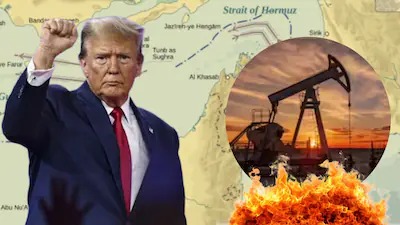
Oil prices spiked nearly 6% on Wednesday after U.S. President Donald Trump declared the Iran ceasefire "over." The collapse of the June MoU, coupled with new U.S. strikes and the revocation of Iranian oil export waivers, has fueled investor fears of prolonged supply disruptions and heightened conflict in the Middle East.
Energy markets reacted sharply on Wednesday after U.S. President Donald Trump declared the ceasefire with Iran “over,” sparking fears of renewed supply disruptions in the Strait of Hormuz.
ANKARA — Global oil prices climbed by nearly 6% on Wednesday as geopolitical tensions between the United States and Iran escalated, effectively ending a tentative diplomatic understanding reached earlier this summer. The sudden collapse of the ceasefire, confirmed by U.S. President Donald Trump on the sidelines of the NATO summit in Ankara, has sent shockwaves through energy markets.
International benchmark Brent crude surged 5.95% to $78.50 per barrel, while U.S. benchmark West Texas Intermediate (WTI) rose by the same margin to $74.60. The price spike follows a turbulent 48-hour period in the Middle East characterized by renewed military strikes and the revocation of key economic waivers.
Escalation in the Strait of Hormuz
The market volatility was triggered by a rapid deterioration of the fragile peace process. Following recent attacks on three commercial vessels in the Strait of Hormuz—including a Qatari LNG carrier—the United States launched a new wave of strikes against Iranian targets.
In a significant policy shift, the U.S. Treasury Department also revoked a general license that had previously permitted the sale of Iranian crude on global markets. This move, intended to tighten economic pressure, has heightened concerns among traders regarding the long-term flow of energy through the world's most critical maritime chokepoint, which historically accounts for a fifth of the world’s daily oil and LNG supply.
Breakdown of the Ceasefire
President Trump signaled the end of the de-escalation efforts while appearing alongside NATO Secretary General Mark Rutte. "For me, I think it's over," Trump stated, dismissing the prospect of further negotiations. "As far as I'm concerned, it's just a waste of time."
The ceasefire had been part of a Memorandum of Understanding (MoU) signed in late June, which aimed to curb attacks on shipping and establish a 60-day window for broader peace talks. With less than a third of that period elapsed, the abandonment of the agreement has left global energy markets braced for further volatility. Analysts at the Soufan Center noted that the diplomatic process is now effectively stalled in a "no war, no peace" stalemate, leaving the future of regional energy stability increasingly uncertain.
Impact on Global Markets
The renewed hostilities are expected to have a ripple effect across the global economy:
Energy Costs: Sustained price increases at the pump are anticipated if the volatility in crude prices persists.
Shipping Premiums: Insurance and operational costs for tankers transiting the Persian Gulf are likely to climb, further inflating the landed cost of energy commodities.
Equity Volatility: Global markets saw a retreat on Wednesday, with investors shifting toward defensive positions as the risk of a regional conflict looms over broader economic sentiment.
Key Facts at a Glance
Price Jump: Brent crude and WTI both surged approximately 6% in Wednesday’s trading session.
Diplomatic Status: The U.S.-Iran ceasefire and its associated Memorandum of Understanding have been declared "over" by President Trump.
Supply Concerns: The revocation of Iranian oil export waivers and attacks on tankers in the Strait of Hormuz have revived fears of supply chain bottlenecks.
Geopolitical Trigger: Renewed U.S. military strikes against Iran followed the recent targeting of commercial shipping.
Frequently Asked Questions (FAQ)
Why did oil prices jump so suddenly?
Prices surged due to the combined effect of the ceasefire's collapse, the reimposition of U.S. sanctions on Iranian oil exports, and fears that military strikes could close or disrupt the Strait of Hormuz.
Is the 60-day peace talk period still active?
No. While the MoU provided for a 60-day negotiation window ending in mid-August, President Trump has stated he no longer wishes to engage in further talks with Tehran.
What does this mean for energy consumers?
If crude prices remain elevated, consumers should expect upward pressure on fuel and energy costs as energy companies pass through the increased risk and supply costs.
Source: Anadolu Agency, Reuters, The Soufan Center, U.S. Treasury Department