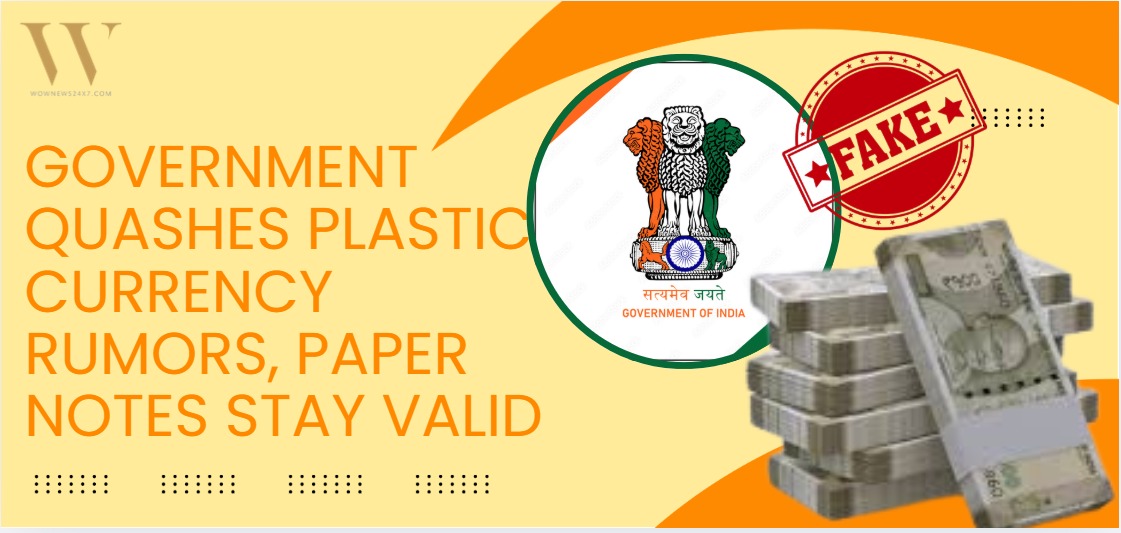
The Government of India and the PIB Fact Check team have officially debunked viral social media rumors claiming that the RBI will replace all paper currency with plastic notes by June 30, 2026. Traditional paper bills remain valid legal tender, and any future transition to polymer substrates remains in a preliminary evaluation phase.
The Government of India has officially dismissed widespread social media reports claiming that the Reserve Bank of India (RBI) intends to withdraw all traditional paper currency notes and replace them entirely with synthetic plastic notes by June 30, 2026. Following an intense wave of viral digital messages that triggered public concern regarding the legal tender status of circulating banknotes, the Press Information Bureau (PIB) issued a definitive clarification late Tuesday. The state communication framework confirmed that the central banking regulator has issued no such mandatory directive, and existing paper currency will continue to remain fully operational across the domestic financial system.
Regulatory Framework Clarifies Currency Rumors
The swift administrative response was spearheaded by the Press Information Bureau (PIB), which utilized its specialized digital verification vertical to track and neutralize the speculative financial reports. According to statement updates disseminated across public informational networks, the viral posts relied on highly coordinated messaging blocks and digitally manipulated concepts to suggest an immediate, overnight demonetization-style transition toward polymer alternatives.
The state's factual tracking division formally stated on its official verification handles that the banking regulator maintains its established cotton-pulp currency infrastructure for all active legal denominations. Authorities emphasized that the claims are entirely manufactured, noting that no policy framework or executive order has been ratified to alter the fundamental material structure of India's paper currency notes before the end of the current month.
Preliminary Polymer Evaluations Distorted Online
The sudden proliferation of the synthetic banknote rumor appears to stem from a distortion of actual policy discussions held during recent central banking assemblies. During the post-Monetary Policy Committee (MPC) press conference in early June 2026, RBI Governor Sanjay Malhotra confirmed that the central bank is conducting preliminary analytical reviews regarding polymer banknotes.
Crucially, the regulatory head explicitly noted that the internal evaluations are in a highly exploratory phase, focusing strictly on examining the long-term cost benefits and potential challenges associated with plastic substrates. While the RBI continues to study if polymer currency can enhance banknote durability and lower the national expenditure incurred on security printing—which reached ₹4,875.2 crore in the 2025-26 fiscal cycle—no pilot projects, localized test rollouts, or replacement deadlines have been authorized for public implementation.
Financial investigators also flagged separate viral images depicting modified ₹500 bills missing prominent historical markers as completely fake. Advanced data analysis conducted by digital forensics teams revealed these circulating designs to be highly optimized, AI-generated images designed specifically to amplify online panic among consumer segments and local traders.
Protecting Market Stability From Information Shocks
For retail consumers, domestic business networks, and institutional investors, the government's direct intervention serves to protect market sentiment against unnecessary cash handling friction. Unverified rumors concerning currency invalidation often create immediate, artificial panic within informal trading clusters and retail food markets, occasionally leading small merchants to temporarily refuse specific denominations out of caution.
Oversight agencies are urging citizens to cross-reference sensitive fiscal alerts directly against authentic data banks hosted by the Reserve Bank of India (RBI) before forwarding unverified posts across private messaging platforms. Under Section 22 of the RBI Act of 1934, any structural alteration to the country’s legal tender requires comprehensive structural preparation, including deep alignment with automated teller machine (ATM) frameworks, commercial cash-sorting ecosystems, and regional banking logistics.
Official Sources Section
Public notices, policy tracking indexes, and official statements debunking regional currency speculation are cataloged via state information platforms:
Quote Section
"According to officials from the PIB Fact Check unit, several social media posts are falsely claiming that the RBI will withdraw paper currency notes and replace them with plastic currency notes from June 30, 2026. This claim is entirely fake; the central bank has no such plans."
Why It Matters
The immediate clarification prevents localized transaction disruptions across the national retail economy. For regular consumers, it ensures that day-to-day cash transactions remain uninterrupted. For corporate logistics groups, commercial banking firms, and fintech companies, the affirmation of policy continuity maintains stable cash circulation architectures, completely removing the logistical overhead and software re-calibration demands associated with sudden material shifts in currency.
Key Facts at a Glance
Rumor Dismissed: The Government of India has officially labeled claims regarding the replacement of paper currency by June 30, 2026, as false.
Legal Tender Intact: All currently circulating paper banknotes remain fully valid and authorized for domestic economic transactions.
Exploratory Studies Only: The RBI is analyzing the long-term benefits of polymer notes, but the project remains in a preliminary research stage.
AI-Generated Assets: Viral online images of altered, plastic ₹500 currency designs have been forensically identified as synthetic, AI-generated content.
FAQ Section
Is the RBI banning or withdrawing paper currency notes this month?
No. The Reserve Bank of India has issued no directives to withdraw or replace paper banknotes. Traditional cotton-pulp paper currency remains the definitive legal tender of the country.
Why is the government studying polymer banknotes if there is no immediate rollout?
Central banks study polymer (plastic) materials because they are highly resistant to moisture, tearing, and dirt, allowing notes to last up to five times longer than paper. This durability could eventually reduce long-term printing and replacement expenditures.
Where should I go to verify if an announcement about Indian currency is real?
Citizens should always avoid third-party messaging forwards and look directly for official notifications published on the official Reserve Bank of India website.
Source: Official communication briefs issued by the Press Information Bureau (PIB) and structural banking policy transcripts preserved by the Reserve Bank of India (RBI).