Flagship government tourism schemes, including Swadesh Darshan 2.0 and PRASHAD, are transforming India’s regional infrastructure with a combined investment pipeline exceeding ₹9,225 crore. The initiatives focus on developing self-contained destination hubs, upgrading spiritual corridors, and deploying long-term interest-free loans to build sustainable, accessible, and world-class tourist centers nationwide.
Flagship initiatives Swadesh Darshan and PRASHAD combine with fresh allocations to re-engineer regional transit and experiential travel.
NEW DELHI — Comprehensive capital deployments backed by flagship government tourism schemes are fundamentally transforming the landscape of physical tourism infrastructure across India. According to updated performance and statutory project briefs, the combined capital allocation under targeted initiatives has crossed ₹9,225 crore.
This multi-tiered strategy is modernizing hundreds of local tourist nodes, introducing rigorous environmental benchmarks, and linking remote domestic destinations to high-capacity transit corridors. The massive infrastructure upgrade serves as a core economic growth driver today, expanding the hospitality value chain and creating sustainable jobs in regional communities.
The Structural Evolution of Swadesh Darshan 2.0
According to official parliamentary disclosures submitted to the Rajya Sabha, the Ministry of Tourism has structurally approved 53 separate destination projects valued at ₹2,208.31 crore under its revamped Swadesh Darshan 2.0 (SD 2.0) framework. This specialized initiative succeeds the original theme-based circuit program, which successfully completed 75 out of 76 initial large-scale structural projects utilizing an investment pool of ₹5,290.33 crore.
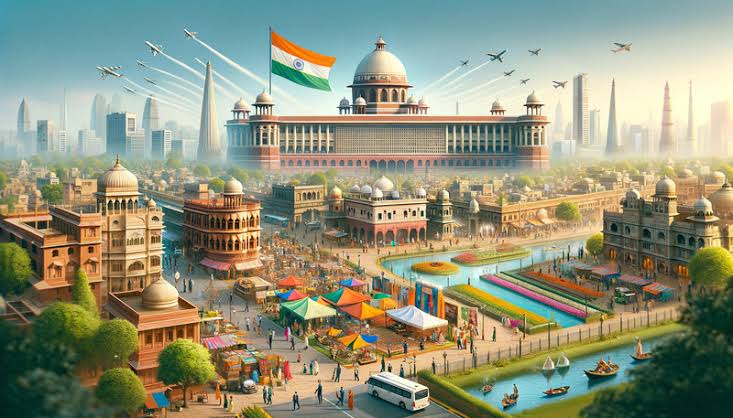
The updated SD 2.0 framework marks a strategic shift away from broad, fragmented tourist tracks in favor of creating self-contained, immersive regional hubs. For instance, in Uttarakhand, the funding has introduced specialized floating log cabins along Tehri Lake to elevate eco-tourism facilities. Concurrently, in Kurukshetra, Haryana, the scheme has delivered extensive thematic pavilions based on the Mahabharata epic, optimizing the location for advanced cultural storytelling and traveler facilitation.
Spiritual Corridors and the PRASHAD Mandate
Running parallel to general experiential travel upgrades, the Pilgrimage Rejuvenation and Spiritual Heritage Augmentation Drive (PRASHAD) scheme remains the government's primary vehicle for expanding religious and heritage site capacities. To date, the program has authorized ₹1,726.74 crore across 54 projects spanning 28 states and union territories.
The targeted funding addresses chronic infrastructure deficits at prominent historical sites, including Somnath in Gujarat, Srisailam in Andhra Pradesh, and Govardhan in Uttar Pradesh. The PRASHAD structural interventions focus on installing centralized pilgrim facilitation centers, building wide passenger promenades, setting up automated multi-level parking facilities, deploying renewable energy grids, and establishing modern public safety systems to accommodate expanding holiday crowds.
Granular Interventions and the Capital Investment Loop
To accelerate localized execution, the central government has integrated new targeted sub-schemes into its broader development portfolio:
Challenge-Based Destination Development (CBDD): This newly deployed program has sanctioned 38 distinct projects worth ₹697.94 crore across specialized categories, including ecotourism, cultural heritage, and the Vibrant Village Program aimed at transforming border towns.
Special Assistance to States for Capital Investment (SASCI): Operating with an approved project ledger of ₹3,295.76 crore, this initiative injects 50-year interest-free loans to states to develop iconic global-scale tourist centers.
Tribal Homestays (PM-JUGA): A dedicated sub-initiative under the Swadesh Darshan umbrella that will fund the construction of 1,000 distinct tribal homestays, integrating rural communities directly into the formal tourism market.
Official Sources Section
The expenditure logs, financial disbursements, and regional project reviews cited in this report have been verified through official updates from the Ministry of Tourism and published statutory datasets distributed via the Press Information Bureau (PIB). Operational targets align directly with the strategic mandates of the National Strategy for Sustainable Tourism and official central bank reporting metrics.
Quote Section
"According to officials and formal Ministry of Tourism releases, the development of tourism infrastructure is executed in close consultation with State Governments and Union Territory Administrations, utilizing an automated Program Management Information System to ensure rigorous project tracking, execution accountability, and timely completion."
Why It Matters
The national overhaul of tourism infrastructure directly resolves historical connectivity gaps for everyday travelers and holidaymakers. For domestic businesses and transport operators, the modernization of smaller regional nodes opens up entirely new customer bases, dampening the impact of seasonal travel drops. Furthermore, by mandating strict sustainability criteria—such as automated waste recycling, solar power integration, and accessible pathways for differently-abled visitors—the schemes help local economies grow without degrading their surrounding environments.
Key Facts at a Glance
Total Investment Pool: Combined government tourism schemes represent an active pipeline exceeding ₹9,225 crore.
Revamped Strategy: Swadesh Darshan 2.0 shifts focus from broad geographical circuits to building deep, localized destination hubs.
Sacred Upgrades: The PRASHAD initiative has deployed over ₹1,726 crore across 54 spiritual and heritage corridors.
Long-Term Financing: The SASCI framework extends 50-year interest-free loans to construct iconic global tourist sites across 23 states.
Rural Integration: The PM-JUGA scheme introduces 1,000 tribal homestays to drive economic development in remote communities.
FAQ Section
Q1: What is the main difference between the original Swadesh Darshan scheme and Swadesh Darshan 2.0? A1: While the original phase developed theme-based tourism circuits across multiple regions, Swadesh Darshan 2.0 focuses on developing standalone, self-contained destinations into sustainable, immersive travel hubs.
Q2: How does the PRASHAD scheme assist regional travelers in India? A2: The PRASHAD scheme funds vital public utilities at heritage and spiritual locations, creating cleaner promenades, secure parking facilities, safety centers, and large-capacity pilgrim amenities.
Q3: What role does the SASCI program play in regional development? A3: The Special Assistance to States for Capital Investment (SASCI) scheme provides states with 50-year interest-free loans to build and market world-class, iconic tourist destinations.
Q4: How are border villages and remote areas included in these tourism plans? A4: Through sub-schemes like the Challenge-Based Destination Development (CBDD) and the Vibrant Village Program, specific border and tribal areas receive specialized funding to build local homestays and eco-trails.
Source: Ministry of Tourism, Government of India, Press Information Bureau (PIB) India