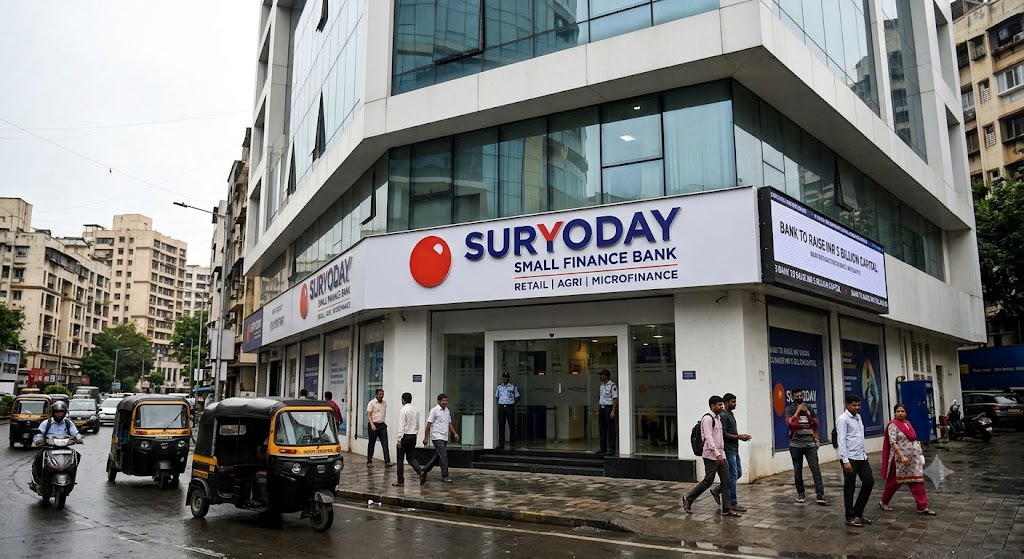
Suryoday Small Finance Bank has approved plans to raise up to 5 billion rupees to accelerate its retail credit operations. The fundraising strategy includes up to 3 billion rupees through Tier-I equity capital and up to 2 billion rupees via Tier-II debt instruments, reinforcing its baseline capital adequacy.
MUMBAI, India — Suryoday Small Finance Bank Limited has announced a comprehensive capital-raising program aimed at generating up to 5 billion rupees (INR) to anchor its next phase of credit expansion. According to institutional notifications sent to the domestic stock exchanges, the lender's board of directors approved the dual-tranche financial strategy to secure both long-term equity and debt funding. The bank will raise up to 3 billion rupees through Tier-I equity capital, alongside an additional issuance of up to 2 billion rupees via Tier-II debt instruments. This development arrives as small finance banks nationwide face regulatory pressure to fortify capital adequacy cushions amid rising credit disbursements.
Strategic Capital Injection Forms Dual-Tranche Growth Plan
The decision by Suryoday Small Finance Bank to mobilize fresh funding comes directly after its fourth-quarter and full-year earnings evaluation. The structural architecture of the fundraising allows the lender to protect its leverage ratios while simultaneously expanding its asset book.
The first tranche involves raising 3 billion rupees in Tier-I equity capital. This equity push will likely be executed via qualified institutional placements (QIP), preferential allotments, or public offer structures, depending on prevailing market conditions and regulatory alignments. Tier-I equity represents core capital, which offers the highest level of loss absorption for banking platforms.
The second tier of the funding strategy focuses on a debt issuance of up to 2 billion rupees in Tier-II debt instruments. These instruments typically manifest as subordinated bonds or unsecured non-convertible debentures. Tier-II debt provides a cost-effective alternative to equity diluting, allowing the bank to optimize its overall cost of capital while fulfilling regulatory benchmarks.
Compliance Framework and Financial Health Assessment
According to the operating guidelines laid down by the Reserve Bank of India (RBI), small finance banks are legally required to maintain a minimum Capital to Risk-Weighted Assets Ratio (CRAR) of 15%. Regulatory disclosures indicate that Suryoday Small Finance Bank currently holds a robust capital adequacy position, with its total CRAR calculated at 20.5% at the close of the financial year.
The decision to generate an extra 5 billion rupees is intended to maintain this protective buffer proactively as the lender transitions its asset mix.
The bank has been progressively shifting from its traditional Joint Liability Group (JLG) microfinance model toward high-growth segments like its "Vikas" individual loans, commercial vehicle financing, and affordable housing mortgages. These diversified asset products require higher capital allocations, making the timing of the board approval essential for upcoming fiscal quarters.
Market Impact and Implications for Stakeholders
The multi-billion rupee funding roadmap directly influences retail depositors, institutional investors, and borrowing clients. For depositors, the infusion of Tier-I and Tier-II funds strengthens corporate solvency, offering increased safety for the bank's growing deposit book, which expanded 32.3% year-on-year to reach 13,994 crore rupees.
For equity investors, the 3 billion rupee Tier-I capital target introduces potential minor share dilution, depending on the final pricing and issuance method. However, institutional analysts suggest that the long-term returns from a well-capitalized balance sheet often outweigh short-term dilution concerns, particularly as the bank records an improved Net Profit of 152 crore rupees.
Official Sources Section
The data parameters, regulatory specifications, and capital allocation targets outlined in this report originate from official corporate filings sent by Suryoday Small Finance Bank Limited to the National Stock Exchange (NSE) and BSE Limited. All core financial indicators correspond with the bank's audited fiscal statements and official investor updates.
Executive Statement
"Our bank continues to maintain a strong capital adequacy ratio of 20.5%, well above the regulatory requirement of 15%," stated the bank's management team during its annual investor presentation. "The approved capital mobilization through equity and debt pathways will provide the necessary balance sheet headroom to sustain business momentum and support our expanding digital and retail asset ecosystem."
Why It Matters
For consumers and business operators in semi-urban and rural markets, this capital raise ensures that Suryoday Small Finance Bank remains liquid and capable of honoring loan applications. By locking in billions in capital, the bank insulates itself from unexpected credit cycles while ensuring a steady pipeline of micro-mortgages, vehicle financing, and inclusive credit facilities.
Key Facts at a Glance
Total Capital Target: Up to 5 billion rupees split across equity and debt options.
Tier-I Equity Allocation: Up to 3 billion rupees to boost the bank's core paid-up equity base.
Tier-II Debt Allocation: Up to 2 billion rupees via subordinated debt instruments to balance funding costs.
Capital Position: Current capital adequacy stands at 20.5%, above the 15% minimum RBI baseline.
Growth Driver: Funds will directly fuel individual retail lending portfolios and expanded digital banking deposits.
Frequently Asked Questions
Why is Suryoday Small Finance Bank raising capital if its current CRAR is above the regulatory limit?
While the bank satisfies the 15% RBI requirement at 20.5%, raising capital allows the organization to expand its loan book without degrading its safety margins, ensuring future financial stability.
Will this capital-raising process affect standard savings or fixed deposit accounts?
No. This is a corporate financial structure optimization. Savings accounts, fixed deposits, and daily retail banking operations are completely unaffected by equity or debt issuances.
What are Tier-II debt instruments in banking terms?
Tier-II instruments are supplementary bank capitals that include subordinated bonds. They rank lower than standard deposits in claims but assist banks in meeting total regulatory capital thresholds affordably.
Source: National Stock Exchange of India (NSE) Corporate Announcements, BSE Listing Disclosures, Suryoday Small Finance Bank Investor Relations (2026).