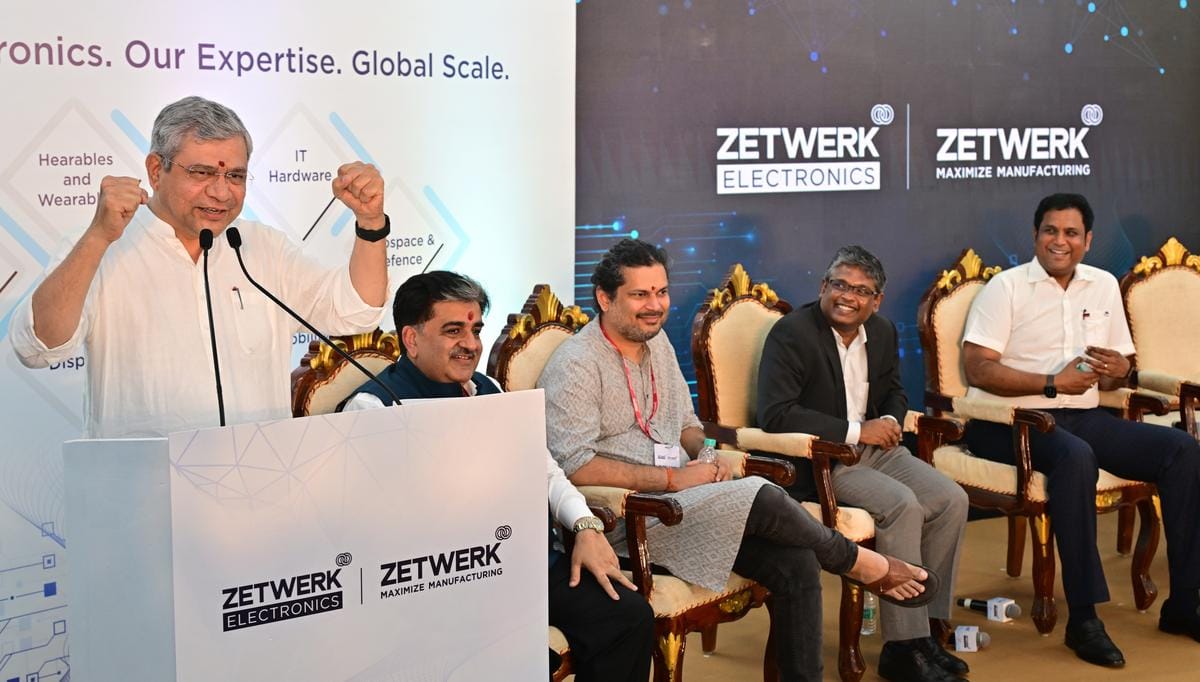
The Central Government has approved two electronics manufacturing clusters in Tamil Nadu worth ₹1,012 crore at Manallur and Pillapaikkam. Announced by Union Minister Ashwini Vaishnaw in the Lok Sabha, the initiative aims to boost domestic hardware production, support regional semiconductor design, and expand industrial employment.
NEW DELHI, India — Union Minister for Electronics and Information Technology Ashwini Vaishnaw confirmed in a written reply to the Lok Sabha on Wednesday, July 22, 2026, that the Central Government has approved two major electronics manufacturing clusters in Tamil Nadu with a combined project outlay of ₹1,012 crore. The new infrastructure hubs, situated at Manallur and Pillapaikkam, aim to bolster domestic component production, attract global industrial investments, and expand advanced manufacturing jobs across the state.
This regulatory clearance underscores a significant push to expand dedicated electronics infrastructure under the Modified Electronics Manufacturing Clusters (EMC 2.0) Scheme. By embedding high-tech industrial parks near established commercial corridors, the government seeks to deepen domestic value addition, reduce import reliance, and strengthen regional technology supply chains.
Breakdown of the New Industrial Hubs in Manallur and Pillapaikkam
The approved development encompasses two dedicated industrial hubs designed to host specialized component manufacturers and assembly units:
Manallur Cluster: Set across 474.3 acres in the Tiruvallur district, this hub carries an estimated project cost of ₹587.47 crore. Strategically located near existing industrial belts, the facility is designed to support high-density manufacturing operations.
Pillapaikkam Cluster: Spanning 379.3 acres in Kancheepuram district, this park involves an investment outlay of ₹424.55 crore. The facility will provide plug-and-play production sheds, testing labs, and shared industrial infrastructure.
According to parliamentary statements, these state-backed electronics manufacturing clusters aim to provide shared testing facilities, ready-built factory sheds, and specialized utility networks. This common infrastructure framework drastically lowers operational entry barriers for both international original equipment manufacturers (OEMs) and domestic suppliers looking to scale up production.
Decade of Exponential Growth in India's Hardware Sector
The approval of these greenfield electronics manufacturing clusters coincides with rapid long-term expansion across India's hardware manufacturing domain. Parliamentary disclosures highlight that total domestic electronics output grew nearly seven-fold over the past decade, rising from ₹1.9 lakh crore in FY 2014-15 to ₹13.11 lakh crore in FY 2025-26. Simultaneously, national electronics exports climbed from ₹38,000 crore to ₹4.24 lakh crore over the same period.
Mobile phone manufacturing has served as a primary driver within this growth trajectory. Local production of mobile devices surged over thirty-fold to reach ₹6.27 lakh crore, with exports touching ₹2.59 lakh crore. Official data indicates that 99.2% of mobile phones sold in India are currently manufactured domestically, supporting an estimated 25 lakh jobs nationwide. Tamil Nadu has consolidated its status as a core manufacturing engine, hosting major automotive, hardware, and mobile assembly plants across districts such as Kancheepuram, Chengalpattu, Tiruvallur, Krishnagiri, and Coimbatore.
Data sourced from official disclosures presented by the Ministry of Electronics and Information Technology in the Lok Sabha.
Expanding Semiconductor Design and Artificial Intelligence Footprint
Beyond physical hardware assembly, government programs are expanding higher-value design and artificial intelligence initiatives across Tamil Nadu. Under the national Semicon India Programme, the Centre has approved 12 semiconductor fabrication and assembly projects across six states, representing cumulative investment commitments of ₹1.64 lakh crore. Three of these facilities have already entered commercial production.
While major fabrication projects are situated elsewhere, Tamil Nadu serves as a critical hub for semiconductor design through the Design Linked Incentive (DLI) Scheme. Seven design firms across Chennai and Coimbatore—including Mindgrove Technologies, InCore Semiconductors, and Aheesa Digital Innovations—receive direct government grants and Electronic Design Automation (EDA) tool access.
To sustain this talent pipeline, 61 institutions across Tamil Nadu out of 315 nationwide—including IIT Madras, NIT Tiruchirappalli, Anna University, and IIITDM Kancheepuram—are engaged in specialized chip-design workforce development programs. Furthermore, under the IndiaAI Mission, the Centre has approved two Artificial Intelligence Centres of Excellence in Tamil Nadu to foster indigenous research and large language model development.
Official Sources Section
According to official parliamentary records published by the Press Information Bureau and submitted by the Ministry of Electronics and Information Technology, the two electronics manufacturing clusters in Tamil Nadu are sanctioned under the Modified Electronics Manufacturing Clusters (EMC 2.0) Scheme.
These initiatives complement broader national industrial strategies, including the Production Linked Incentive (PLI) scheme, labor law modernizations, and streamlined Foreign Direct Investment (FDI) guidelines designed to facilitate foreign capital entry.
Quote Section
According to officials, the establishment of dedicated electronics manufacturing clusters provides the baseline infrastructure required to offset domestic manufacturing disabilities and attract leading multinational hardware companies to establish local production nodes.
Minister Ashwini Vaishnaw stated in his written parliamentary response that the government's integrated policy structure—combining the EMC 2.0 scheme, PLI incentives, and the Semicon India Mission—is designed to transition India into a self-reliant global hardware and semiconductor manufacturing destination.
Why It Matters
The rollout of dedicated electronics manufacturing clusters delivers tangible economic and operational benefits across multiple sectors:
For Job Seekers & Citizens: The creation of centralized manufacturing facilities generates thousands of skilled technical, engineering, and factory floor positions, absorbing technical graduates from state engineering colleges.
For Tech Enterprises & Businesses: Companies gain access to plug-and-play production units with pre-approved environmental clearances, uninterrupted power grids, and shared testing facilities, significantly shortening time-to-market.
For Supply Chain Resilience: Concentrating component suppliers, sub-assembly specialists, and packaging units within contiguous parks reduces transit costs, decreases import dependencies, and hedges against global supply disruptions.
Key Facts at a Glance
Total Project Outlay: ₹1,012 crore allocated across two new projects in Tamil Nadu.
Location & Acreage: 474.3 acres at Manallur (₹587.47 crore) and 379.3 acres at Pillapaikkam (₹424.55 crore).
Domestic Production Growth: India's overall electronics production expanded to ₹13.11 lakh crore in FY 2025-26.
Mobile Phone Dominance: Domestic mobile phone assembly reached ₹6.27 lakh crore, fulfilling 99.2% of internal consumer demand.
Semiconductor Support: 61 Tamil Nadu academic institutes and seven state-based chip design firms are supported under national semiconductor programs.
Frequently Asked Questions
Where are the two new electronics manufacturing clusters located in Tamil Nadu?
The two clusters are located at Manallur in the Tiruvallur district and Pillapaikkam in the Kancheepuram district.
What is the primary purpose of the EMC 2.0 scheme?
The scheme provides financial support to establish dedicated industrial parks with shared infrastructure, such as testing laboratories, logistics centers, and ready-built factory sheds, to attract hardware manufacturers.
How much has India's mobile phone production grown over the past decade?
Mobile phone manufacturing has grown over thirty-fold, increasing from ₹18,000 crore in 2014-15 to ₹6.27 lakh crore in 2025-26.
Are there semiconductor initiatives supported in Tamil Nadu alongside these clusters?
Yes. The Centre supports seven semiconductor design companies and 61 educational institutions across Tamil Nadu under the Semicon India Programme and Design Linked Incentive scheme.
Source: Official parliamentary disclosures released by the Ministry of Electronics and Information Technology and published via the Press Information Bureau.