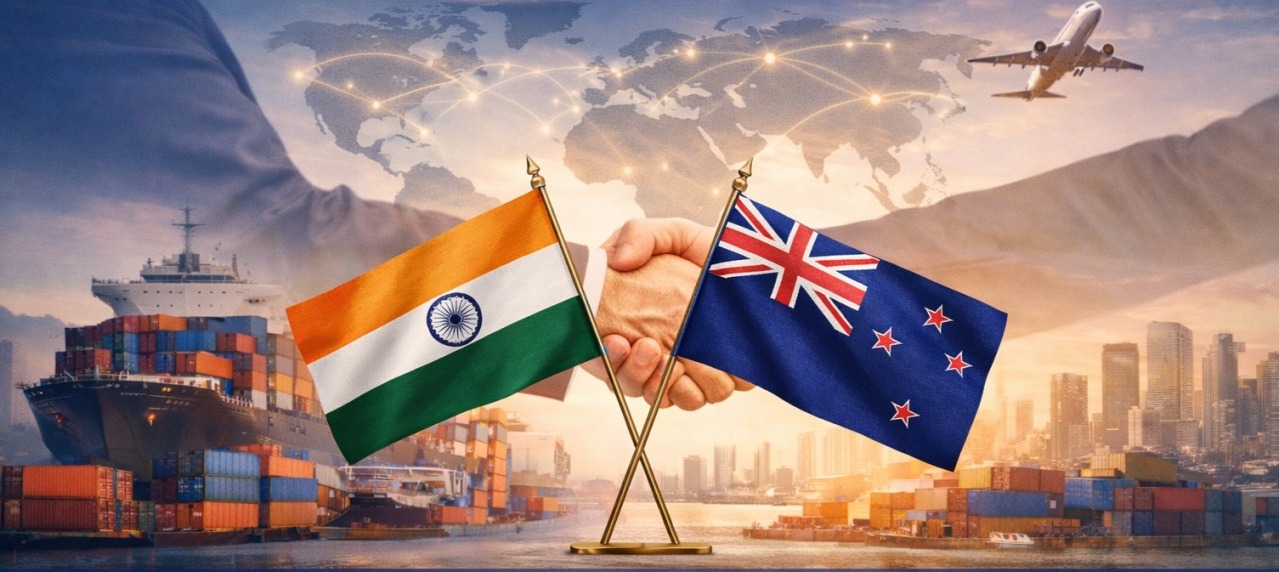
Indian Prime Minister Narendra Modi arrives in Auckland on July 10, 2026, marking a historic state visit to New Zealand after a 40-year hiatus. The two nations are poised to formalize an enhanced Strategic Partnership, advancing bilateral defense pacts and ratifying a free trade agreement that removes initial tariffs on 57% of New Zealand exports.
AUCKLAND — Indian Prime Minister Narendra Modi arrives in Auckland today, July 10, 2026, for a historic two-day state visit aimed at formally elevating the India-New Zealand relationship into a comprehensive strategic partnership. The high-profile diplomatic mission marks the first time an Indian prime minister has traveled to New Zealand in four decades, following Rajiv Gandhi’s bilateral tour in 1986.
The state visit stands as the final leg of Prime Minister Modi’s three-nation tour, which included high-level maritime security and trade rounds across Indonesia and Australia. Foreign policy officials in both New Delhi and Wellington indicate that the core objective of the bilateral discussions will focus on ratifying a sweeping free trade agreement (FTA) signed earlier this year, alongside expanding regional defense coordination within the Indo-Pacific corridor.
Strategic Partnership Aims to Deepen Indo-Pacific Ties
According to operational itineraries released by the Ministry of External Affairs (MEA), Prime Minister Modi will engage in wide-ranging, restricted bilateral talks with New Zealand Prime Minister Christopher Luxon. Diplomatic sources report that the center of these discussions is the structural expansion of the India-New Zealand Strategic Partnership. The proposed framework establishes a regularized "2+2" dialogue mechanism between foreign and defense ministers, ensuring institutional consistency that bypasses future domestic electoral cycles.
The visit builds directly on the economic architecture laid down by the New Zealand Ministry of Foreign Affairs and Trade (MFAT) following the signing of a landmark bilateral trade pact in April. Under the agreed parameters, the deal guarantees that 57% of New Zealand’s total export categories to India will become completely tariff-free from day one of formal ratification, unlocking vast opportunities for agricultural, technological, and educational trade.
Defense Cooperation and Market Implications
Beyond traditional commerce, the geopolitical dimension of the visit highlights a shared focus on maritime security. Security analysts note that both India and New Zealand function as strategic balancing forces in the South Pacific, seeking to maintain an open, inclusive, and rules-based maritime commons amid rising regional contestation.
The implementation of the strategic partnership is expected to impact several sectors:
Technology Transfer: India aims to secure specialized Kiwi agro-technology and cold-chain logistics practices to enhance domestic production yields for premium fruits and honey.
Foreign Direct Investment: The trade deal contains an institutional roadmap pointing toward a projected $20 billion investment inflow from New Zealand entities into Indian infrastructure projects over the next 15 years.
Labor and Education Mobility: Negotiators are working to finalize streamlined visa channels for high-skilled Indian professionals, particularly within technology and healthcare fields.
Official Sources Section
Bilateral parameters and diplomatic schedules were formally synchronized via state circulars issued by the Prime Minister of New Zealand's Official Office and verified by Indian High Commissioner to New Zealand Muanpuii Saiawi during media briefings in Wellington.
Quote Section
"My visit to Indonesia and Australia followed by New Zealand will further strengthen India's Act East Policy, MAHASAGAR Vision, as well as our outlook towards a free and open Indo-Pacific," stated Prime Minister Narendra Modi in an official departure statement.
"We are taking the two countries' relationship to the next level," noted New Zealand Prime Minister Christopher Luxon in a public policy brief. "India is one of the world's largest and fastest-growing economies, and it is of enormous importance to New Zealand's economic prosperity."
Why It Matters
The formalization of an enhanced India-New Zealand Strategic Partnership carries immediate practical implications for multinational corporations, institutional investors, and regional supply chain operators. By reducing historical trade barriers and implementing uniform double-taxation avoidance frameworks, the agreement provides businesses with a reliable alternative to traditional manufacturing hubs while ensuring supply chain resilience across the broader Pacific rim.
Key Facts at a Glance
Historical Context: First state visit by a sitting Indian prime minister to New Zealand in 40 years.
Trade Parameters: The signed FTA grants immediate tariff-free entry to 57% of New Zealand's core export categories into India.
Investment Volume: Includes a projected blueprint for $20 billion in long-term capital investments over 15 years.
Diaspora Outreach: Prime Minister Modi will address a large-scale civic gathering of the Indian diaspora in Auckland.
FAQ Section
Why is this particular state visit considered historic?
The visit is the first official state mission by an Indian head of government to New Zealand since 1986, ending a 40-year diplomatic gap between the two democratic nations.
What are the main points of friction remaining in the trade agreement?
While the treaty slashes tariffs on most goods, market access details regarding New Zealand's dominant dairy exports and domestic immigration anxieties inside the Kiwi ruling coalition remain active points of negotiation.
How does this agreement affect regional maritime security?
The strategic partnership seeks to integrate India's "MAHASAGAR" regional security vision with New Zealand's Pacific maritime protocols, enhancing joint naval patrolling and disaster response workflows.
Source: Press communiqués from the Ministry of External Affairs (MEA), India and official press releases from the Executive Office of the Prime Minister of New Zealand.