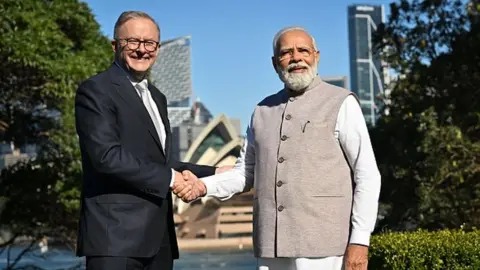
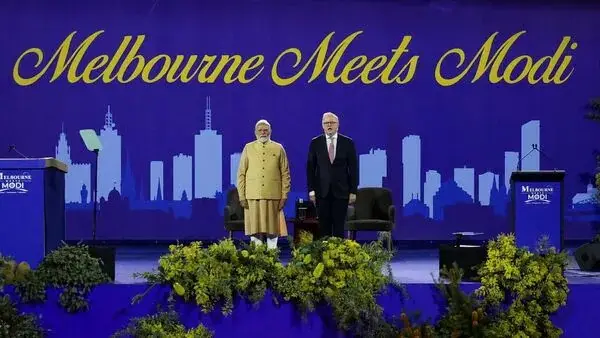
Prime Minister Narendra Modi and PM Anthony Albanese concluded the third Australia-India Annual Summit with 18 strategic agreements. Key highlights include a landmark deal for Australian uranium exports to India, a Joint Declaration on Defence and Security Cooperation, and the launch of the PACTS initiative for critical technologies.
Prime Minister Narendra Modi and Australian Prime Minister Anthony Albanese have unveiled an ambitious roadmap of 18 strategic agreements following the third annual leaders' summit in Melbourne.
MELBOURNE — Indian Prime Minister Narendra Modi and Australian Prime Minister Anthony Albanese concluded a pivotal summit in Melbourne on Thursday, announcing a comprehensive package of 18 landmark agreements designed to deepen ties in defence, energy, technology, and maritime security. The summit, held from July 8–10, 2026, marked a significant milestone in the bilateral relationship, aimed at securing the Indo-Pacific region and boosting economic resilience.
The most anticipated outcome of the visit was the finalization of administrative arrangements under the India-Australia Civil Nuclear Agreement. This long-awaited pact paves the way for the commercial export of Australian uranium to India, a move expected to provide a crucial boost to India’s clean energy goals and nuclear power capacity.
Elevating Defence and Maritime Security
Defence collaboration stood at the center of the summit’s outcomes, with both leaders endorsing a "Joint Declaration on Defence and Security Cooperation." This new framework focuses on enhancing military interoperability, strengthening industrial collaboration, and expanding maritime security coordination.
Central to this effort is the new India-Australia Maritime Security Collaboration Roadmap, which seeks to bolster information sharing and operational coordination between the two nations' naval and coast guard forces. A specific Memorandum of Understanding (MoU) was signed between the Indian Coast Guard and Australia’s Maritime Border Command to streamline maritime law enforcement and border protection activities.
"Our fight against terrorism is shared, our resolve is unwavering, and our cooperation is continuously strengthening," Prime Minister Modi said during a joint press briefing at the Government House.
Technology, Energy, and Talent Partnerships
Beyond security, the two nations launched the Australia-India Partnership on Cyber, Critical Technologies and Supply Chains (PACTS). This initiative aims to address regional challenges in digital resilience, supply chain diversification, and critical technology research.
Economic and human resource cooperation also reached new heights with several key developments:
Clean Energy: The operationalization of a Rooftop Solar Training Academy in Gandhinagar, which aims to train 2,000 women and youth as solar technicians.
Mining Technology: An agreement between India’s Ministry of Skill Development and Entrepreneurship and Western Australia’s TAFE to establish a Centre of Excellence in Mining Equipment and Technology in Bhubaneswar.
Cultural Preservation: Australia agreed to repatriate three significant Indian antiquities, including an 11th-century bronze Bhadrakali trident and a 12th-century basalt sculpture of Skanda.
Official Sources
According to the Third India-Australia Annual Summit Joint Statement, the leaders reaffirmed their commitment to the early finalization of a Comprehensive Economic Cooperation Agreement (CECA). The statement highlights that effective maritime cooperation and technological synergy are essential to maintaining a peaceful and prosperous Indo-Pacific region.
Why It Matters
For citizens, businesses, and investors, these agreements represent a synchronized move to integrate India's massive growth potential with Australia’s vast resource base. By reducing non-tariff barriers and creating a more predictable regulatory environment for trade and defense, the two nations are working to hit a bilateral trade target of US$100 billion by 2030. The formalization of uranium supplies and critical mineral partnerships also provides energy security for India’s manufacturing sector while opening new export avenues for Australian producers.
Key Facts at a Glance
Nuclear Energy: A new administrative arrangement enables the long-term export of Australian uranium to India.
Defence Milestone: A Joint Declaration on Defence and Security Cooperation was adopted, alongside plans for an Annual Defence Ministers' Dialogue.
Maritime Security: A new roadmap and an MoU between the Indian Coast Guard and Australia's Maritime Border Command were established.
Strategic Tech: The PACTS initiative was launched to enhance cyber-security and critical technology resilience.
Trade Goal: Both countries are accelerating negotiations for a comprehensive CECA to boost bilateral trade to US$100 billion by 2030.
Frequently Asked Questions (FAQ)
1. What is the significance of the nuclear agreement signed?
The agreement operationalizes the export of Australian uranium to India for peaceful civilian use, providing a major boost to India’s clean energy objectives and nuclear power generation.
2. How will the new defence declaration impact the Indo-Pacific?
The declaration focuses on deeper industrial collaboration, military interoperability, and maritime security, serving to maintain a rules-based order in the Indo-Pacific region.
3. What is the PACTS initiative?
PACTS (Australia-India Partnership on Cyber, Critical Technologies and Supply Chains) is designed to increase collaboration on emerging tech, digital resilience, and securing supply chains.
4. When will the Comprehensive Economic Cooperation Agreement (CECA) be finalized?
While the leaders reaffirmed their commitment to finalizing an ambitious and balanced CECA, negotiations are ongoing to unlock the full potential of the economic relationship.
Source: Prime Minister's Office (India), Australian Government (PM.gov.au), Ministry of External Affairs (India)