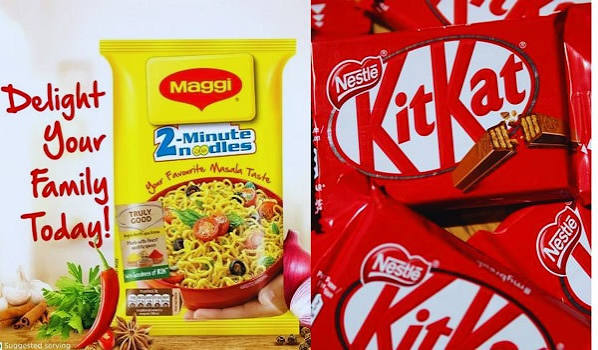
India has officially become the world's largest market for Nestlé’s Maggi and KitKat. This milestone reflects the company's aggressive expansion into tier-2 and tier-3 towns, supported by over 5.2 lakh new retail outlets since 2023 and a focus on premium product innovations tailored to the evolving Indian consumer base.
NEW DELHI — India has cemented its status as a critical engine for growth for Nestlé, officially emerging as the world’s largest market for both Maggi noodles and the chocolate-wafer brand KitKat. The milestone, confirmed by leadership at the company's 67th annual general meeting this week, marks a significant shift in the multinational's global operations, underscoring the success of its aggressive expansion into tier-2 and tier-3 towns.
Nestlé India Chairman and Managing Director Manish Tiwary announced that the Indian market now holds the top global spot for these two flagship products. While India has long maintained its position as the largest market for Maggi, the rise of KitKat to the number one position globally represents a rapid ascent; a decade ago, India ranked only tenth in KitKat sales worldwide.
A Strategy of Deep Penetration
The performance of these brands comes against the backdrop of what leadership described as a "challenging" fiscal year 2026. Despite volatile commodity costs and uneven urban consumption patterns, Nestlé India has pursued a strategy of "penetration-led volume growth."
Since April 2023, the company has expanded its footprint by adding approximately 5.2 lakh retail outlets across urban, semi-urban, and rural India. By focusing on smaller towns, Nestlé has successfully tapped into a growing demographic of consumers who are increasingly demanding the same high-quality packaged goods as urban residents.
"We are operating in a market full of opportunities, but one that will increasingly reward only those who are agile, disciplined, and genuinely close to the consumer," Tiwary told shareholders.
Innovation and Diversification
Beyond basic distribution, the company attributes this market leadership to targeted product innovation. For KitKat, the company shifted beyond its traditional single-finger format by introducing new consumption spaces, including the "KitKat Celebreak" range for gifting and "KitKat pops" for nibbling. Premiumization efforts—such as the launch of the KitKat Delights range featuring hazelnut and salted caramel variants—have also played a pivotal role in boosting both value and volume growth.
These initiatives are supported by significant capital investment, with the company having deployed nearly ₹2,000 crore in capital expenditure over the past two years to bolster manufacturing capacity and supply chain technology.
Official Sources
Quote Section
According to Nestlé India Chairman and Managing Director Manish Tiwary: "India is now the largest market for KitKat globally, and the brand has accelerated its market share growth over the last few years. It has now become the second brand in Nestlé’s portfolio, after Maggi, to emerge as the largest market globally."
Why It Matters
For investors and industry analysts, this development highlights the shifting gravity of the global FMCG (Fast-Moving Consumer Goods) sector toward India. The success of Maggi and KitKat serves as a blueprint for how global brands can tailor their portfolios to match the specific needs of Indian consumers—balancing price sensitivity with premium offerings—to secure long-term, sustainable growth in one of the world's fastest-growing consumption economies.
Key Facts at a Glance
Global Standing: India is currently the largest global market for both Maggi noodles and KitKat chocolates.
Rapid Growth: KitKat moved from the 10th largest market globally a decade ago to the number one position in 2026.
Retail Reach: Nestlé India has added over 5.2 lakh retail outlets since April 2023 to deepen its urban and rural penetration.
Investment: The company has committed ₹2,000 crore in capital expenditure over the last two years to drive manufacturing and capacity.
FAQ
1. Why is India suddenly the largest market for KitKat?
The growth is attributed to aggressive marketing, expanded distribution in semi-urban areas, and product innovations like gifting packs and premium chocolate variants.
2. How many Maggi serves are sold in India?
The company reports that its Indian business sells over 5 billion serves of Maggi annually.
3. Does this growth impact consumer prices?
While the company faces inflationary pressures, it has focused on reinvesting savings into brand advertising and capacity, while managing pack sizes and variety to maintain accessibility.
4. Are these brands produced locally?
Yes, Nestlé India sources approximately 92% of its raw materials domestically, supporting local supply chains.
Source: NDTV Profit, The Economic Times, LiveMint.