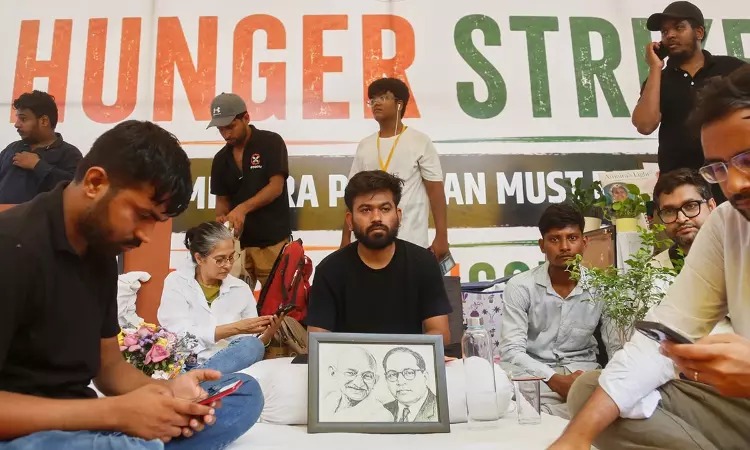
The Union government has formally defended its security operations at Delhi’s Jantar Mantar protest site, telling the Delhi High Court that the heavy police presence and continuous videography are "absolutely legitimate state interests."
NEW DELHI — The Union government has formally defended its security operations at Delhi’s Jantar Mantar protest site, telling the Delhi High Court that the heavy police presence and continuous videography are "absolutely legitimate state interests."
The government's stance, presented by Solicitor General Tushar Mehta during ongoing legal proceedings this week, comes in response to a Public Interest Litigation (PIL) filed by former Jawaharlal Nehru University Students' Union (JNUSU) president Aishe Ghosh. The petition challenges the "indiscriminate and continuous surveillance" of protesters associated with the Cockroach Janta Party (CJP), who have been demonstrating since June 20, 2026, to demand the resignation of Union Education Minister Dharmendra Pradhan over alleged examination irregularities.
State’s Defense: Security vs. Snooping
Addressing a bench led by Chief Justice D.K. Upadhyaya and Justice Tejas Karia, Solicitor General Mehta rejected allegations that the police were "snooping" on peaceful demonstrators. He asserted that the videography and the operation of a surveillance tower at the protest site are standard security arrangements intended to maintain law and order.
"There is no snooping. There is no surveillance," Mehta submitted to the court, according to reports from the hearing. He further dismissed the petition as "luxury litigation," arguing that the protests at Jantar Mantar are routinely recorded for safety purposes and that the presence of protesters’ own mobile devices to film and viralize their activities renders the police’s localized documentation a standard necessity.
Protesters Allege Intimidation
The PIL filed by Ms. Ghosh paints a different picture, describing an "atmosphere of fear" designed to deter student participation. The petition alleges that police personnel use the recordings to threaten student protesters, claiming that photographs and videos of them would be forwarded to their parents, guardians, and university authorities.
The petitioner, represented by senior advocate Nandita Rao, contends that the surveillance apparatus—which includes a permanent tower equipped with cameras—is disproportionate to any threat to public order and constitutes a violation of the fundamental right to privacy. The plea seeks a declaration that such mass surveillance is constitutionally impermissible, especially when ordinary incidents of daily life at the site, such as resting or eating, are captured.
Context of Ongoing Agitation
The legal confrontation unfolds against a backdrop of escalating tension in the capital. The Cockroach Janta Party’s agitation, which gained national attention after activist Sonam Wangchuk joined the indefinite hunger strike, has faced multiple flashpoints. On July 20, 2026, a "Sansad Chalo" (March to Parliament) protest resulted in clashes where police deployed tear gas and lathis. While protesters alleged excessive police force, the state has cited the need to manage violent attempts to breach barricades.
The Supreme Court recently declined to intervene in a separate plea regarding the alleged police brutality during that march, with Chief Justice of India Surya Kant stating, "We don't have time to watch videos."
Official Sources and Legal Status
Government Position: Solicitor General Tushar Mehta maintains that videography is solely for law and order and is a standard security protocol.
Petitioner’s Claim: Former JNUSU president Aishe Ghosh alleges the surveillance is used as an "instrument of intimidation" to suppress dissent.
Court Status: The Delhi High Court is currently weighing the constitutionality of the surveillance measures while simultaneously reviewing other petitions concerning the management of the Jantar Mantar site.
Why It Matters
The case represents a critical test for the right to protest and the right to privacy in public spaces. As the state increasingly relies on digital surveillance to manage large-scale civil demonstrations, the court’s eventual ruling on whether such monitoring constitutes "legitimate state interest" or unconstitutional "intrusive surveillance" will have lasting implications for democratic expression in India.
Key Facts at a Glance
Protest Timeline: The Cockroach Janta Party (CJP) has been protesting at Jantar Mantar since June 20, 2026.
Surveillance Tools: Allegations focus on a permanent surveillance tower and continuous police photography/videography of all attendees.
Government Stance: Defends the measures as "absolutely legitimate" and necessary for public order.
Court Action: The Delhi High Court has agreed to hear the PIL following concerns that the surveillance creates a "chilling effect" on dissent.
FAQ
What is the Cockroach Janta Party (CJP)?
It is a Gen Z-led protest movement formed in response to remarks comparing unemployed youth to "cockroaches," which has since focused on demanding accountability for examination irregularities.
Why are protesters challenging the surveillance?
They argue that the police are using cameras to intimidate students and that such indiscriminate monitoring is an unconstitutional violation of privacy.
What has the court decided so far?
The Delhi High Court has admitted the PIL for hearing, acknowledging the sensitivity of the privacy claims, even as the Supreme Court has declined to intervene in related matters regarding police conduct.
Has the government admitted to using facial recognition?
The government has defended videography as standard law enforcement; however, critics and legal experts point to the use of broader biometric and digital tracking technologies in such protest environments.
Source: The Hindu, The Times of India, Human Rights Watch, Tech Policy Press