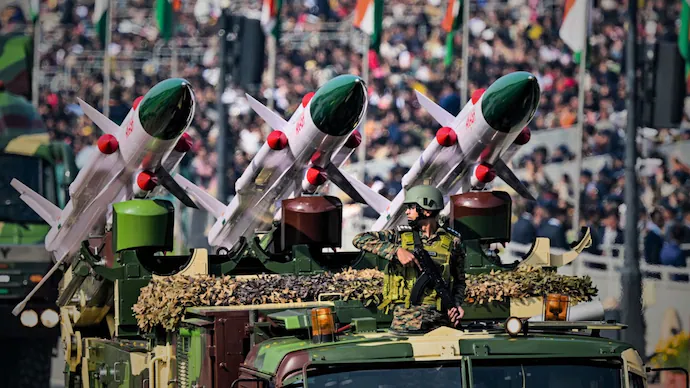
The Stockholm International Peace Research Institute (SIPRI) Yearbook 2026 claims India has operationally deployed 12 nuclear warheads for the first time in peacetime, shifting away from its traditional policy of storing warheads separate from launchers. The report notes India's total arsenal grew to 190 warheads, reflecting a modernized, sea-based second-strike deterrent.
STOCKHOLM, Sweden — India has placed 12 nuclear warheads on active operational deployment for the first time in its peacetime history, according to a major report released on Monday by a prominent global arms watchdog. The strategic adjustment marks a departure from New Delhi’s long-standing security posture of keeping its atomic warheads and delivery systems stored separately during peacetime.
The findings, published in the Yearbook 2026 by the Stockholm International Peace Research Institute (SIPRI), indicate that India's total nuclear weapons stockpile has simultaneously grown to an estimated 190 warheads as of January 2026, up from 180 a year earlier. Analysts state that the deployment of these 12 warheads indicates a calculated effort by Indian strategic planners to enhance the country's immediate second-strike capability amid shifting regional geopolitical dynamics.
Escalating Readiness: Peacetime Posture Undergoes Strategic Revision
According to the comprehensive global security data compiled by SIPRI, the 12 warheads are classified as "operationally deployed" because they have been actively mated with their launchers or positioned at bases alongside operational military forces. For decades, international defense monitors assumed that India maintained a decoupled state for its arsenal to minimize the risk of accidental escalation.
"The country's recent moves towards placing missiles in canisters and conducting sea-based deterrence patrols suggest that India could be shifting in the direction of mating some of its warheads with their launchers in peacetime," the think tank noted in its official publication.
The report assesses that New Delhi has likely deployed these initial warheads aboard a single nuclear-powered ballistic missile submarine (SSBN) engaged in routine regional deterrence patrols. The Indian Navy has steadily bolstered its maritime triad leg, operationalizing advanced vessels like the INS Arighaat and INS Aridhaman over the past two years, which significantly reinforces its survivable second-strike infrastructure.
Regional Modernization Fueled by Evolving Security Perceptions
The structural changes detailed by international researchers show that India's defense modernization remains focused on long-term deterrence requirements across Asia:
The China Factor: Market and defense analytics confirm India is increasingly prioritizing long-range delivery systems, such as the Agni-V ballistic missile series, which are capable of reaching targets throughout mainland China.
The Pakistan Dimension: While strategic focus expands eastward, military planning continues to account for the long-standing rivalry with Pakistan. SIPRI estimates Pakistan’s nuclear inventory remained stable at approximately 170 warheads as of January 2026.
The Global Nuclear Trend: The shift arrives at a time when all nine nuclear-armed nations—including the United States, Russia, China, the United Kingdom, France, Pakistan, Israel, and North Korea—are actively expanding or modernizing their strategic forces.
Despite the operational deployment of 12 warheads, defense experts highlight that India's immediate readiness remains highly restrained compared to its neighbors. For context, China’s total nuclear arsenal has reached an estimated 620 warheads, with 34 currently maintained on active deployment.
Unchanged Commitment to Defensive Military Doctrines
Despite the increased readiness levels reported by international observers, independent security experts emphasize that India has not abandoned its core defensive military philosophies. The nation maintains a strict, legally codified "No First Use" (NFU) policy, which dictates that its atomic forces serve strictly as a deterrent against external aggression and will only be utilized in retaliation to an incoming strike on Indian territory or forces.
The deployment of a limited number of warheads is viewed by regional analysts as a stabilizing mechanism rather than an aggressive move. By ensuring that a small fraction of its deterrent is highly survivable and ready for immediate deployment, New Delhi significantly limits the potential for miscalculation by adversarial states.
Official Sources Section
The defense statistics, historical weapon counts, and policy assessments presented in this journalistic report are drawn directly from the following official international and regional research organizations:
The data registries and regional military indices compiled within the SIPRI Yearbook 2026 by the Stockholm International Peace Research Institute (SIPRI).
Operational and vessel deployment records tracked through the Indian Navy and Ministry of Defence media releases.
Global non-proliferation frameworks and review conference documents archived under the United Nations Office for Disarmament Affairs.
Quote Section
"It has long been assumed that India stores its nuclear warheads separate from its deployed launchers during peacetime. However, the country's recent moves suggest that India could be shifting in the direction of mating some of its warheads with their launchers."
— Stockholm International Peace Research Institute (SIPRI) Yearbook 2026
"According to officials close to regional security networks, the deployment of 12 warheads indicates a natural evolution toward maintaining a credible, highly survivable maritime deterrent, without fundamentally altering the nation's core defensive posture."
— Defense Analyst, tracking South Asian strategic stability
Why It Matters
For international diplomats and geopolitical strategists, the deployment signifies a critical transformation in South Asian deterrence logic, indicating that India is building a more operationally responsive military posture to counter multi-front challenges. For citizens and businesses within the region, this structured modernization reinforces national defense security during a period of global instability. Economically, the steady development of sovereign, high-technology defense platforms like nuclear submarines demonstrates India's advancing domestic industrial and engineering capabilities, which continues to attract major institutional aerospace and defense investments.
Key Facts at a Glance
First Operational Deployment: An international report claims India has placed 12 nuclear warheads on an active, deployed status during peacetime for the first time.
Growing Atomic Arsenal: India's total estimated nuclear stockpile has risen to 190 warheads as of January 2026, marking an increase from 180 warheads recorded the previous year.
Maritime Triad Focus: Analysts indicate the deployed warheads are likely positioned aboard a nuclear-powered ballistic missile submarine (SSBN) engaged in routine regional patrols.
Adherence to Doctrine: The operational adjustments do not alter India's established "No First Use" policy, meaning the weapons are intended strictly for retaliatory deterrence.
Regional Disparities: India’s active deployment remains highly conservative compared to global powers; China possesses approximately 620 warheads, with 34 operationally deployed.
FAQ Section
What does it mean when a nuclear warhead is "deployed"?
According to international arms-tracking definitions, a nuclear warhead is considered deployed when it is actively mated to a delivery vehicle, such as a ballistic missile, or positioned at a military base with operational forces for immediate use.
Which organization published the claim about India’s nuclear warheads?
The claim was published by the Stockholm International Peace Research Institute (SIPRI), an independent international institute based in Sweden that tracks global arms transfers, disarmaments, and international security data.
Has India changed its "No First Use" nuclear policy?
No. International researchers and security experts confirm that India still strictly adheres to its defensive "No First Use" doctrine, meaning its nuclear weapons serve entirely as a deterrent and would only be launched in retaliation to an attack.
Where are the 12 deployed warheads believed to be located?
The report suggests that India has likely positioned a small number of warheads on a single nuclear-powered ballistic missile submarine (SSBN) executing deterrence patrols to ensure a highly survivable, sea-based second-strike capability.
How does India's nuclear stockpile compare to its neighboring countries?
According to the report, India possesses approximately 190 warheads (12 deployed), Pakistan holds an estimated 170 warheads (none deployed), and China maintains a larger inventory of roughly 620 warheads (34 deployed).
Source: Stockholm International Peace Research Institute (SIPRI) Digital Library, Indian Ministry of Defence Security Archive, United Nations Disarmament Registry.