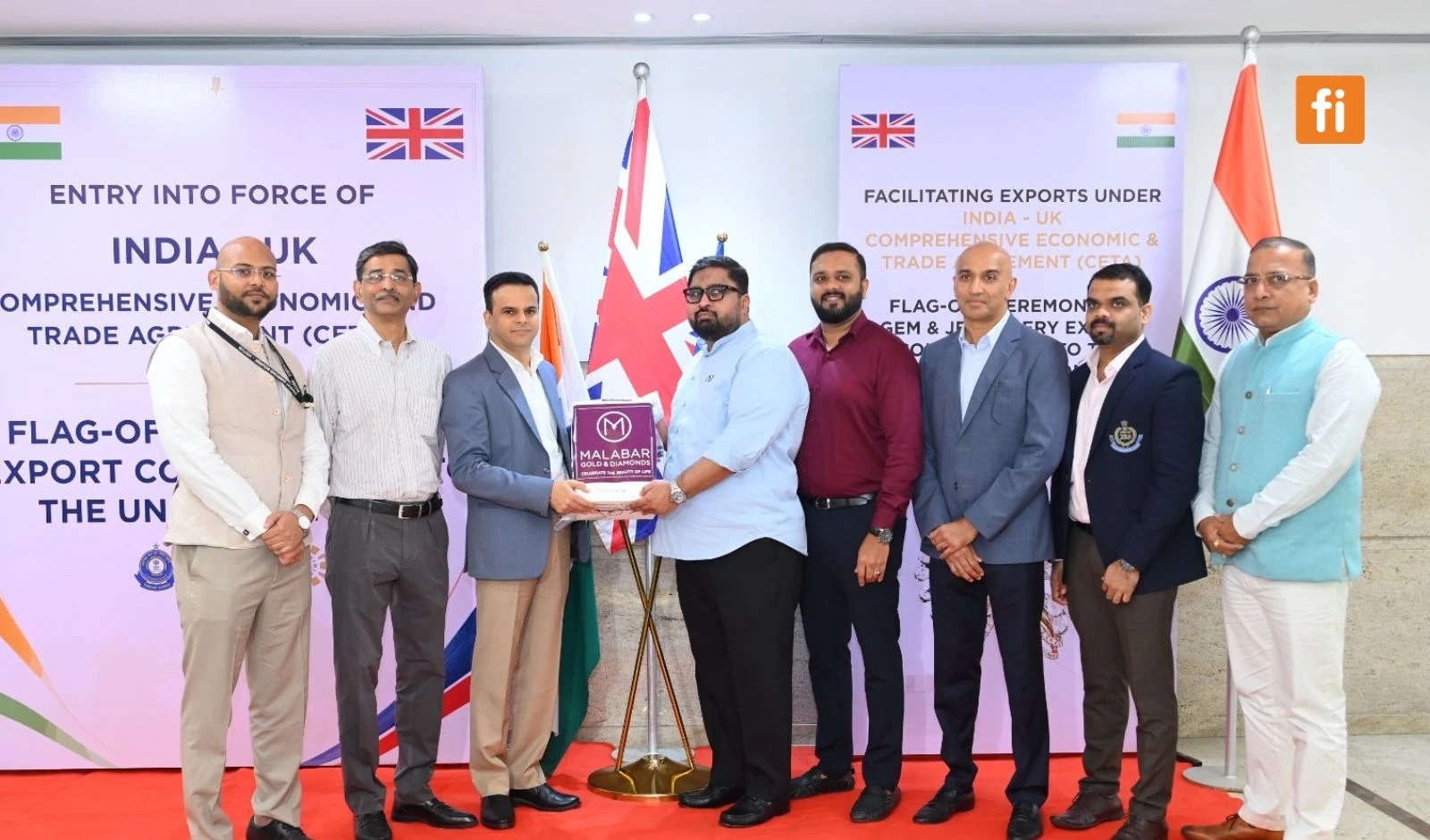
India flagged off its first jewellery export consignment to the UK under the newly implemented India-UK CETA on July 15, 2026. The $10 million nationwide shipment marks the beginning of zero-duty access to the British market, with experts projecting export growth to $2.5 billion within three years.
Simultaneous ceremonies across six major cities mark the first duty-free jewellery shipments to the United Kingdom following the implementation of the bilateral trade pact.
India officially commenced its first wave of jewellery exports to the United Kingdom under the newly implemented India-UK Comprehensive Economic and Trade Agreement (CETA) on Wednesday, July 15, 2026. The inaugural shipment, valued at approximately $10 million, was flagged off simultaneously from key manufacturing hubs including Kolkata, Delhi, Mumbai, Surat, Jaipur, and Chennai, signaling a transformative step for India’s gem and jewellery sector.
The trade agreement, which officially entered into force on the same day, eliminates UK import tariffs of up to 4% on Indian jewellery. This preferential access is expected to significantly enhance the global competitiveness of Indian exporters in the United Kingdom, a market that imports roughly $4 billion worth of jewellery annually.
Nationwide Launch and Strategic Impact
The simultaneous flag-off ceremonies underscored the nationwide scale of the opportunity. In Kolkata, the event at the Air Cargo Complex saw participation from senior officials, including state Industry and Commerce Minister Tapas Roy and the British Deputy High Commissioner for East and Northeast India, Andrew Fleming.
According to Kirit Bhansali, Chairman of the Gem & Jewellery Export Promotion Council (GJEPC), the agreement is more than a commercial milestone; it represents a "defining moment" for India's global trade journey. Industry projections indicate that this zero-duty access could help increase India’s annual gem and jewellery exports to the UK from the current $754 million to nearly $2.5 billion within the next three years.
Competitive Advantage in the UK Market
For Indian manufacturers and MSMEs, the elimination of tariffs provides a critical buffer against global market volatility. As exporters navigate shifting trade policies in other major markets, the India-UK CETA offers a stable, high-value alternative.
Zero-Duty Access: The pact removes tariffs of up to 4% on gold, diamond, silver, and platinum jewellery, providing an immediate pricing advantage for Indian goods.
Sector-Wide Benefits: The agreement is designed to boost value-added manufacturing, encourage employment, and promote skill development for artisans and designers.
Ease of Doing Business: The pact includes provisions for simplified customs procedures and self-certification of origin, reducing compliance costs for small and medium enterprises.
Official Sources
The implementation of the India-UK CETA was confirmed through official releases from the Ministry of Commerce and Industry and the Press Information Bureau (PIB). Details regarding the export shipments were provided by the Gem & Jewellery Export Promotion Council (GJEPC), the nodal industry body overseeing the initiative.
Quote Section
"According to officials," the CETA framework is designed to deepen economic integration between the two nations through enhanced market access. Industry leaders stated that the removal of tariffs will enable Indian jewellery to compete more effectively in the UK’s premium retail segment, creating new opportunities for manufacturers and artisans across the country’s major gem and jewellery clusters.
Why It Matters
The practical implication of this trade pact is a lower cost-of-entry for Indian jewellery in Britain. By streamlining the supply chain and lowering financial barriers, the agreement fosters stronger participation of MSMEs in global value chains. For the UK consumer, it means greater access to Indian craftsmanship at potentially more competitive price points, while for India, it secures a strategic, long-term trade partner.
Key Facts at a Glance
Agreement Status: The India-UK CETA officially came into force on July 15, 2026.
Inaugural Export: A nationwide consignment valued at $10 million was dispatched across six major cities.
Tariff Relief: The pact eliminates UK import duties of up to 4% on various jewellery categories.
Growth Projection: Industry estimates suggest exports could rise from $754 million to $2.5 billion over three years.
FAQ
What is the India-UK CETA?
It is a comprehensive free trade agreement aimed at deepening economic ties by reducing trade barriers, including import tariffs and simplifying customs procedures.
How does this affect Indian jewellery exporters?
Exporters now benefit from zero-duty access to the UK market, making their products more price-competitive against global rivals.
Which jewellery categories are included?
The duty-free benefits apply to gold, diamond, silver, platinum, and various value-added jewellery products.
What are the long-term goals of this agreement?
The pact aims to boost bilateral trade to $100 billion by 2030, increase employment in labour-intensive sectors, and strengthen the 'Make in India' initiative.
Source: Press Information Bureau (PIB), Gem & Jewellery Export Promotion Council (GJEPC), Ministry of Commerce and Industry