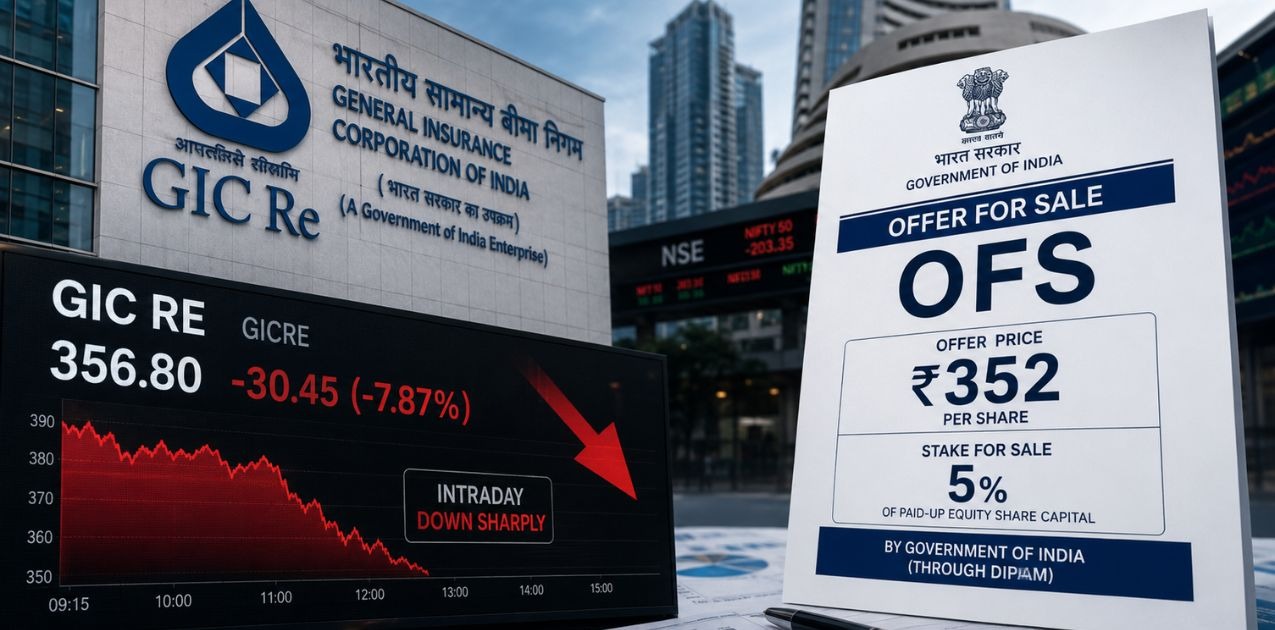
The Indian government has exercised its 3% over-subscription option in the General Insurance Corporation of India (GIC Re) Offer for Sale, raising the total stake divestment to 5%. The ₹3,088 crore transaction helps meet SEBI’s 25% public shareholding mandate while advancing the nation's annual asset monetization goal.
NEW DELHI — The Government of India has officially confirmed it will exercise its over-subscription option of approximately 3% in the ongoing Offer for Sale (OFS) for General Insurance Corporation of India (GIC Re). The decision follows strong initial bidding from institutional buyers, expanding the baseline divestment from its original 2% framework up to a cumulative 5% equity liquidation.
High Demand Activates Greenshoe Clause
According to formal statements filed with regional stock exchanges on June 16, 2026, the Ministry of Finance has chosen to utilize the full green-shoe capacity built into the transaction structure. The share sale initially opened with a base offer of 2% of the company's outstanding paid-up equity, equivalent to roughly 35.1 million shares.
With the over-subscription option now fully triggered, the government will offload an additional 52.6 million equity shares. This bumps the total volume of the market transaction up to 87.7 million shares.
The floor price for the transaction was locked at ₹352 per share. This price reflects an approximate 9.1% tactical discount relative to the stock's prior market close of ₹387.25 on Monday. With institutional appetite validating the higher supply volume, the total capital mobilization for the state exchequer is estimated to reach approximately ₹3,088 crore upon final settlement.
Compliance with Public Float Norms
The strategic timing of the equity sale serves as an important bridge toward satisfying mandatory regulatory guidelines. Prior to the launch of this two-day divestment window, central government ownership in the prominent public-sector reinsurer hovered at 82.40%.
Under statutory compliance protocols established by the Securities and Exchange Board of India (SEBI), all public listed corporations are required to maintain a minimum public shareholding (MPS) threshold of 25%. Consequently, maximum promoter control is capped at 75%. By reducing its total holding down toward 77.4%, the Ministry of Finance effectively shrinks its public float non-compliance gap while elevating total market liquidity for secondary traders.
The capital generated through the GIC Re transaction further advances the central administration’s revised disinvestment and public asset monetization blueprint. For the current fiscal year, the state’s aggregate asset-sale target remains positioned at a budgeted ₹80,000 crore. Before this week's insurance sector intervention, the government had already accumulated ₹13,389 crore via minority stake sales across public institutions including Coal India, NHPC, Central Bank of India, and NLC India.
Impact on Retail Investors and Financial Markets
The administrative timeline specifies that while institutional and non-retail corporate entities dominated block bidding on Tuesday, June 16, the allocation pipeline officially welcomes retail bids and eligible company employees on Wednesday, June 17. Up to 20,000 equity shares have been set aside exclusively for internal staff structures under the framework.
Following the pricing disclosure and the introduction of a larger-than-expected share volume via the 3% greenshoe trigger, GIC Re stock values experienced minor near-term technical pressure. In localized Tuesday trading on the National Stock Exchange (NSE), share values adjusted downward by roughly 6% to trade near the ₹364 range, a common adjustment pattern as public prices realign closer to fixed corporate transaction floor levels.
Official Sources Section
All performance indices, equity volumes, regulatory metrics, and platform structures described within this report have been sourced directly from regulatory statements submitted to the BSE India Corporate Announcements Desk and official public social media disclosures shared by the Department of Investment and Public Asset Management (DIPAM).
Quote Section
"According to officials familiar with the exchange filing, the absolute activation of the over-subscription channel reflects healthy foundational interest from major institutional pools. The structural mechanism ensures the state continues its systematic alignment with nationwide market capitalization rules."
Why It Matters
For common market participants, the expansion of the share sale structure means GIC Re will hold a substantially wider free-float weight across institutional market indexes over the coming quarters. Additionally, the fiscal proceeds give the central government extra budgetary leverage to meet its core development objectives without straining direct tax avenues.
Key Facts at a Glance
Total Equity Dilution: 5% of paid-up capital (2% base plus 3% over-subscription).
Fixed Floor Price: ₹352 per individual equity unit.
Exchequer Generation: Total yield estimated near ₹3,088 crore.
Promoter Position: Initial government holding drops from 82.4% down towards 77.4%.
FAQ Section
Why did the government choose to exercise the 3% over-subscription option?
The option was exercised due to strong buying demand from non-retail and institutional investors during the first day of the offer, allowing the government to maximize capital collection.
When can retail market players participate in the GIC Re offer?
Retail distribution networks and standard retail accounts can officially submit bids beginning Wednesday, June 17, 2026.
What is the main regulatory driver behind this asset sale?
The sale is primarily intended to help GIC Re align with SEBI's Minimum Public Shareholding rule, which mandates that at least 25% of a listed entity's equity must be held by the public.
Source: BSE India Exchange Portal, Ministry of Finance Department of Investment and Public Asset Management (DIPAM) Communications.