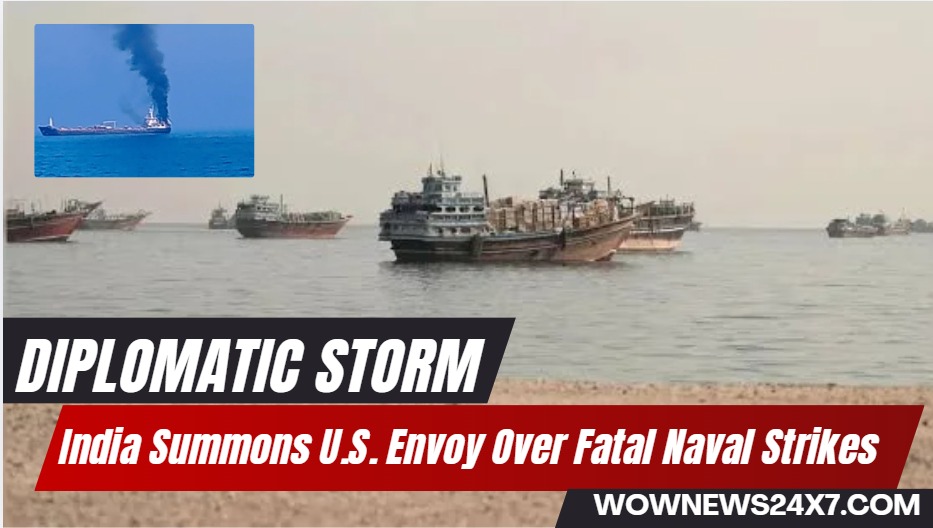
India has summoned the top U.S. diplomat for the second time this week to lodge a strong protest over U.S. naval strikes on merchant vessels in the Gulf of Oman. The attacks have resulted in three Indian deaths, prompting New Delhi to demand an immediate stop to the use of lethal force.
NEW DELHI — The Indian Ministry of External Affairs (MEA) has lodged a formal and strong protest with the United States following a series of naval strikes on commercial vessels in the Gulf of Oman that resulted in the deaths of three Indian nationals. The development marks a significant escalation in diplomatic tensions, as New Delhi publicly condemned the "unacceptable" use of lethal force against civilian shipping in one of the world's most critical maritime corridors.
In an official press release, the MEA stated that U.S. Chargé d’Affaires Jason Meeks was summoned to the Ministry on June 12, 2026, to address the "continuing attacks by U.S. naval forces" on commercial vessels carrying Indian mariners. This follows a separate summons earlier in the week regarding the same issue, as the death toll from the U.S. military’s blockade enforcement operations climbed to three.
Details of the Naval Incidents
According to official reports, the strikes targeted three specific commercial vessels within a four-day span:
M/T Marivex (June 8): The Palau-flagged tanker was disabled by U.S. forces. While the crew was rescued, the vessel was incapacitated by precision munitions.
M/T Settebello (June 10): A second Palau-flagged tanker was struck, resulting in the deaths of three Indian crew members.
M/T Jalveer (June 11): The Guinea-Bissau-flagged tanker was disabled by combat aircraft firing missiles into its engine room.
The U.S. Central Command (CENTCOM) has characterized these actions as necessary measures to enforce a blockade against vessels allegedly violating sanctions and attempting to transit toward Iran. However, India has rejected the justification of these actions when they compromise the safety of civilian crews.
Diplomatic Stance and "Strong Concerns"
During the meeting with the U.S. envoy, Indian officials emphasized that such actions undermine the "safety, security, and stability of international maritime commerce" at a time when the region is already experiencing significant conflict. The MEA reiterated India's demand for free and unimpeded navigation through international waterways, consistent with international law.
"The Ministry once again conveyed its deep concern over the use of lethal and deadly force against civilian shipping," the MEA statement read. "Such actions are unacceptable... the U.S. Chargé d’Affaires was requested to convey India's strong concerns to his authorities and to ensure that U.S. forces operating in the region take all necessary measures to prevent the loss of civilian life."
Impact on Maritime Commerce and Regional Security
The strikes have caused widespread alarm among India’s seafaring community. With more than 18,000 Indian seafarers currently operating in the Gulf region, the potential for further escalation poses a significant risk to both human life and global energy supplies. The Strait of Hormuz remains a critical energy corridor, and India’s firm diplomatic stance reflects the gravity of the situation for its national interests.
Key Facts at a Glance
Casualties: Three Indian nationals confirmed dead following the strike on M/T Settebello.
Diplomatic Action: The U.S. Chargé d’Affaires was summoned twice in one week to register India's formal protest.
Vessels Targeted: Three foreign-flagged tankers (Marivex, Settebello, and Jalveer) carrying Indian crew members were disabled by U.S. naval forces.
Official Position: India maintains that the use of lethal force against civilian vessels is unacceptable and violates the norms of unimpeded international commerce.
Frequently Asked Questions (FAQ)
Why is India protesting these naval actions?
India is protesting because U.S. naval strikes on commercial tankers have led to the deaths of Indian mariners and threaten the safety of civilian shipping in international waters.
What is the U.S. justification for these strikes?
CENTCOM has stated these vessels were "non-compliant" with a blockade and were attempting to transport cargo in violation of sanctions.
How many Indian sailors have been affected?
While many crew members have been rescued, three Indian sailors were killed in the strike on the Settebello, and dozens more were placed at direct risk during the three separate naval engagements.
What is India’s diplomatic goal?
India is demanding an immediate cessation of attacks on civilian shipping and is calling for de-escalation and a diplomatic solution to the ongoing regional conflict.
Source: Ministry of External Affairs (MEA), The Hindu, The New Indian Express