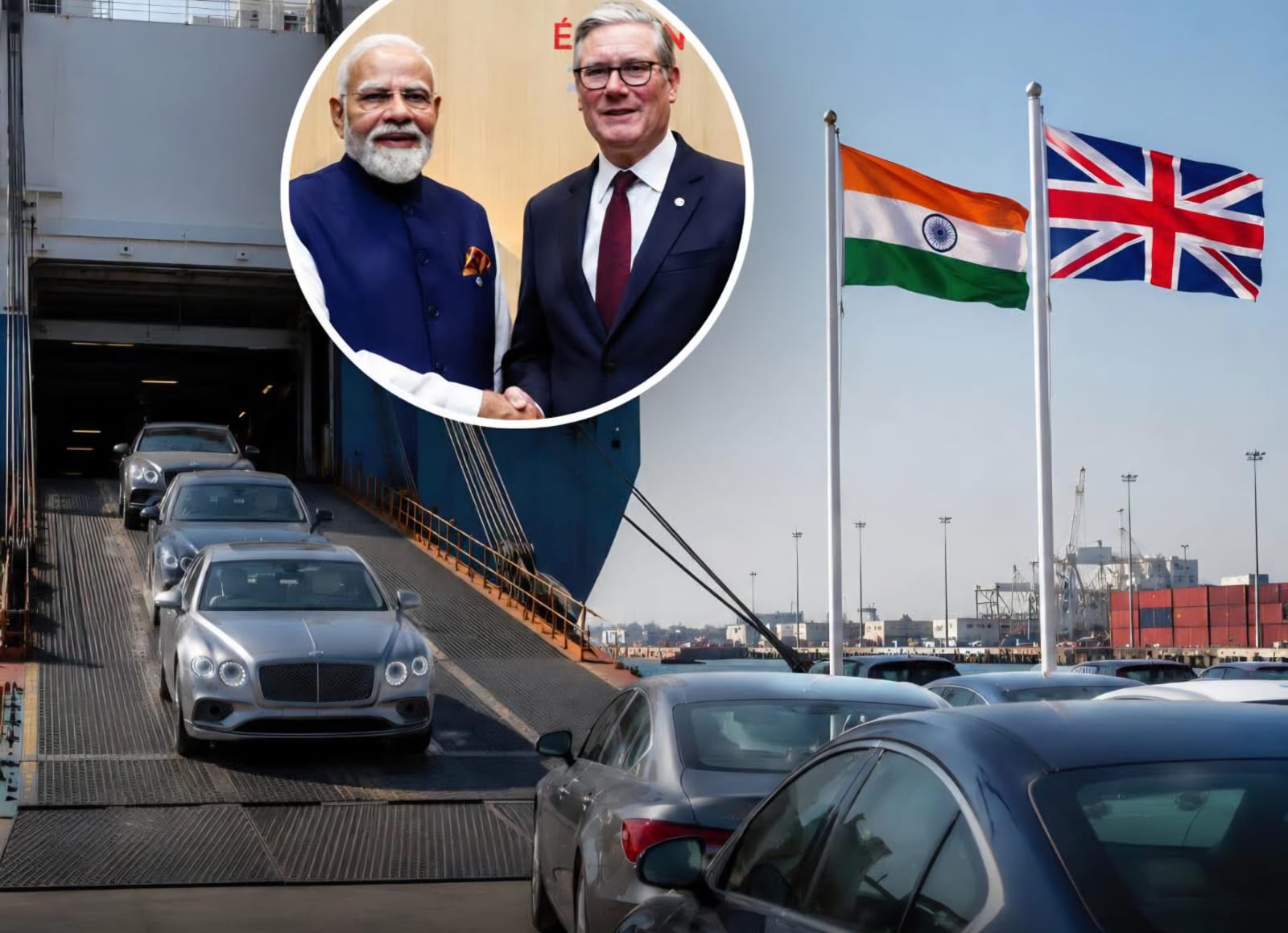
India has officially invited applications for the first phase of its 2026 car import quota under the new India-UK trade pact, with the application window open from July 21 to August 4. The move slashes luxury car tariffs from 110% to 30%, offering massive price relief on premium British imports.
NEW DELHI — The Government of India has officially opened the application window for the first tranche of the 2026 car import quota under the freshly implemented India-UK free trade pact. Announcing the operational guidelines on Monday, July 20, 2026, the Directorate General of Foreign Trade (DGFT) stated that eligible importers can submit applications for Tariff Rate Quota (TRQ) benefits starting July 21 through August 4, 2026. This rapid administrative launch follows the landmark India-UK Comprehensive Economic and Trade Agreement (CETA) entering into force on July 15, 2026.
The regulatory move marks a historic shift in India’s traditionally protective automotive trade posture. By allowing luxury and mass-market British vehicles to enter the domestic grid at substantially lowered customs duties, the allocation process is set to alter the competitive landscape for high-end auto markets and expand choices for affluent consumers.
Detailed Allocations Across Engine and Vehicle Segments
According to the official public notice issued by the commerce ministry's foreign trade arm, the current allocation round covers a total of 9,316 vehicle units for the remaining portion of the calendar year. This allocation is part of an overarching first-year ceiling that permits up to 20,000 completely built units (CBUs) of conventional internal combustion engine passenger cars to enter India under preferential terms.
The DGFT has compartmentalized the available car import quota into specific engine capacities to ensure balanced market access:
Small and Mid-Sized Cars (Up to 1,500 cc): A total volume of 2,329 units has been allocated for this segment. Vehicles cleared under this provision will face a reduced basic customs duty of 50 percent, down from the standard rate of 66 percent.
Medium-Large Engines (1,500 cc to 3,000 cc Petrol / 2,500 cc Diesel): This category similarly receives 2,329 quota units. The customs duties for these vehicles will drop to 50 percent from the baseline 66 percent.
High-Capacity Luxury Vehicles (Above 3,000 cc Petrol / 2,500 cc Diesel): Marking the most substantial single fiscal concession, a quota of 4,658 units has been cleared. Importing companies will see tariffs plummet from a steep 110 percent down to just 30 percent.
Commercial Goods Transporters: Beyond passenger cars, the government has set aside a sub-quota of 1,164 units for completely built cargo vehicles, carrying a duty structure of 37 percent instead of the usual 44 percent.
Strict Eligibility and Verification Safeguards
To prevent speculative trading of import rights, the Ministry of Commerce and Industry has built rigorous verification filters into the application gateway. Under the newly established guidelines, standard third-party trading houses and independent brokers are explicitly barred from applying.
Only Original Equipment Manufacturers (OEMs) with manufacturing footprints in the United Kingdom, or their explicitly authorized local dealers and channel partners inside India, can submit bids for the car import quota. Furthermore, each filed corporate application must be backed by a legally binding pre-purchase agreement issued directly by the British principal manufacturer. This documentation must explicitly detail the exact production volume committed for shipment to the Indian market within the TRQ cycle.
Once approved, all authorizations will be transmitted electronically into the Indian Customs Electronic Data Interchange System (ICES). Physical shipments arriving at domestic maritime ports will be systematically debited against the importer's digital quota ledger only upon presentation of a valid, verifiable United Kingdom Certificate of Origin.
Strategic Market Impact: Luxury Automakers Prepare for Price Adjustments
The financial implications of opening up the car import quota have prompted rapid realignments among top luxury automotive brands operating in India. Premium British marques—including Jaguar Land Rover (JLR), Rolls-Royce Motor Cars, Aston Martin, and McLaren Automotive—stand as the primary beneficiaries of the 30 percent tariff tier.
Industry executives estimate that the dramatic reduction from a 110 percent duty down to 30 percent could trim final retail prices for fully imported flagship models by 20 to 25 percent. On high-end models, these structural cuts could translate to consumer savings ranging between ₹1 crore and ₹3 crore per vehicle.
Conversely, the Indian government has strategically isolated the domestic electric vehicle (EV) sector from immediate foreign competition. Under the CETA framework, British-manufactured electric, hybrid, and hydrogen-powered passenger vehicles will not receive any tariff concessions until the sixth year of the agreement's implementation. This buffer gives local manufacturing programs ample runway to scale operations before lower-duty clean-energy alternatives begin arriving under the car import quota.
Official Sources Section
Regulatory orders, quota submission protocols, and tariff schedules are officially compiled and published via the Directorate General of Foreign Trade and the revenue collection circulars managed by the Central Board of Indirect Taxes and Customs.
Quote Section
"According to officials at the Ministry of Commerce, the electronic administration of the Tariff Rate Quota is designed to maintain absolute transparency, ensuring that only certified manufacturers and genuine channel partners can utilize the duty concessions."
Why It Matters
The rollout of the car import quota marks an important operational milestone in the broader India-UK trade corridors, which saw bilateral volumes hit $25.12 billion in the last fiscal year. For automotive investors and corporate dealerships, the phased reduction of tariffs over 15 years provides predictable pricing structures. For affluent consumers, it introduces near-immediate relief on ultra-luxury purchases, signaling a deeper integration of the Indian consumer market into global luxury supply chains.
Key Facts at a Glance
Application Window: The submission window for the initial round of the 2026 car import quota spans from July 21 to August 4, 2026.
Volume Threshold: The first phase seeks to allocate 9,316 total units out of a capped 20,000-unit first-year limit for conventional engines.
Massive Luxury Cut: Import tariffs for vehicles exceeding 3,000 cc have been sharply reduced from 110 percent to 30 percent.
EV Protection: Green vehicles are excluded from immediate concessions, with alternative fuel tariffs deferred to year six.
FAQ Section
Who can apply for the new car import quota under the trade deal?
Only Original Equipment Manufacturers (OEMs), authorized local dealers, and certified channel partners representing vehicles manufactured in the United Kingdom are eligible to apply.
Are electric vehicles included in this specific round of trade quotas?
No. British-made electric, hybrid, and hydrogen passenger vehicles are excluded from immediate duty cuts and will only become eligible for concessions from the sixth year of the agreement.
How long does the current application window remain open?
According to the official DGFT notification, the online application portal will actively receive submittals from July 21, 2026, until the close of business on August 4, 2026.
Source: Directorate General of Foreign Trade, Ministry of Commerce and Industry.