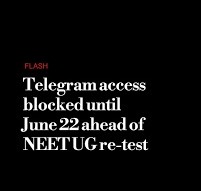
The Government of India has blocked access to Telegram nationwide from June 16 to June 22, 2026, to protect the integrity of the NEET-UG re-examination on June 21. The emergency directive also disables message editing until June 30 to prevent cheating syndicates from fabricating fake paper leak evidence.
NEW DELHI — The Government of India has officially enforced a temporary, nationwide restriction on the instant messaging platform Telegram. Formally enacted on Tuesday, June 16, 2026, the emergency order suspends public access to the platform across all regional telecommunication networks and internet service providers. According to direct administrative notifications, the restriction is strictly bound to a defined, limited period terminating at midnight on Monday, June 22, 2026. The Ministry of Electronics and Information Technology (MeitY) executed the sudden blockade in response to intelligence alerts regarding organized cheating rackets using the encrypted application to coordinate mass fraud and circulate fabricated question paper leaks.
Technical Enforcement and Exam Integrity Mandates
The digital block was requested by central tracking administrators from the National Testing Agency (NTA), the apex statutory body responsible for organizing India's premier educational entrance evaluations. Security personnel discovered that fraudulent entities had created anonymous Telegram channels to extort money from candidates and their families by falsely promising early access to leaked materials for the upcoming NEET-UG 2026 re-examination scheduled for Sunday, June 21, 2026.
In a coordinated effort to stop the spread of panic and protect the testing cycle, the federal government issued a two-pronged directive under the Information Technology Act:
Total Access Suspension: Legally blocking all primary internet domain extensions and app servers tied to Telegram within India from June 16 through June 22, 2026.
Message-Editing Freeze: Instructing Telegram's core developers to fully disable its signature message-editing capabilities across all Indian accounts until Tuesday, June 30, 2026.
The editing restriction is designed to prevent scammers from altering the text of old messages to match real-time event outcomes, a common tactic used to create fake "proof" of an early leak after an exam has already concluded.
Investigative Background and Social Media Crackdown
This emergency block follows weeks of growing scrutiny on anonymous messaging applications. Union Education Minister Dharmendra Pradhan recently chaired high-level briefings with representatives from the Indian Cyber Crime Coordination Centre (I4C) and the Central Bureau of Investigation (CBI) to evaluate digital security blind spots. Investigators found that specialized cheating networks were using automated bots and throwaway phone numbers to distribute spam links to over 150,000 students at once.
While alternative platforms managed by companies like Google and Meta have automated moderation systems to flag and block illegal academic materials within minutes, Telegram’s end-to-end encryption and historically slow response to domestic takedown notices required a temporary, complete service suspension to insulate the testing cycle.
The Safe Harbor Provision: Under Section 79 of India's IT Act, digital intermediaries lose their standard immunity from third-party legal liability if they fail to act immediately on government or court orders to remove illegal content.
Practical Impact on Citizens, Businesses, and Candidates
The sudden seven-day suspension has disrupted operations for millions of legitimate users across India's digital economy. For the estimated 24 lakh students preparing for competitive entrance exams, the block cuts off access to both fraudulent channels and legitimate peer-to-peer study networks and resource groups.
In the business sector, independent digital merchants, software startups, and customer service teams that rely on Telegram channels to distribute daily newsletters or coordinate remote field teams are scrambling to shift their operations to alternative channels like WhatsApp or Signal. Financial analysts track this disruption as a temporary blow to trading groups that use the platform to share stock market analysis, but emphasize that the measure is necessary to preserve public trust in national educational institutions.
Official Sources Section
The operational details, technical directives, and exam schedules cited in this report are sourced from formal public statements published by the National Testing Agency (NTA), official gazette notifications from the Ministry of Electronics and Information Technology (MeitY), and public compliance logs on India's central MyGov innovation portal.
Quote Section
"According to officials from the Ministry of Electronics and Information Technology, while the temporary restriction creates short-term inconveniences for general users, completely blocking the platform's communication lines during this critical tracking window is a necessary step to protect millions of student futures from organized cyber fraud syndicates."
Why It Matters
When central governments temporarily suspend major communication networks to protect high-stakes national exams, it highlights the growing role of encrypted apps in organized crime and corporate espionage. This intervention establishes a key precedent for how sovereign states can balance citizen convenience with the need to protect vital public systems from digital disruption.
Key Facts at a Glance
Restriction Timeline: Access to Telegram is suspended across India from June 16 until June 22, 2026.
Core Driver: The block counters organized cheating syndicates targeting the NEET-UG re-examination on June 21.
Feature Freeze: The application's message-editing feature is disabled nationwide until June 30, 2026, to prevent the fabrication of fake leak evidence.
Enforcing Agency: Directed by MeitY with field support from the Indian Cyber Crime Coordination Centre (I4C) and the CBI.
FAQ Section
1. Is Telegram permanently banned in India?
No. The current directive from MeitY specifies a temporary, limited restriction that is legally scheduled to conclude at midnight on June 22, 2026, following the completion of major national re-examinations.
2. Can I use a VPN to access Telegram during this temporary block?
While Virtual Private Networks (VPNs) can technically route traffic through international servers, using them to bypass a sovereign electronic block to access flagged exam channels can violate national cybersecurity rules and lead to direct legal action under the IT Act.
3. Why was the message-editing feature blocked until June 30?
Cheating networks often edit older posts to add correct exam answers after the test is over, making it appear as though they had leaked the questions beforehand. Freezing the edit feature until June 30 prevents scammers from creating this fake evidence to deceive students.
Source: