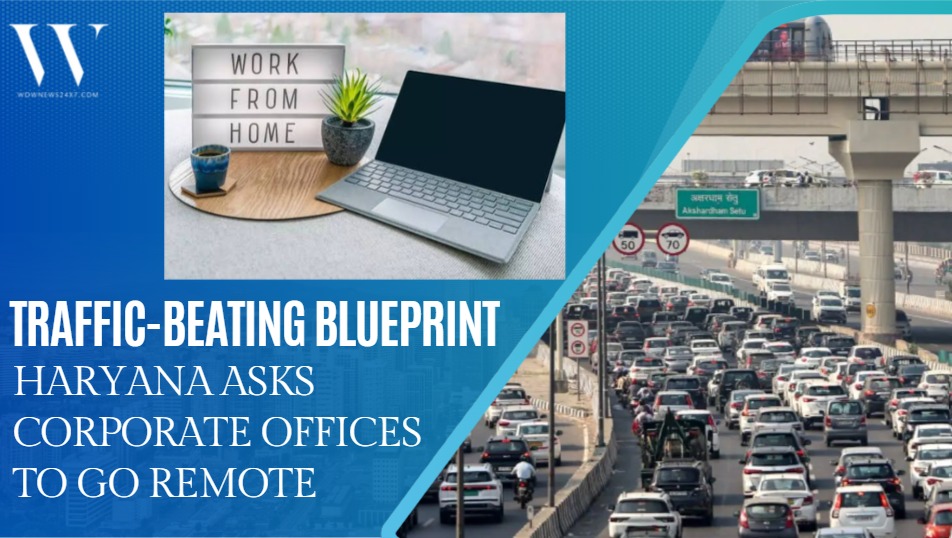
The Haryana government has issued an advisory urging private firms to adopt work-from-home and staggered scheduling to ease traffic and conserve fuel. The move, part of a broader austerity drive effective until September 2026, aims to mitigate the impact of global supply chain disruptions on the state’s economy.
CHANDIGARH — The Haryana government has formally urged private companies and corporate offices across the state to adopt work-from-home (WFH) policies and implement staggered office schedules. This strategic shift, announced mid-June 2026, aims to curb rising fuel consumption and mitigate severe traffic congestion, particularly in major corporate hubs like Gurgaon.
The advisory, spearheaded by the office of the Chief Secretary, follows a series of state-wide austerity measures implemented in response to global supply chain disruptions and escalating fuel prices. By reducing the number of daily commuters on the roads, the state administration intends to conserve energy resources and reduce the economic pressure caused by high import costs.
Promoting Corporate Flexibility
The government has directed its Industries Department to collaborate with major industry bodies, including Nasscom, the Confederation of Indian Industry (CII), and the Federation of Indian Chambers of Commerce and Industry (FICCI), to facilitate this transition. The state’s primary objective is to flatten the intense peak-hour traffic spikes that frequently paralyze the National Capital Region (NCR).
According to officials, the move is a logical extension of policies already mandated for state departments. As of June 2026, government offices have been instructed to slash petroleum-related expenditure by 20% and reduce official vehicle usage by at least 10% monthly. The government is now calling upon the private sector to adopt similar sustainability-driven models, such as hybrid work, to demonstrate shared responsibility in resource management.
Impact on Gurgaon and the Corporate Sector
Gurgaon, home to numerous Fortune 500 companies and leading Indian firms, is expected to feel the most significant impact. With nearly five lakh vehicles entering and exiting the city daily, the government believes that even a modest shift toward remote working could drastically improve air quality and decrease commute times for essential workers.
Corporate leadership has responded with cautious optimism. Industry experts, including Nitin Sahini, President of Foqal Analytics, noted that knowledge-driven sectors have already proven the viability of hybrid work models. "For knowledge-based industries, hybrid working has demonstrated that productivity and client service can be maintained effectively while reducing commuting time and operational costs," Sahini stated, adding that the initiative aligns with global environmental, social, and governance (ESG) goals.
Official Sources and Austerity Measures
The directive is part of a broader sustainability initiative titled "Mera Bharat, Mera Yogdan." According to the official notification issued by Chief Secretary Anurag Rastogi, these measures are mandated to remain in effect until September 2026.
Key state-level austerity mandates include:
A 20% reduction in fuel spending across all government departments.
A ban on the purchase of new internal-combustion-engine vehicles for government use.
A 50% reduction in the size of VVIP convoys.
Mandatory use of video conferencing for at least half of all official meetings.
Why It Matters
This policy shift reflects a growing emphasis on resource conservation in the face of international economic volatility. For employees, the encouragement of remote work offers a potential reprieve from daily gridlock and fuel expenses. For businesses, it serves as a nudge to optimize operational costs and modernize workforce management, while simultaneously contributing to the broader state mandate of reducing the collective carbon footprint of the region’s corporate hubs.
Key Facts at a Glance
Primary Objective: Reduce traffic congestion and fuel consumption amidst global supply chain disruptions.
Target Audience: Private companies and corporate offices, especially in NCR hubs like Gurgaon.
Recommended Strategies: Implementation of work-from-home (WFH) and staggered office timings.
Timeline: Measures are effective immediately and remain in force through September 2026.
Supporting Bodies: Engagement facilitated by Nasscom, CII, and FICCI.
FAQ
Is work-from-home mandatory for private companies?
The current government order is an advisory encouraging companies to adopt remote or hybrid models wherever operationally feasible.
Why is the Haryana government pushing for this now?
The initiative is a response to global economic uncertainties and fuel price volatility in West Asia, aimed at reducing resource consumption.
How will this affect employees?
Employees may experience increased flexibility and reduced commuting time, which can lead to lower personal transport costs and improved work-life balance.
Are there specific restrictions on government vehicles?
Yes, the state has implemented a 20% cut in fuel expenditure, a ban on new fossil-fuel vehicle purchases, and a 50% reduction in VVIP convoy sizes.
Source: Haryana Government - Official Notifications, Nasscom, Confederation of Indian Industry (CII), Federation of Indian Chambers of Commerce and Industry (FICCI)