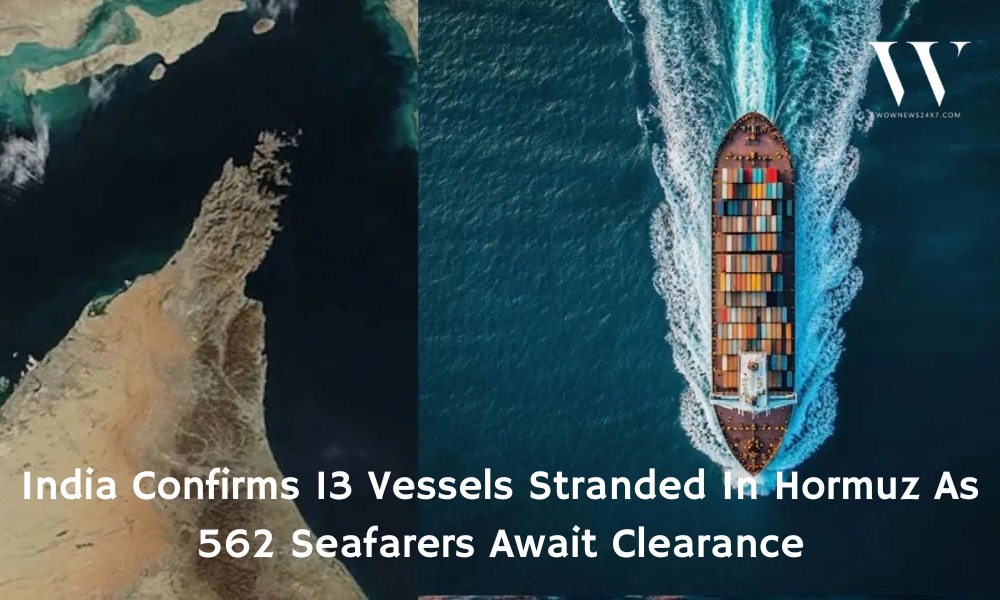
India's Shipping Ministry announced that 13 Indian-flagged commercial vessels, carrying 562 domestic seafarers, are currently stranded in the Strait of Hormuz due to regional conflict. The Directorate General of Shipping is monitoring the situation hourly to safeguard the more than 18,000 Indian maritime professionals working throughout the Gulf.
NEW DELHI, June 11, 2026 — India's Ministry of Ports, Shipping and Waterways confirmed today that 13 Indian-flagged commercial vessels are currently stranded inside the Strait of Hormuz. The ongoing maritime gridlock underscores the widening economic and human impact of escalating West Asia hostilities on global energy supply routes. Shipping Ministry data indicates that more than 18,000 Indian seafarers are active across the wider Gulf region, with 562 crew members directly operating on the Indian-flagged merchant ships awaiting clearance to exit the high-risk corridor.
Strategic Shipping Lane Choked Amid Escalating Regional Conflict
According to an official operational briefing conducted by the Ministry of Ports, Shipping and Waterways, the 13 merchant vessels are safely positioned but unable to secure stable transit routes out of the Persian Gulf. The Strait of Hormuz, a critical 21-mile-wide maritime choke point separating Iran and Oman, accommodates nearly one-fifth of the world's liquid petroleum consumption. Recent military strikes in the region have effectively restricted commercial shipping lines, forcing international logistics firms to anchor heavy tonnage in safer zones west of the strait.
The maritime data confirms that while hundreds of foreign-owned hull numbers remain trapped inside the wider gulf basin, India's primary exposure involves 562 Indian seafarers currently serving on home-flagged bulk carriers, product tankers, and liquefied petroleum gas (LPG) vessels.
Massive Mobilization of Seafarer Logistics and Tracking Controls
To mitigate sudden security changes, the Directorate General of Shipping (DGS) has placed all active regional assets under round-the-clock observation via the Long-Range Identification and Tracking (LRIT) National Data Centre. The tracking network monitors vessel coordinates at hourly intervals, feeding real-time situational reports directly to the Ministry of External Affairs (MEA) and the Indian Navy’s Information Fusion Centre for the Indian Ocean Region (IFC-IOR).
The administrative footprint of Indian maritime professionals in the Middle East includes:
The Wider Gulf Fleet: More than 18,000 Indian seafarers deployed across foreign and domestic merchant ships, harbor tugs, and offshore oil platforms in the Gulf.
Direct Domestic Fleet: 562 Indian seafarers operating on the 13 domestic-flagged vessels caught behind the choke point.
Emergency Infrastructure: Activation of the DGS Quick Response Team to manage dedicated satellite lines connecting stranded mariners to their families in India.
Impact on Domestic Energy Supplies and Commercial Industrial Assets
Industry analysts note that prolonged delays within the Strait of Hormuz carry serious financial implications for Indian energy importers and industrial consumers. India relies on overseas production for roughly 88% of its crude oil and 60% of its domestic LPG requirements.
While state-run refineries have increasingly diversified their bulk procurement toward Russian grades over the past year, several large-scale hydrocarbon shipments originating from the United Arab Emirates and Saudi Arabia are currently anchored inside the zone. Major domestic ports along India's western coastline, including Mundra and Kandla, have already initialized strict Standard Operating Procedures (SOPs) to fast-track any arriving energy cargo via ad-hoc berthing preferences and expedited customs clearance lanes.
Official Sources Section
The maritime figures, crew distributions, and defensive measures detailed in this dispatch are corroborated by institutional updates from central maritime boards:
Government Response and Protective Mandates
In institutional circulars distributed to national shipowners and Recruitment and Placement Service Licensees (RPSL), federal authorities emphasized that crew protection remains the state's highest priority.
"According to officials, all 13 Indian-flagged vessels currently held on the western side of the corridor are structurally sound and heavily supplied with essential provisions," a maritime tracking coordinator stated during the ministry's review. "Organizers stated that mandatory security drills have been intensified across all commercial decks, and vessel masters have been ordered to keep satellite transponders active while staying clear of designated military transit boundaries."
Why It Matters
The disruption of the Strait of Hormuz impacts more than global oil prices; it directly threatens the safety of thousands of specialized mariners who keep global trade moving. For India, a country heavily reliant on imported energy, the stranding of these vessels strains domestic fuel reserves and complicates industrial manufacturing schedules. Furthermore, managing over 18,000 maritime workers in a volatile environment requires careful diplomatic and military coordination to prevent supply chain interruptions from turning into a humanitarian crisis.
Key Facts at a Glance
Stranded Fleet: 13 Indian-flagged merchant vessels are currently blocked inside the Strait of Hormuz sector.
Direct Crew Count: 562 Indian seafarers are on board the restricted domestic vessels.
Total Regional Workforce: More than 18,000 Indian seafarers are active on various commercial vessels across the broader Gulf region.
Oversight Framework: Hourly location updates are managed by the LRIT National Data Centre and the DGS Quick Response Team.
Economic Exposure: Crucial shipments of crude oil and liquefied petroleum gas remain anchored awaiting safe transit windows.
FAQ Section
Q: Why are the 13 Indian-flagged vessels unable to leave the region?
A: Ongoing military strikes and heightened security threats have restricted commercial traffic through the Strait of Hormuz, forcing vessels to anchor in designated safe zones until secure transit lanes open.
Q: Are the 562 seafarers on board the stranded ships safe?
A: Yes. The Ministry of Shipping has verified that all crew members are unharmed, and the ships are well-stocked with food, water, and fuel while under constant electronic surveillance.
Q: How is the Government of India tracking these workers?
A: The Directorate General of Shipping tracks all vessels at hourly intervals using the Long-Range Identification and Tracking (LRIT) satellite network, working closely with the Indian Navy and international maritime centers.
Q: Will this maritime gridlock cause fuel shortages in India?
A: While India imports a significant portion of its oil and gas from the Gulf, major ports have set up priority berthing and expedited customs processes for energy shipments to protect domestic supplies.
Source: Directorate General of Shipping India Portal, Press Information Bureau, Government of India, Ministry of External Affairs Diplomacy Archive