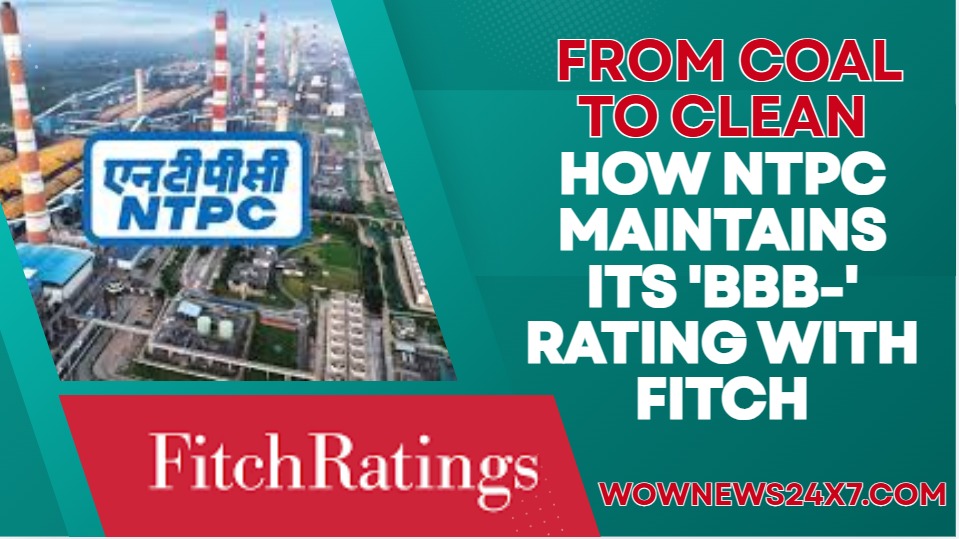
Fitch Ratings has affirmed NTPC Limited’s 'BBB-' credit rating with a stable outlook, citing its stable regulated business model and strategic importance to India's energy sector. Despite high capital expenditure for capacity expansion, the company’s leverage remains manageable, bolstered by a growing renewable energy pipeline and consistent operational performance.
Fitch Ratings has affirmed the Long-Term Foreign- and Local-Currency Issuer Default Ratings (IDRs) of NTPC Limited at 'BBB-' with a Stable Outlook. The agency also maintained the 'BBB-' ratings on the company’s $6 billion medium-term note program and the associated notes issued under that facility.
The decision underscores the financial stability of India's largest power producer, despite the capital-intensive nature of its ongoing expansion. NTPC’s credit profile remains anchored by its dominant market position and its close ties to the Government of India, which retains a 51.1% stake in the entity.
A Regulated Foundation for Stability
According to Fitch’s analysis, the 'BBB-' rating is constrained by the sovereign rating of its majority owner, the Indian government. However, NTPC’s Standalone Credit Profile (SCP) of 'bbb' remains resilient, supported by a highly predictable, regulated business model.
The company operates under a cost-plus framework that allows it to recover costs and earn a regulated return on equity, provided its plants maintain operational availability. This structure effectively insulates NTPC from volatility in fuel prices and fluctuations in short-term power demand. Even in the financial year ended March 2026 (FY26), NTPC reported a 3% increase in EBITDA, demonstrating its ability to maintain earnings stability despite a 1.5% reduction in generation volumes.
Strategic Shift Toward Renewables
While coal remains a significant part of its portfolio, NTPC is actively diversifying its energy mix. The company is aggressively adding solar and wind power capacity, with renewables now accounting for approximately 50% of its current under-construction project pipeline.
Fitch expects that the company’s leverage—measured by EBITDA net leverage—will remain below the 5.0x ceiling required for its SCP. This is largely due to the anticipated commissioning of new assets, which is expected to boost EBITDA and provide sufficient headroom to manage the company's extensive capital expenditure (capex) plans.
Official Sources and Credit Rationale
In its latest rating action commentary, Fitch highlighted that the "regulated power plants have long-term power purchase agreements that allow changes in fuel costs to be passed through." The agency also noted that the company’s working-capital requirements have moderated, aided by more timely payments from state-owned electricity distribution companies (discoms).
Why It Matters
For investors and bondholders, this affirmation provides assurance regarding the credit quality of NTPC’s debt instruments. As the company scales its capacity to meet India's growing electricity needs—with a target of reaching 149GW by 2032—its ability to maintain a 'BBB-' rating is crucial for accessing both domestic and international capital markets at competitive rates. For the broader economy, the stable rating of a company generating roughly 24% of India’s power serves as a foundational element of the country's energy security and infrastructure stability.
Key Facts at a Glance
Rating Affirmed: NTPC’s Long-Term IDRs affirmed at 'BBB-' with a Stable Outlook.
Standalone Strength: The company maintains a Standalone Credit Profile (SCP) of 'bbb'.
Ownership: The Government of India holds a 51.1% stake, influencing the company’s strategic role.
Growth Strategy: Renewables now constitute approximately 50% of the company's under-construction capacity.
Financial Discipline: EBITDA net leverage is expected to remain below the 5.0x ceiling despite high capex.
FAQ
What does the 'BBB-' rating imply?
A 'BBB-' rating indicates that the entity has adequate capacity for payment of financial commitments, though it is somewhat more vulnerable to adverse economic conditions than higher-rated entities.
Why is NTPC's rating linked to the government?
Under Fitch’s Government-Related Entities (GRE) criteria, the rating of an entity with majority state ownership is often constrained by the sovereign credit rating of the government, as the entity is viewed as a strategic vehicle for national policy.
How does NTPC mitigate risks from state power distributors?
NTPC utilizes long-term power purchase agreements and tripartite arrangements—involving the Reserve Bank of India—to ensure timely recovery of dues from state utilities, which significantly reduces counterparty payment risks.
Source: Fitch Ratings, NTPC Limited