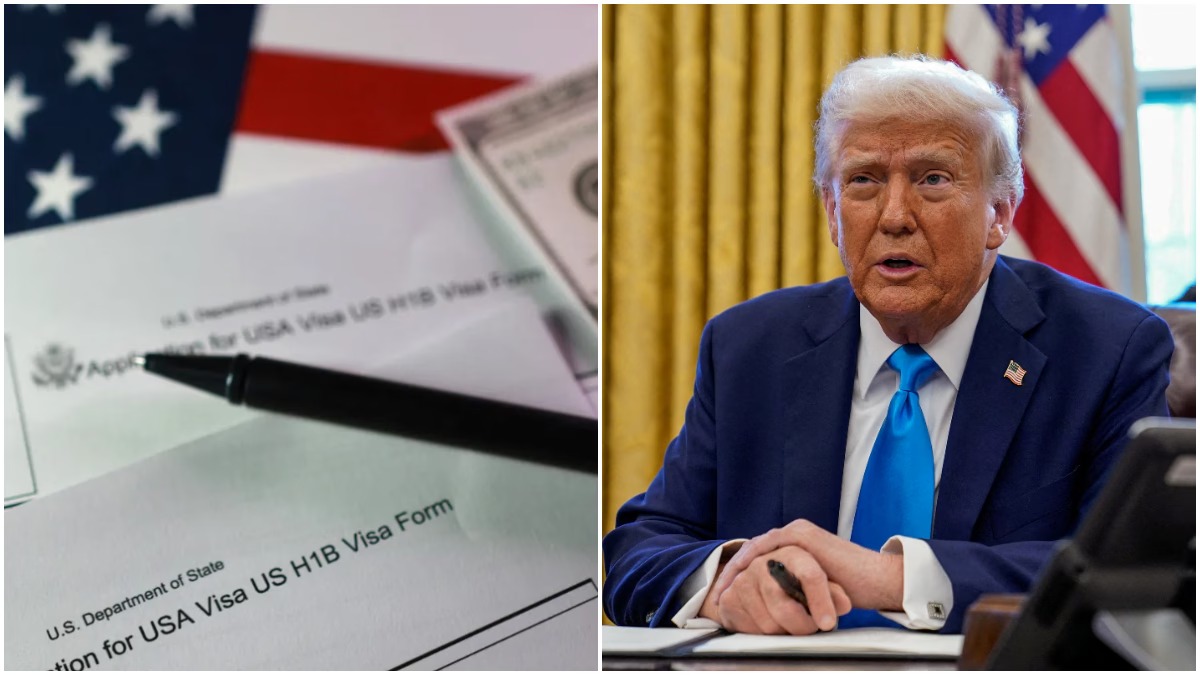
A US federal judge in Boston has struck down President Trump’s $100,000 H-1B visa fee, declaring the surcharge unlawful. The ruling, responding to a lawsuit by 20 states, invalidates the executive order, removing a major financial barrier for US companies, universities, and hospitals recruiting highly skilled foreign professionals.
BOSTON — June 8, 2026 — A United States federal judge on Monday declared that a $100,000 fee imposed by President Donald Trump on new H-1B visas for highly skilled foreign workers is unlawful and must be permanently invalidated. US District Judge Leo Sorokin, presiding in Boston, issued the definitive ruling in a coordinated lawsuit brought by a coalition of 20 Democratic state attorneys general, striking a major blow to the administration’s restrictive economic border policies.
The legal decision effectively halts a highly controversial immigration policy enacted via presidential proclamation in September last year. The mandate had fundamentally transformed the specialized nonimmigrant work category by adding a massive financial requirement, disrupting recruitment operations for American technology firms, higher education institutions, healthcare providers, and scientific research laboratories nationwide.
Legal Rejection of Executive Immigration Overreach
In his written opinion, Judge Sorokin determined that the unilateral imposition of a six-figure surcharge bypassed established legislative boundaries. The administration had previously argued that the President retained sweeping statutory authority under Section 212(f) of the Immigration and Nationality Act (INA) to condition or restrict the entry of noncitizens if their admission was deemed detrimental to domestic interests.
However, the court ruled that utilizing entry conditions to establish a dramatic, non-statutory financial barrier explicitly conflicts with the specialized fee structures already calibrated and capped by the US Congress. Furthermore, the court noted that the administration had entirely bypassed the mandatory public notice-and-comment protocols required under the Administrative Procedure Act (APA), rendering the sudden implementation of the $100,000 fee procedurally invalid.
The policy, since its rollout, had introduced severe operational bottlenecks. Prior to the executive proclamation, standard H-1B filing fees typically scaled between $2,000 and $8,000 depending on corporate headcount. The introduction of a $100,000 surcharge for fresh petitions filed from abroad was heavily criticized by industrial trade groups as an effective ban on early-career global talent, forcing companies to absorb extraordinary placement costs or leave critical technical roles vacant.
Broad Relief for Tech, Healthcare, and Academia
The sudden invalidation of the fee carries immediate operational implications for thousands of American businesses. The H-1B visa program serves as the primary gateway for US corporations to recruit specialized global professionals in fields such as artificial intelligence engineering, cybersecurity, and software design.
The structural impact of the $100,000 penalty was particularly acute within public infrastructure sectors:
Higher Education: Public universities faced catastrophic cost pressures when attempting to sponsor international professors, post-doctoral researchers, and laboratory technicians.
Healthcare Systems: Rural and medically underserved clinics encountered massive recruiting barriers when attempting to retain resident foreign physicians and specialized nurses.
Small Businesses: Capital-constrained startups were completely priced out of the global labor market, shifting software development pipelines to international locations.
According to data recently presented by Department of Homeland Security (DHS) Secretary Markwayne Mullin to a Senate panel, more than 200,000 applicants seeking H-1B visas had navigated the tightened system during the 2026 fiscal year. Monday’s ruling eliminates these compounding financial burdens, allowing corporate accounting teams to reset their hiring projections.
Official Sources Section
The judicial final judgment was processed and filed on the official docket of the United States District Court for the District of Massachusetts on June 8, 2026. The initial multi-state challenge was organized under the leadership of regional offices, including filings coordinated by the Washington State Office of the Attorney General and parallel civil rights coalitions. Operational fee baselines were verified against public archives maintained by U.S. Citizenship and Immigration Services.
Statements From the Court Action
While representatives from the Department of Justice have not yet confirmed whether the federal government will pursue an immediate appellate review, state legal leaders praised the ruling.
"According to officials, the federal government cannot arbitrarily transform a Congressionally mandated visa program into an extortion racket to penalize specific economic sectors," stated Washington Attorney General Nick Brown during a joint press briefing following the decision. "Organizers stated that this definitive court order protects vital domestic industries, keeps our advanced research laboratories open, and ensures that American institutions retain their global competitive edge in critical technological fields."
Why It Matters
The court's decision establishes a critical constitutional check on how far an administration can use executive actions to reshape employment-based immigration. By ruling that a president cannot unilaterally attach arbitrary, multi-thousand-dollar price tags to valid visa categories, the federal judiciary has protected the exclusive authority of Congress to set immigration costs. This brings much-needed regulatory stability back to American businesses, preventing sudden executive mandates from disrupting long-term corporate budgeting, academic research pipelines, and healthcare staffing models.
Key Facts at a Glance
Judicial Action: US District Judge Leo Sorokin has ruled the administration's $100,000 H-1B visa fee unlawful and invalid.
Legal Plaint: The lawsuit was initiated by a coalition of 20 state attorneys general alongside labor and educational associations.
Core Violations: The court found the fee violated the Administrative Procedure Act and conflicted with statutory fee structures set by Congress.
Target Impact: The ruling completely removes a massive financial barrier that applied to newly hired highly skilled foreign professionals located abroad.
Frequently Asked Questions (FAQ)
Who was directly affected by the $100,000 H-1B visa fee?
The $100,000 surcharge primarily targeted employers seeking to hire new H-1B workers from abroad. According to agency guidelines, it did not apply to current H-1B visa holders already working inside the United States, visa extensions, or internal changes of status.
Why did the federal judge declare the fee policy unlawful?
Judge Sorokin ruled that the executive branch overstepped its legal bounds by inventing an extraordinary financial fee that bypassed the specific immigration cost limits established by Congress, while also failing to follow required public notice-and-comment procedures.
Will employers who previously paid the fee receive refunds?
The initial court order invalidates the current enforcement of the fee. Detailed administrative procedures regarding potential corporate refunds or the processing of pending applications will be issued by the Department of Homeland Security in subsequent regulatory updates.
Source: Washington State Office of the Attorney General, U.S. Citizenship and Immigration Services.