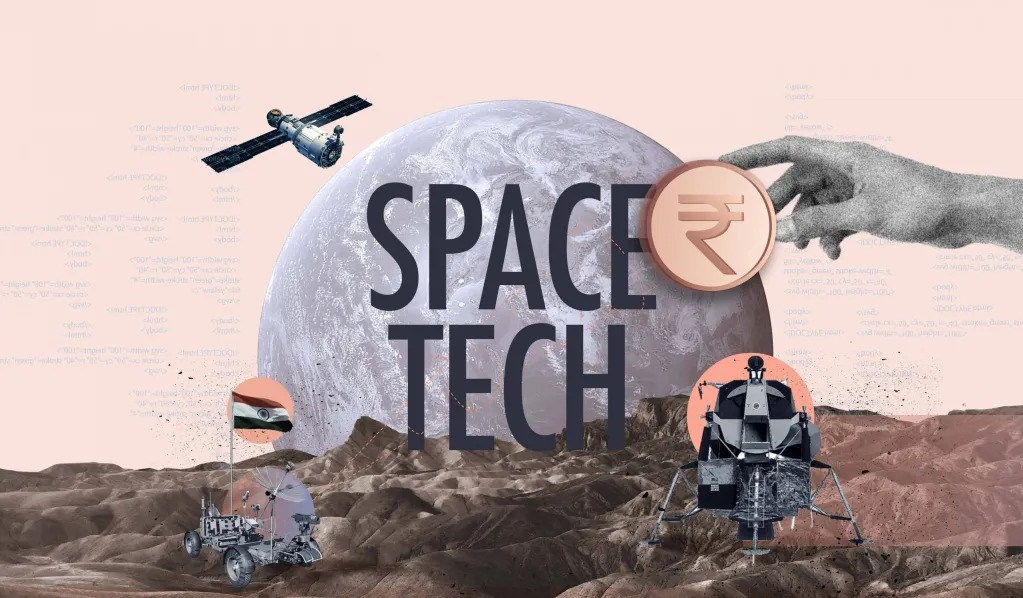
At the India Space Congress 2026, global industry leaders hailed space technology as one of India's core structural strengths. Driven by major deregulation and cost-efficient manufacturing, India's space ecosystem is moving rapidly toward an estimated $44 billion valuation by 2033, powered by more than 300 private space tech startups.
NEW DELHI — International space agency representatives, commercial operators, and policy analysts gathered today at the opening of the India Space Congress (ISC) 2026 to declare that space technology has solidified into one of India’s definitive structural strengths. The three-day convention, running from June 15 to June 17, has drawn over 600 delegates from 25 countries to map out cross-border technological partnerships.
The global industrial consensus aligns with an aggressive domestic expansion strategy. Supported by sweeping regulatory updates that dismantled the state monopoly on orbital infrastructure, India is driving an industrial scale-up to lift its domestic space market valuation from an estimated $13 billion to $44 billion by 2033. Global leaders emphasized that India's dual advantage of extreme cost efficiency and a hyper-scaled deep tech startup ecosystem has transformed the nation from a localized launch option into a primary anchor for the international aerospace supply chain.
Shifting From State Missions to a Privately Capitalized Economy
A major theme during the plenary dialogues was India's deliberate transition from a strictly government-led science program under the Indian Space Research Organisation (ISRO) into a decentralized market ecosystem. Recent policy overhauls executed by the Indian National Space Promotion and Authorisation Centre (IN-SPACe) have permitted private entities to autonomously manufacture launch vehicles, own satellite payloads, and market independent space-based downstream data.
According to metrics reviewed during the congress panels, this policy transition has yielded substantial operational changes:
Startup Acceleration: India’s private space tech landscape has expanded to more than 300 active startups, shifting from building components to ISRO’s exact specifications to filing proprietary intellectual property (IP) for reusable engines and hyperspectral sensors.
Commercial Launch Cadence: Private aerospace corporations are projected to execute 40 to 45 commercial satellite launches annually for international clients by 2030, leveraging domestic infrastructure.
Downstream Data Penetration: Commercial applications in climate monitoring, telecommunications, precision agriculture analytics, and dual-use defense systems are expected to generate over 60% of new revenue within the domestic space economy.
Radical Cost Advantage Solidifies India’s Strategic Position
Global industry delegates pointed out that India's primary competitive advantage remains its ability to design, iterate, and deploy orbital architectures at a fraction of Western capital costs. Historical tracking data shows that domestic launch and deep-space missions operate at 30% to 60% lower costs relative to parallel projects managed by global counterparts.
Structural Engineering Edge: Decades of supply-chain localization by ISRO have established an extremely deep, low-cost vendor base of micro, small, and medium enterprises (MSMEs) capable of precision aerospace manufacturing.
This established industrial base enables rapid scaling for commercial consortia now producing standard launch platforms, like the Polar Satellite Launch Vehicle (PSLV) and Small Satellite Launch Vehicle (SSLV), directly for global commercial consumption.
Official Sources Section
The corporate and strategic assertions delivered at the event were synthesized from formal proceedings organized by the Space Industry Association of India (SIA-India) and co-organized by the Satcom Industry Association. Structural economic projections are synchronized with the "India Spacetech 2026" policy blueprint co-authored by institutional analysts, alongside baseline directives provided via IN-SPACe.
Quote Section
"According to officials presenting at the capital roundtables, India is no longer an emerging participant looking for outsourced subcontracts. Global space captains stated that the depth of engineering talent, combined with institutional legal reforms, means India is uniquely situated to secure a minimum 10% share of the trillion-dollar global space ecosystem over the next decade."
Why It Matters
The global recognition of India’s space technology sector translates into tangible economic advantages for domestic industries, tech consumers, and retail investors. Massive capital inflows into space tech startups generate high-value engineering, avionics, and software development jobs within major tech hubs.
Furthermore, the domestic deployment of heavy commercial satellite constellations will radically lower the costs of high-speed satellite broadband for rural telecommunications, enhance real-time crop intelligence for agricultural businesses, and provide high-fidelity weather modeling to shield national infrastructure from severe climate disruptions.
Key Facts at a Glance
Ambitious Target Set: Global leaders at ISC 2026 backed India's statutory objective to build a $44 billion space economy by 2033.
Massive Cost Reductions: India continues to deliver high-reliability orbital launches at a calculated 30% to 60% lower cost than global alternatives.
Explosive Startup Influx: The nation's private space tech ecosystem now features over 300 highly specialized startups deploying unique intellectual property.
Heavy Launch Trajectory: Private operators plan to manage up to 45 dedicated international commercial satellite launches annually by the end of the decade.
FAQ Section
What is driving the massive growth in India's space technology sector?
The growth is primarily driven by deliberate regulatory deregulation. By establishing IN-SPACe and passing the Indian Space Policy, the government opened up satellite manufacturing, launch vehicle development, and data extraction to private entities, shifting the sector from a closed state program to a commercial market.
How does India manage to launch space missions at a lower cost?
India leverages a highly localized supply chain built over decades, cost-efficient manufacturing clusters, and competitive domestic engineering talent. This infrastructure allows domestic firms to design and test aerospace components for far less than Western firms.
What type of space services will impact common citizens and businesses most?
Downstream services, which rely on satellite imagery and communication signals, will have the biggest impact. These include direct-to-device remote internet connectivity, precision agricultural mapping, real-time disaster management, and hyper-accurate climate monitoring systems.
Source: Space Industry Association of India Official Proceedings, IN-SPACe Regulatory Disclosures, Indian Space Research Organisation (ISRO).