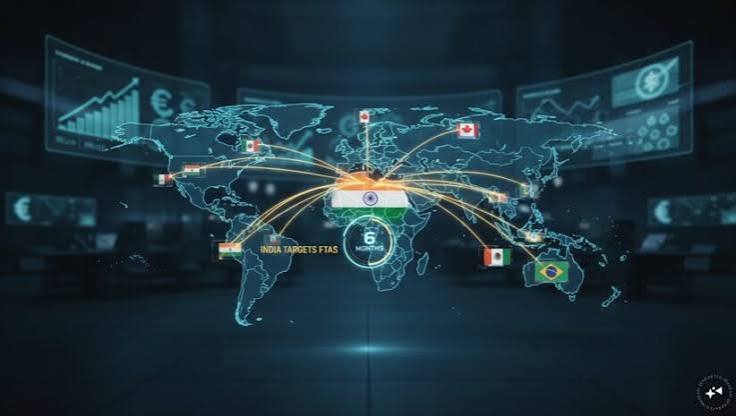
India has initiated an aggressive six-month timeline to finalize Free Trade Agreements with Canada, Mexico, and Brazil. The move aims to diversify export markets and integrate India more deeply into global supply chains, specifically targeting growth in pharmaceutical, energy, and automotive sectors while boosting overall investor confidence in the economy.
NEW DELHI — The Indian government has launched an ambitious initiative to finalize Free Trade Agreements (FTAs) with Canada, Mexico, and Brazil within the next six months. The Ministry of Commerce and Industry announced on Sunday, July 5, 2026, that these negotiations are central to a broader strategy to diversify India’s export portfolio and strengthen strategic economic ties with North and South American markets.
These targeted agreements are designed to reduce tariff barriers, streamline customs procedures, and facilitate deeper investment cooperation. By prioritizing these nations, New Delhi seeks to move beyond its traditional trading partners and capture emerging opportunities in the agricultural, pharmaceutical, and technology service sectors.
Strategic Economic Diversification
The push for FTAs with Canada, Mexico, and Brazil comes at a time when India is actively seeking to integrate more deeply into global value chains. According to internal briefings from the Ministry of Commerce and Industry, officials are currently engaged in intense working-group discussions with representatives from each of the three nations.
The agreement with Canada is expected to focus heavily on critical minerals and energy security, while the proposed pacts with Mexico and Brazil are designed to facilitate greater access for Indian automotive components and pharmaceutical exports. By securing these FTAs, India aims to mitigate risks associated with geopolitical trade volatility and improve the price competitiveness of its manufactured goods in overseas markets.
Strengthening Trade with Latin America
The focus on Brazil and Mexico represents a tactical expansion into the Latin American market, which has historically remained under-penetrated by Indian businesses. Brazil, a key member of the BRICS grouping, offers significant potential for agricultural collaboration and energy partnerships. Meanwhile, Mexico serves as a strategic gateway to the North American market, providing Indian firms with a robust manufacturing base.
Trade economists note that these agreements are not merely about reducing import duties but are foundational to creating an environment that encourages long-term Foreign Direct Investment (FDI). If successful, these FTAs will enable Indian companies to establish deeper regional footprints, reducing logistics costs and improving the turnaround time for exports.
Impact on Domestic Industry and Consumers
For Indian businesses, the successful negotiation of these trade deals would mean a significant reduction in trade barriers, allowing for increased penetration into markets with high consumer demand. Analysts suggest that the agreements will likely favor the services sector, where India holds a global competitive advantage, as well as the manufacturing sector, which is currently benefiting from domestic policy incentives.
For citizens and consumers, the liberalization of trade could lead to a wider availability of international goods and lower costs for essential commodities sourced from these regions. However, the government has emphasized that negotiations will be conducted to ensure that sensitive domestic sectors—particularly in agriculture and small-scale manufacturing—remain adequately protected against import surges.
Official Sources
Quote Section
"According to officials" at the Ministry of Commerce, the timelines for these FTAs are aggressive but realistic, provided that all participating nations maintain their current momentum in negotiations. Organizers stated that the high-level talks are scheduled to continue throughout the summer, with the aim of presenting draft agreements for cabinet approval by the end of the year.
Why It Matters
These agreements are essential for India to sustain its export-led growth strategy. By diversifying its trade partners, India is positioning itself as a more resilient and versatile player in the global economy. For investors, the announcement provides a clear signal that India is committed to an open-trade policy, which is expected to boost investor confidence in India’s manufacturing and service-oriented sectors.
Key Facts at a Glance
Target Timeline: Finalization of FTAs expected within six months (by January 2027).
Target Nations: Canada, Mexico, and Brazil.
Primary Sectors: Pharmaceuticals, agriculture, automotive components, and energy/critical minerals.
Strategic Goal: Diversification of export markets and enhancement of global supply chain integration.
FAQ
Why are these specific countries being prioritized?
Canada, Mexico, and Brazil offer unique opportunities in critical minerals, North American market access, and large-scale agricultural and pharmaceutical trade, respectively.
Will these agreements hurt domestic manufacturers?
The Ministry has stated that negotiations are designed to include robust safeguards to protect sensitive domestic sectors and small-scale industries.
How will this affect the average consumer?
Increased trade can lead to lower costs for imported goods and a more diverse range of international products available in the Indian market.
Source: Ministry of Commerce, DPIIT, WTO