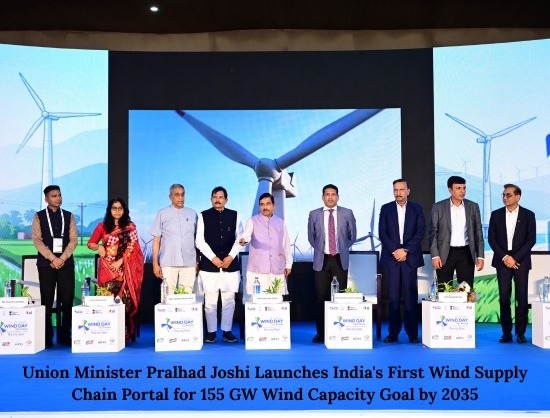
India’s New and Renewable Energy Minister Pralhad Joshi announced that the government is streamlining regulations to replace old, low-capacity wind turbines with modern, high-yield models. The repowering effort targets unlocking India’s estimated 1,164 GW wind potential while accelerating progress toward its 100 GW wind energy target by 2030.
NEW DELHI — Union Minister of New and Renewable Energy Pralhad Joshi confirmed that the Indian government is actively working on streamlined regulations to replace aging, sub-megawatt wind turbines with modern, high-capacity models across high-potential sites.
Speaking on the country’s clean energy trajectory, the minister stated that repowering legacy wind farms many of which occupy prime wind-corridor land in states like Gujarat, Tamil Nadu, and Maharashtra is essential to maximizing energy yields and strengthening grid reliability. The initiative forms a key pillar of India’s strategy to achieve 100 GW of installed wind power capacity by 2030 and 156 GW by 2036.
Overcoming Administrative Hurdles to Unlock 1,164 GW Potential
While the technical framework for replacing older turbines with 3 MW+ models is well established, execution has historically been slowed by complex land aggregation, power purchase agreement (PPA) re-negotiations, and multi-owner site infrastructure disputes.
Minister Joshi noted that many repowering challenges are administrative rather than technological. The Ministry of New and Renewable Energy (MNRE) has engaged industry stakeholders and renewable energy associations to submit operational recommendations to resolve land rights, micro-siting permissions, and evacuation transmission capacity bottlenecks.
Economic and Grid Infrastructure Advantages
Under current repowering guidelines, replacing legacy turbines (typically below 2 MW) with modern high-efficiency units can increase site power generation by 1.5 to 3 times without requiring substantial geographic expansion.
The government estimates that optimizing wind resources could help the national economy save up to ₹2.3 lakh crore in fossil-fuel import costs while providing round-the-clock (RTC) clean power when integrated with solar PV and energy storage systems.
Official Sources Section
Policy directives, regulatory frameworks, and national capacity statistics are issued by the Ministry of New and Renewable Energy (MNRE) and published via the Press Information Bureau (PIB), with project implementation supported by the Solar Energy Corporation of India (SECI) and the National Institute of Wind Energy (NIWE).
Quote Section
"According to officials in statements delivered by Union Minister Pralhad Joshi, the government is working on resolving administrative challenges in the repowering framework to replace aging wind turbines with modern high-yield models, enabling India to accelerate toward its target of 100 GW wind capacity by 2030."
Why It Matters
For Power Developers: Opens investment avenues to upgrade existing wind sites with high-capacity 3 MW+ to 5 MW turbines, expanding output and revenue potential.
For State DISCOMs: Increases clean energy supply from existing transmission interconnections, aiding compliance with Renewable Purchase Obligations (RPOs).
For Clean Energy Investors: Enhances market predictability through streamlined repowering PPAs and improved power grid evacuation access.
Key Facts at a Glance
Policy Scope: Streamlining regulations to replace low-capacity, aging wind turbines with modern high-efficiency units.
2030 Target: Reaffirming India's goal to achieve 100 GW of total installed wind capacity by 2030.
Economic Savings: Expected to save up to ₹2.3 lakh crore through optimized renewable generation.
Nodal Agency: Managed by the Ministry of New and Renewable Energy (MNRE).
Frequently Asked Questions (FAQ)
What is repowering in the context of wind energy?
Repowering involves dismantling older, less efficient, low-capacity wind turbines (often under 2 MW) and replacing them with modern, higher-capacity turbines (3 MW to 5 MW+) to generate more power from the same land site.
Why is repowering important for India's clean energy goals?
Older wind turbines occupy some of the best wind corridors in states like Tamil Nadu and Gujarat. Replacing them with modern units significantly boosts clean power output without requiring new land acquisition.
What is India's current installed wind capacity target?
India aims to reach 100 GW of installed wind capacity by 2030 and 156 GW by 2036, up from approximately 56.09 GW as of mid-2026.
Source: Official press statements and media releases from the Ministry of New and Renewable Energy (MNRE) and the Press Information Bureau (PIB), alongside reporting archived by The New Indian Express and Indian Infrastructure.