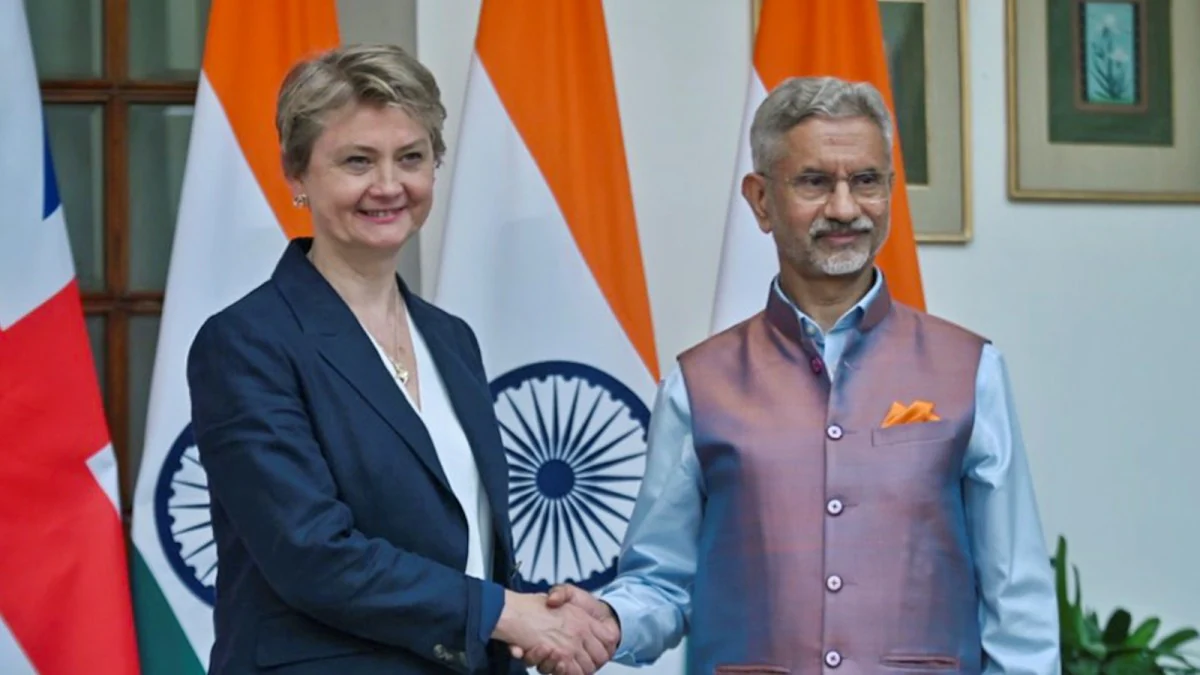
External Affairs Minister S. Jaishankar and British Foreign Secretary Yvette Cooper met in New Delhi to advance the India-U.K. Vision 2035 partnership. Bolstered by a firmed-up comprehensive trade deal (CETA) and new defense roadmaps, the nations launched initiatives in critical mineral supply chains, maritime security, and transnational higher education.
NEW DELHI — External Affairs Minister S. Jaishankar announced that India and the United Kingdom are strongly positioned to construct a new future-oriented and mutually beneficial partnership. Speaking at a high-level bilateral summit in New Delhi on June 4, 2026, alongside visiting British Foreign Secretary Yvette Cooper, Jaishankar emphasized that recent commercial and defense frameworks have fundamentally transformed the geopolitical dynamic between the two nations. This development marks a critical shift today as both major economies move to shield themselves from mounting global macroeconomic shocks, volatile supply chains, and rising maritime security threats across the Indo-Pacific.
Shifting From History to High-Technology
The bilateral discussions served as the first formal annual review of the India-U.K. Vision 2035 roadmap, a strategic blueprint originally established during reciprocal prime ministerial visits last year. According to the Ministry of External Affairs, the recent finalization of the India-U.K. Comprehensive Economic and Trade Agreement (CETA) and the implementation of a 10-year Defence Industrial Partnership have provided a firm foundation for deeper economic and structural cooperation.
Jaishankar noted that bilateral relations have successfully evolved past lingering historical and cultural frameworks. Instead, he characterized the current modern relationship as a forward-looking highway built upon shared economic ambitions, deep technological collaboration, and joint industrial initiatives.
Launch of Critical Minerals and Maritime Centers
To operationalize the updated strategic framework, officials announced two major institutional initiatives intended to protect critical infrastructure and manufacturing sectors:
Critical Minerals Global Supply Chain Observatory (GSCO): Formally inaugurated by Union Minister of Coal and Mines G. Kishan Reddy and Foreign Secretary Cooper, this data-sharing platform aims to secure global supply chains for materials vital to electric mobility, advanced manufacturing, clean energy transitions, and emerging technologies.
Regional Maritime Security Centre of Excellence: Established through a Memorandum of Understanding (MoU) between King's College London and the National Maritime Foundation, this center will focus on building administrative and defensive capacity for Indian Ocean states countering non-traditional maritime threats.
The economic implications are substantial. Long-term projections from the U.K. Foreign, Commonwealth & Development Office indicate that CETA could eventually boost annual bilateral trade by up to £25.5 billion, while expanding the Gross Domestic Product (GDP) of both countries by nearly £5 billion each.
Transnational Higher Education Gains Momentum
The future-oriented partnership is also altering the academic landscape for students and researchers. During the New Delhi summit, officials witnessed the delivery of a formal letter of approval to the University of Liverpool to establish a new international branch campus in Bengaluru.
This move follows earlier campus foundations by the University of Southampton in the Delhi National Capital Region and Queens University Belfast in Gujarat’s GIFT City. British regulatory filings confirm that seven additional British universities have secured approval to open specialized Indian facilities throughout the 2026–27 academic year.
Official Sources Section
The material details outlined in this report are based on official government briefings from the India Ministry of External Affairs, joint statements released by the British High Commission in New Delhi, and formal operational updates from the Ministry of Coal and Mines. The long-term trade value, GDP impact data, and institutional timelines conform to regulatory filings maintained by the U.K. Department for Business and Trade.
Quote Section
"Our relationship has moved from being a historical and perhaps cultural connection to being a forward-looking highway of shared economic ambitions and high technology. We are today well positioned to build a new future-oriented and mutually beneficial partnership. CETA addresses many concerns about creating resilient supply chains and addressing concerns in areas of trade, energy, food and economic security."
S. Jaishankar, India External Affairs Minister
Why It Matters
For everyday consumers, businesses, and investors, this modern alignment directly impacts economic and resource security. Businesses operating within electronics, semiconductor manufacturing, and electric automotive sectors will gain more predictable access to rare-earth metals via the new Critical Minerals Global Supply Chain Observatory.
Concurrently, travelers, professionals, and students will find simplified pathways for cross-border collaboration due to the ongoing Migration and Mobility Partnership and the direct expansion of physical British university campuses inside India, which eliminates the need for expensive overseas relocation.
Key Facts at a Glance
Trade Integration: Powered by the newly finalized Comprehensive Economic and Trade Agreement (CETA), projected to increase bilateral trade by £25.5 billion.
Critical Minerals: Launch of the GSCO observatory to secure supply chains for electric vehicles, green energy, and defense technology.
Maritime Defense: Establishment of a new Regional Maritime Security Centre of Excellence by King's College London and India's National Maritime Foundation.
Higher Education Expansion: University of Liverpool approved for a Bengaluru campus, with seven more U.K. institutions slated to open Indian branches by 2027.
FAQ Section
What is the India-U.K. Vision 2035?
The Vision 2035 roadmap is an expansive bilateral agreement structured across five strategic pillars: economic growth, technology and innovation, defense and security, climate and clean energy, and higher education.
How will the Critical Minerals Global Supply Chain Observatory help businesses?
The observatory provides market intelligence, data tracking, and information-sharing protocols regarding crucial raw materials. This helps manufacturing and technology companies mitigate supply shortages and reduce dependence on singular export markets.
Can Indian students study at U.K. universities without leaving India?
Yes. Under the educational directives of the partnership, prominent institutions like the University of Liverpool, University of Southampton, and Queens University Belfast are opening fully operational branch campuses directly within Indian metropolitan and economic hubs.
Source: India Ministry of External Affairs, U.K. Foreign, Commonwealth & Development Office, Ministry of Coal and Mines