The Ministry of New and Renewable Energy launched operational guidelines for small hydropower projects with a financial outlay of ₹2,585 crore through 2031. Implemented by SECI, the initiative targets 1,500 MW of new capacity, offering maximum subsidies of ₹30 crore for border districts to secure localized clean energy.
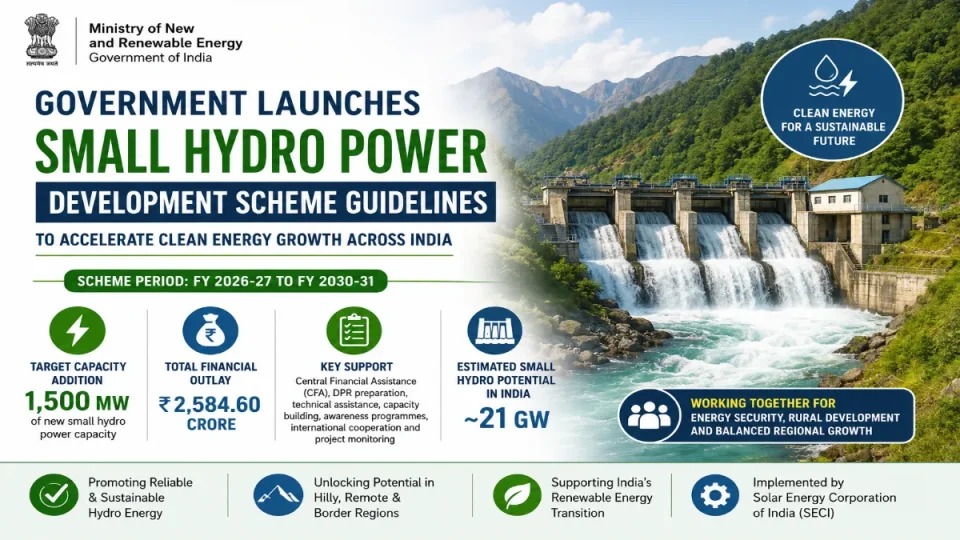
The Ministry of New and Renewable Energy (MNRE) has officially launched operational guidelines for developing small hydropower projects nationwide. Backed by a structural fiscal layout of ₹2,584.60 crore (approximately ₹2,585 crore), this infrastructure scheme aims to unlock 1,500 MW of new, non-fossil generation capacity over the next five fiscal years, running through 2031. The decentralized clean energy deployment targets water-abundant, mountainous landscapes, providing grid stability and balancing regional development across India's remote territories.
Strategic Focus on Remote Border Regions
The freshly minted policy framework clarifies that the Ministry of New and Renewable Energy (MNRE) will classify all water-driven generation facilities up to an individual capacity of 25 MW as small hydropower projects. To guarantee high execution metrics, the Solar Energy Corporation of India Limited (SECI) has been designated as the National Programme Implementing Agency (NPIA). This initiative is structured to leverage approximately ₹15,000 crore in supplementary public and private co-investments to complete the projects.
The financial framework categorizes central assistance baselines to target historically underserved, complex geographic topographies:
North Eastern States and Border Districts: Projects developed in northeastern territories and locations with international borders qualify for the highest financial support. The central subsidy will cover up to ₹3.6 crore per MW, or 30% of total project installation capital, capped strictly at ₹30 crore per project site.
Other Locations and States: Standard projects across remaining states will receive Central Financial Assistance (CFA) up to ₹2.4 crore per MW, or 20% of the aggregate configuration costs, with a maximum financial ceiling of ₹20 crore per independent project.
Eco-Friendly Energy Infrastructure and Local Jobs
Speaking at a national infrastructure workshop, MNRE Secretary Santosh Kumar Sarangi detailed that small-scale hydro systems are mature, sustainable, and reliable. Unlike large-scale reservoir systems, the vast majority of these sub-25 MW generation assets operate on a run-of-the-river model. This engineering approach eliminates massive land acquisition struggles and avoids local civilian displacement by utilizing the natural velocity of river paths or canal drops to spin turbines.
The economic and socioeconomic impact metrics are expected to be substantial. Official projections suggest the initiative will create around 51 lakh person-days of employment throughout the raw engineering and construction phases. Once fully online, the operational network will yield 9,000 permanent technical and maintenance positions, providing localized economic benefits to isolated rural economies. Furthermore, to remove institutional delays, the government announced the launch of a centralized National Online SHP Portal to process approvals, track milestones, and disburse subsidies transparently.
Official Ministerial Keynote
"India's clean energy transition requires diversification of renewable energy sources and greater focus on region-specific solutions. Small hydropower can play a crucial role in strengthening energy security, supporting rural development, and promoting balanced regional growth. While the country's small hydropower potential is estimated at around 21 GW, only a fraction has been harnessed so far."
— Santosh Kumar Sarangi, Secretary, Ministry of New and Renewable Energy
Why It Matters
This deployment addresses key energy delivery challenges. For industrial developers, green technology investors, and heavy equipment manufacturers, the policy provides long-term budget visibility, supported by upfront central capital. For local citizens and businesses in remote and border districts, decentralized small hydro arrays provide clean, stable localized grids. By minimizing transmission losses and lowering dependence on conventional fossil-fuel transport networks, the system secures reliable electricity for vulnerable border economies.
Key Facts at a Glance
Total Budget Outlay: Explicitly set at ₹2,584.60 crore spanning from FY 2026-27 to FY 2030-31.
Target Capacity: Designed to add 1,500 MW of decentralized renewable generation.
Implementation Agency: Managed directly via the Solar Energy Corporation of India Limited (SECI).
Sector Potential: India possesses 21,133 MW of identified potential, with only 5,171 MW developed so far.
Maximum Subsidy: Capped at ₹30 crore per project for the North East and ₹20 crore for other states.
Frequently Asked Questions
What defines a small hydropower project under the new government guidelines?
Under the active policy guidelines of the Ministry of New and Renewable Energy, small hydropower projects are defined as eco-friendly water-to-electricity generation facilities that have an individual installed capacity of up to 25 MW.
How does this scheme support the development of border and northeastern regions?
Recognizing the construction and logistical hurdles of remote terrains, the government provides elevated financial aid of up to 30% of the project cost (capped at ₹30 crore per site) for units built in the North East and international border districts.
Will these small hydro installations cause large-scale environmental displacement?
No. Because these plants primarily use the run-of-the-river design or exploit existing canal drops, they do not require building large, expansive storage dams. This configuration requires minimal land footprint and keeps environmental impact very low.
Source: Official operational framework manuals released by the Ministry of New and Renewable Energy (MNRE), national development reports from the Press Information Bureau (PIB), and project execution presentations from the Solar Energy Corporation of India Limited.