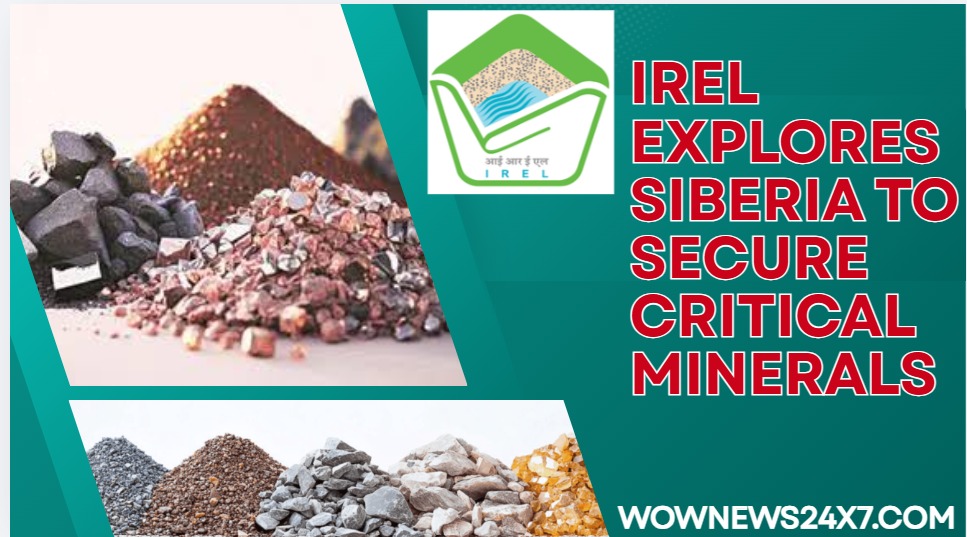
IREL (India) Limited is in preliminary talks to source rare earth samples from the Tomtor deposit in Siberia. As India seeks to reduce reliance on Chinese imports for the heavy rare earth elements essential to its EV and defense sectors, the move marks a strategic step in diversifying its mineral feedstock.
Indian state-owned miner IREL (India) Limited is in preliminary discussions with Russian entities, including those linked to the state-run nuclear sector, to source rare earth mineral samples from the Tomtor deposit in Siberia. The initiative marks a strategic effort by India to secure a diversified supply of heavy rare earth elements (HREEs) required for its burgeoning electric vehicle (EV) and high-tech manufacturing industries.
The interest in Tomtor—one of the world’s most significant high-grade niobium and rare earth deposits—comes as New Delhi looks to reduce its reliance on Chinese-refined materials. According to reports from the "Rare Metals-2026" congress in Moscow, Indian firms are exploring opportunities to participate in the development of Russian mineral bases to bridge the current domestic gap in heavy rare earth supply.
A Strategic Hunt for Heavy Rare Earths
India’s domestic production currently focuses on lighter elements, leaving the country heavily dependent on imports for the "heavy" rare earths—lanthanides ranging from gadolinium to lutetium—that are essential for manufacturing permanent magnets used in EVs and defense equipment.
Sarada Bhushan Mohanty, head of India Rare Earths Limited (IREL), has acknowledged the company’s interest in Tomtor as a potential resource for these critical heavy rare earths. While the dialogue remains in early stages, IREL has signaled a preference for obtaining metallurgical samples to conduct rigorous testing before committing to any formal extraction or offtake agreements.
The Russian Connection: Giredmet and Rosatom
The recent interest is being facilitated through dialogue with Russian institutions such as Giredmet, a research and development subsidiary of the Russian state nuclear corporation Rosatom. Following a directive from the Russian government to accelerate the development of the Tomtor field, Moscow has sought international partners to provide the large-scale investment and technological collaboration necessary to bring the remote Siberian site to full industrial capacity.
"India is short on heavy rare earth elements... Russia has deposits, like the Tomtor deposit, where these elements are abundant," noted Konstantin Ivanovskikh, Deputy Director for Science and Innovation at Giredmet. He confirmed that Russian license holders are actively engaging with Indian industrial players to develop mineral projects within the Tomtor and Angara-Yenisei clusters.
Why It Matters
For India, securing access to rare earth feedstock is a national priority. Under the government's "Self-Reliant India" (Atmanirbhar Bharat) initiative, there is a dedicated push to establish domestic manufacturing of rare earth permanent magnets by 2031. However, the path from sampling to refined supply is complex. Industry analysts warn that while diplomatic and preliminary frameworks—such as those discussed at recent BRICS mining congresses—are vital, establishing the necessary hydrometallurgical infrastructure and separation capabilities within India will take years of coordinated investment.
Key Facts at a Glance
Target Deposit: Tomtor, located in Siberia’s Yakutia region, known for high-grade rare earths and niobium.
Primary Objective: IREL is seeking samples for metallurgical testing to assess the viability of heavy rare earth extraction.
Strategic Need: India requires a secure supply of neodymium and other heavy rare earths to meet its 6,000-tonne annual magnet production target.
Regulatory Status: Discussions are in the preliminary enquiry stage; no binding production or offtake agreements have been signed.
The Russian Link: Collaboration is being explored via Giredmet, a subsidiary of the state-owned nuclear corporation Rosatom.
FAQ
Why is IREL interested in the Tomtor deposit?
Tomtor contains high concentrations of heavy rare earth elements (HREEs) which India currently lacks domestically but requires for defense and EV magnet production.
Are there any finalized agreements between India and Russia on this?
No. At this stage, Indian companies are exploring interests and seeking samples for testing; no binding mining or offtake contracts have been formalized.
How does this fit into India’s wider rare earth strategy?
It is part of a broader "hedging" strategy to reduce dependence on Chinese supply chains by developing multiple independent feedstock pathways, including partnerships in Australia, Canada, and now Russia.
How long would it take to get production from such a project?
Experts suggest that even if exploration and mining agreements are signed, it would realistically take a decade or more to establish the necessary processing infrastructure and achieve refined output.
Source: IREL (India) Limited, Interfax News (Rare Metals-2026), Mining Magazine, Rare Earth Mining Report