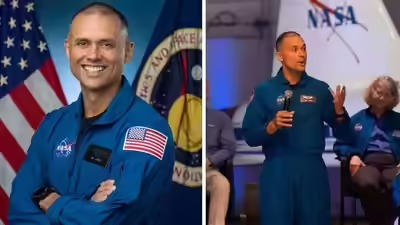
NASA astronaut Anil Menon is scheduled to launch on an eight-month mission to the International Space Station on July 14, 2026, aboard the Soyuz MS-29 spacecraft. The Indian-origin physician and Space Force colonel will conduct vital microgravity experiments focusing on space medicine, artificial intelligence diagnostics, and semiconductor crystal manufacturing.
WASHINGTON — In a major milestone for international space exploration, NASA has finalized launch coverage details for Indian-origin astronaut Anil Menon’s upcoming mission to the International Space Station (ISS). Scheduled to lift off on Tuesday, July 14, 2026, the 49-year-old emergency medicine physician and U.S. Space Force colonel will embark on a comprehensive eight-month mission in low Earth orbit.
Menon will launch aboard the Roscosmos Soyuz MS-29 spacecraft from the Baikonur Cosmodrome in Kazakhstan, traveling alongside cosmonauts Pyotr Dubrov and Anna Kikina. The crew will join the Expedition 74/75 teams, executing advanced technological and biological experiments designed to clear operational pathways for future human exploration missions to the Moon and Mars.
High-Tech Flight Profile and Orbital Convergence
According to the launch manifest published by the National Aeronautics and Space Administration (NASA), the Soyuz MS-29 spacecraft is scheduled to lift off at 10:47 a.m. EDT (7:47 p.m. Baikonur time). Utilizing a rapid two-orbit tracking trajectory, the vehicle will complete a three-hour journey before autonomously docking with the station's Prichal module at 1:56 p.m. EDT.
Once inside the orbital complex, the incoming trio will expand the station's active population, collaborating alongside a diverse international crew comprising NASA astronauts Jessica Meir, Jack Hathaway, and Chris Williams, alongside European Space Agency (ESA) astronaut Sophie Adenot. The prolonged 240-day operational deployment is slated to conclude with a scheduled return to Earth in the spring of 2027.
Advanced Space Medical and Semiconductor Research
The assignment leverages Menon’s unique professional background as a Harvard-trained neurobiologist, Stanford medical doctor, and mechanical engineer. A former NASA flight surgeon and the inaugural medical director for SpaceX, Menon’s orbital research portfolio is heavily focused on addressing critical biomedical barriers encountered during long-duration spaceflight.
The upcoming scientific itinerary involves specific experimental workflows overseen by NASA's Human Research Program:
Microgravity Vascular Dynamics: Menon will serve as a direct test subject to observe how prolonged weightlessness alters human blood flow, vein structures, and blood composition.
Autonomous Medical Systems: Testing augmented reality and artificial intelligence-driven ultrasound procedures to enable deep-space crews to diagnose injuries without real-time guidance from Earth networks.
In-Space Manufacturing: Managing automated crystallization systems to refine the in-space production of high-purity semiconductor crystals, essential for scaling the components powering next-generation AI and computing systems.
Bioprinting and Fluid Synthesis: Testing specialized hardware capable of converting standard potable space station water into medical-grade intravenous fluids, reducing cargo resupply requirements for planetary transit vehicles.
Official Sources Section
Flight operational schedules, crew roles, and communication timelines have been verified through official press declarations from the NASA Headquarters Desk and public notices published by the Roscosmos State Corporation for Space Activities.
Quote Section
"During his stay on the station, Menon will conduct scientific research and technology demonstrations aimed at advancing human space exploration and benefiting life on Earth," NASA officials confirmed in an agency press statement.
"According to training instructors at the Gagarin Cosmodrome, the crew has completed all final baseline survival and automated docking simulations in preparation for the July 14 flight window."
Why It Matters
The research executed during this eight-month ISS deployment delivers practical benefits across both terrestrial healthcare and future commercial space economies. Perfecting autonomous AI diagnostics and on-demand intravenous fluid generation directly enhances emergency medical capabilities inside remote, underserved rural environments on Earth. Simultaneously, validating microgravity semiconductor synthesis provides global technology investors and manufacturers with a clear blueprint for building highly efficient supply chains in low Earth orbit.
Key Facts at a Glance
Launch Date: July 14, 2026, from Baikonur Cosmodrome, Kazakhstan.
Mission Duration: Approximately eight months (240 days) extending into spring 2027.
Spacecraft: Roscosmos Soyuz MS-29.
Core Research: Medical AI diagnostics, vascular aging, and in-space semiconductor manufacturing.
FAQ Section
What is Anil Menon’s background before joining NASA?
Menon is a U.S. Space Force colonel and emergency medicine physician who previously served as a military frontline surgeon in Afghanistan, a rescue doctor on Mount Everest, and the first chief flight surgeon at SpaceX.
Who are the other crew members flying on this mission?
Menon will travel alongside veteran Russian cosmonauts Pyotr Dubrov and Anna Kikina. Interestingly, Menon’s wife, Anna Menon, is also an astronaut who flew on the private SpaceX Polaris Dawn mission in 2024.
What specific technology is being tested for deep-space flights?
The crew will test methods for bioprinting vascular tissue structures and producing medical IV fluids directly from the station’s recycled drinking water supply, eliminating reliance on terrestrial resupply runs.
Source: Official Mission Press Release, National Aeronautics and Space Administration (NASA) and Flight Manifests via the International Space Station Research Office.