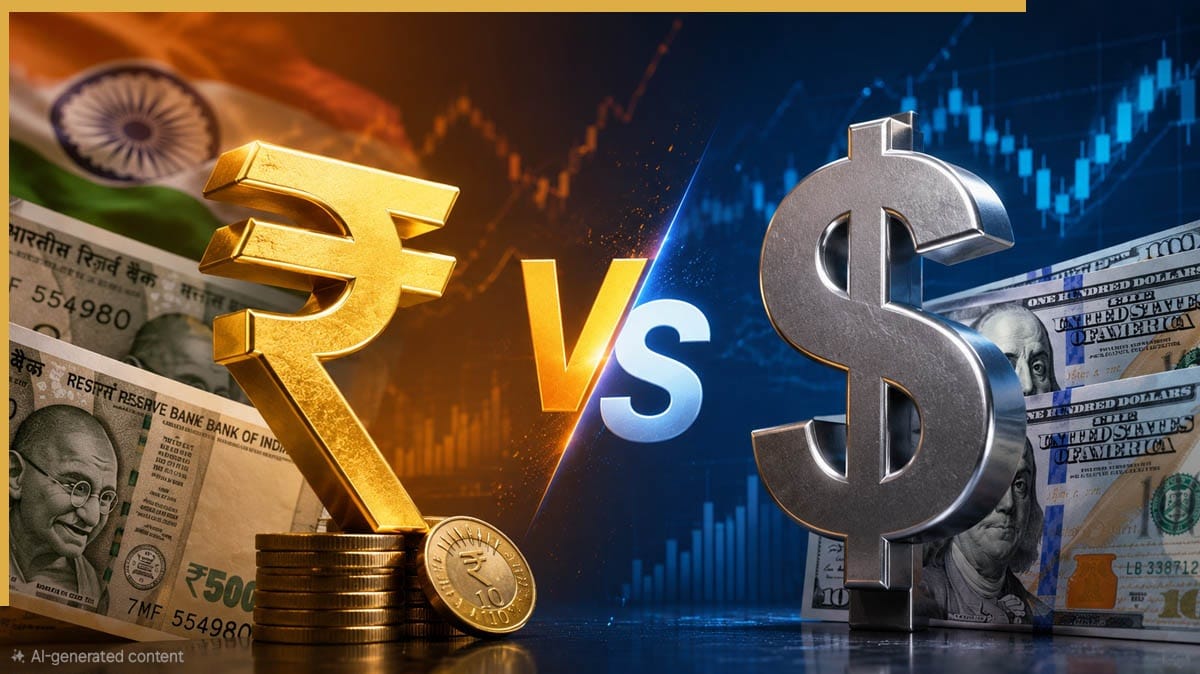
The Indian rupee opened down 0.06 percent at 95.6625 against the U.S. dollar on Tuesday, August 18, 2026, following a previous close of 95.6025 per dollar. Interbank currency movements reflected dollar strength and importer demand, while central bank monitoring maintained overall foreign exchange orderliness.
MUMBAI — The Indian rupee opened lower against the U.S. dollar on Tuesday, August 18, 2026, dipping 0.06 percent to trade at 95.6625 per dollar in early interbank foreign exchange transactions.
The domestic currency had closed at 95.6025 per dollar in the previous session, according to trading data from the Reserve Bank of India and interbank currency desks. Market participants attributed the opening depreciation to slight gains in the U.S. dollar index and routine foreign capital adjustments by institutional investors.
Interbank Exchange Rates and Opening Performance
The Indian rupee opened lower during morning trade as currency markets processed overnight economic indicators and regional currency trends across Asian trading hubs.
According to interbank exchange logs, early trading levels reflected tight range-bound activity:
Opening Level: The Indian rupee opened at 95.6625 per U.S. dollar, down 0.06 percent from the prior trading day.
Previous Closing Level: The Indian rupee concluded the preceding session at 95.6025 per U.S. dollar.
Net Change: A decline of 0.0600 rupees (6 paise) against the greenback at market open.
Domestic interbank trading desks reported balanced dollar demand from import aggregators alongside routine corporate hedging activities.
Economic Factors and Market Implications
The opening exchange rate performance reflects ongoing interactions between foreign portfolio flows, crude oil import obligations, and central bank intervention benchmarks.
Currency market analysts highlight several key operational dynamics governing short-term movements:
Import and Export Dynamics: A softer Indian rupee modestly raises landed costs for crude oil, electronics, and imported raw materials, while providing nominal margin relief to exporters in IT services, textiles, and pharmaceuticals.
Capital Outflows and Inflows: Foreign institutional investors (FIIs) continuously recalibrate debt and equity portfolio allocations based on relative U.S. treasury yield premiums and domestic growth projections.
Central Bank Operations: The Reserve Bank of India frequently operates across spot, forward, and non-deliverable forward (NDF) platforms to mitigate excess exchange rate volatility and smooth erratic market swings.
Official Sources Section
Exchange rate disclosures and interbank currency statistics cited in this report originate directly from official market announcements published by the Reserve Bank of India and public financial filings monitored by the Ministry of Finance.
Quote Section
According to official interbank market trading logs:
"The Indian rupee opened down 0.06% at 95.6625 per U.S. dollar, compared to its previous close of 95.6025 per dollar."
Why It Matters
The relative stability of the Indian rupee directly impacts corporate import costs, international trade balances, and inflation management. A minor shift in the exchange rate influences short-term cross-border transaction pricing for domestic businesses, overseas travel expenses for citizens, and asset valuation metrics for international investors holding Indian financial instruments.
Key Facts at a Glance
Opening Exchange Rate: The Indian rupee opened at 95.6625 per U.S. dollar on August 18, 2026.
Previous Close: The currency closed at 95.6025 per U.S. dollar in the previous trading session.
Percentage Variation: A decrease of 0.06 percent (6 paise) in early interbank trade.
Primary Regulatory Authority: Reserve Bank of India (RBI).
Frequently Asked Questions
What was the opening exchange rate for the Indian rupee today?
The Indian rupee opened at 95.6625 per U.S. dollar on Tuesday, August 18, 2026.
How much did the Indian rupee change from the previous close?
The Indian rupee fell 0.06 percent (6 paise) from its previous close of 95.6025 per U.S. dollar.
Who oversees foreign exchange policy and operations in India?
The Reserve Bank of India (RBI) manages foreign exchange operations, maintaining monetary stability under the Foreign Exchange Management Act (FEMA).
How does a change in the U.S. dollar rate affect consumers?
A depreciation of the Indian rupee can increase the domestic cost of imported commodities like crude oil and electronics, while making foreign travel and international education more expensive.
Source: Reserve Bank of India | Ministry of Finance