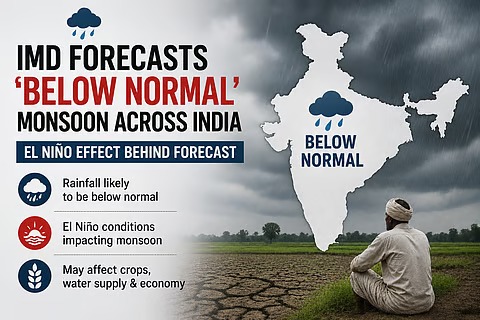
India's 2026 monsoon season is navigating the shadow of a developing El Niño, with the IMD projecting neutral Indian Ocean Dipole conditions to persist. With rainfall likely to hit 90-92% of the long-period average, the outlook signals potential challenges for agriculture and water management across the nation throughout the coming months.
NEW DELHI — The India Meteorological Department (IMD) has indicated that neutral Indian Ocean Dipole (IOD) conditions are expected to persist throughout the ongoing June-September southwest monsoon season. This forecast, coupled with the emerging influence of El Niño in the equatorial Pacific, has prompted officials to monitor potential impacts on national agricultural output and water security.
While some global climate models have suggested the possibility of a positive IOD—a phenomenon often associated with improved rainfall in India—the IMD’s current assessments remain cautious, projecting neutral conditions that may offer limited relief against the broader drying influence of El Niño.
Understanding the Climate Drivers
The Indian Ocean Dipole refers to the differential in sea surface temperatures between the western and eastern sections of the Indian Ocean. A positive IOD is typically characterized by warmer waters near the African coast and cooler waters near Indonesia, a configuration that historically enhances moisture-bearing winds toward the Indian subcontinent.
Conversely, El Niño, which is currently developing in the Pacific, is historically linked to suppressed monsoon rainfall and elevated temperatures. Meteorologists note that the interplay between these two massive climate drivers is critical for the 2026 season. According to officials, while a positive IOD could theoretically counteract some of the moisture-depleting effects of El Niño, the current forecast for neutral IOD conditions means this "cushioning" effect may not materialize as hoped.
Impact on Monsoon Progression
The 2026 southwest monsoon reached Kerala on June 4, slightly behind the historical average. The IMD has projected that seasonal rainfall for the country as a whole is likely to be approximately 90% to 92% of the Long Period Average (LPA).
The persistence of neutral IOD conditions implies that the monsoon's performance will remain highly sensitive to regional atmospheric changes. Experts warn that a weaker-than-normal monsoon could have direct implications for:
Agriculture: Farmers in rain-fed regions face increased risks regarding crop yields, particularly for Kharif season staples.
Water Reservoirs: Sustained dry spells could impact the filling levels of critical irrigation and hydropower reservoirs.
Energy Demand: Elevated temperatures and reduced rainfall often lead to higher electricity demand for cooling, putting further pressure on power grids.
Official Outlook and Precautions
According to official reports released by the Ministry of Earth Sciences, the IMD is utilizing a multi-model ensemble (MME) to track the progression of the monsoon. The department has emphasized that while neutral IOD conditions currently prevail, weather patterns can remain volatile, and contingency planning for water management is advised.
"Organizers stated that the forecast is based on dynamical and statistical models which currently show a higher probability for below-normal rainfall across most of the country," a recent bulletin noted. Disaster management agencies have been encouraged to prepare for the dual risks of localized water scarcity and sudden, intense rainfall episodes, which can occur even during deficient monsoon years.
Why It Matters
For citizens, consumers, and investors, the "neutral" designation for the IOD removes a key variable that might have otherwise mitigated the risks of the developing El Niño. With the Indian economy’s reliance on the monsoon—often termed the "real Finance Minister of India"—the potential for a below-normal season necessitates proactive agricultural and economic strategies to manage potential food inflation and supply chain disruptions.
Key Facts at a Glance
Monsoon Forecast: Seasonal rainfall is projected at 90-92% of the Long Period Average (LPA).
IOD Status: Neutral Indian Ocean Dipole conditions are expected to persist through the end of the September season.
El Niño Shadow: The developing El Niño in the Pacific remains the primary driver of concern for lower-than-average precipitation.
Regional Variation: While most of the country faces a drier outlook, Northeast India and specific coastal pockets may experience varied rainfall patterns.
Frequently Asked Questions (FAQ)
What is the significance of "neutral" IOD conditions?
Neutral IOD means there is no significant temperature gradient between the eastern and western Indian Ocean to provide a "bonus" boost to monsoon rainfall, leaving the country more susceptible to the drying influence of El Niño.
How does El Niño affect the Indian monsoon?
El Niño typically involves the warming of the equatorial Pacific, which alters global wind patterns, often weakening the moisture-laden winds that reach India, leading to lower rainfall.
When does the monsoon season end?
The southwest monsoon season in India officially spans from June 1 to September 30.
Where can I track daily monsoon progress?
Real-time updates, maps, and sub-divisional reports are available via the official IMD Monsoon Portal.
Source: India Meteorological Department (IMD), Ministry of Earth Sciences, Press Information Bureau