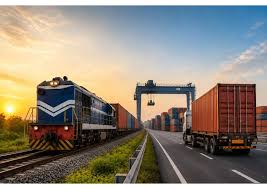
While India's freight shift toward rail is accelerating with the expansion of dedicated corridors and multi-modal terminals, moving a greater share of cargo off highways remains a vital challenge. Achieving the national 2030 modal targets requires overcoming persistent last-mile and terminal integration gaps.
NEW DELHI — India’s freight ecosystem is experiencing a notable transformation, driven by massive capital investments, multi-tracking initiatives, and the rapid expansion of dedicated rail networks. However, experts note that achieving a comprehensive modal shift—moving millions of tonnes of cargo from congested highways onto the national railway grid—remains a complex economic and structural challenge.
While Indian Railways has posted record-breaking cargo volumes—handling over 1,670 million tonnes in recent fiscal periods—road transport continues to command roughly 70 percent of the nation's freight movement. Policymakers and industry leaders emphasize that closing this gap is vital to lowering national logistics costs, reducing carbon emissions, and boosting the global competitiveness of Indian manufacturing.
Infrastructure Expansion and Network Modernization
The ongoing transition is anchored by the rollout of Dedicated Freight Corridors (DFCs), which separate freight movement from high-density passenger lines. Major arteries, including the Eastern and Western DFCs, now handle hundreds of freight trains daily, enabling faster transit times, double-stack container operations, and heavier payload capacities.
Complementing these physical corridors, the government’s PM Gati Shakti framework has accelerated the development of Gati Shakti Multi-Modal Cargo Terminals (GCTs). Designed to encourage private sector participation, these terminals bridge the first- and last-mile connectivity gaps that have traditionally hindered rail freight adoption.
According to official ministry announcements, transport logistics reports, and infrastructure disclosures:
Modal Disparity: Road transport handles approximately 70% of national freight, while rail accounts for roughly 25% to 27%.
Strategic Targets: National logistics frameworks aim to elevate the railway's freight modal share toward 45% by 2030.
Corridor Growth: The Eastern and Western Dedicated Freight Corridors now manage an average of over 443 freight movements daily.
Private Integration: Scores of Gati Shakti Multi-Modal Cargo Terminals have become operational, backed by billions in private capital injections.
Official Sources Section
Ministry of Railways, Government of India: Official network performance updates, freight loading statistics, and infrastructure expansion whitepapers.
Dedicated Freight Corridor Corporation of India (DFCCIL): Operational status reports, corridor mapping, and engineering milestone disclosures.
National Logistics Portal (Logistics Division): Policy frameworks, National Master Plan updates, and cost-reduction metrics under the National Logistics Policy.
Quote Section
According to statements released by logistics industry analysts regarding the ongoing transition of freight corridors:
"The structural shift toward rail is gathering momentum along major industrial corridors, but unlocking the full potential of multi-modal logistics requires deeper terminal integration, flexible pricing, and seamless last-mile connectivity for non-bulk commodities."
Why It Matters
For manufacturers, consumers, and commercial enterprises, reducing logistics expenditures—which have historically remained higher in India than in many developed economies—directly enhances product pricing and export viability. Furthermore, shifting high-volume freight from fossil-fuel-powered trucks to electrified rail networks plays a pivotal role in meeting national carbon reduction targets.
Key Facts at a Glance
Current Rail Share: Approximately 25% to 27% of national freight.
Cost Advantage: Rail transport typically offers lower per-tonne-kilometer operational costs compared to road transit.
Strategic Goal: Reaching a 45% modal share target by 2030.
Primary Catalyst: Integration of Dedicated Freight Corridors and private cargo terminals.
FAQ Section
Why does road transport still dominate India's freight market?
Road transport continues to lead due to flexible door-to-door connectivity, faster turnaround times over short distances, and fewer operational constraints compared to legacy rail networks.
What is the primary objective of India's Dedicated Freight Corridors?
The corridors are built exclusively for freight trains to ease congestion on mixed passenger lines, allow heavier loads, and drastically improve average transit speeds.
What modal share target has been set for Indian Railways?
National planning frameworks aim to increase the railway freight modal share to 45% by 2030.
Where can stakeholders track official updates on freight corridor developments?
Progress reports and network maps are published directly through the DFCCIL Portal and Ministry of Railways updates.
Source: Ministry of Railways, DFCCIL, National Logistics Policy Portal, KPMG Logistics Insights