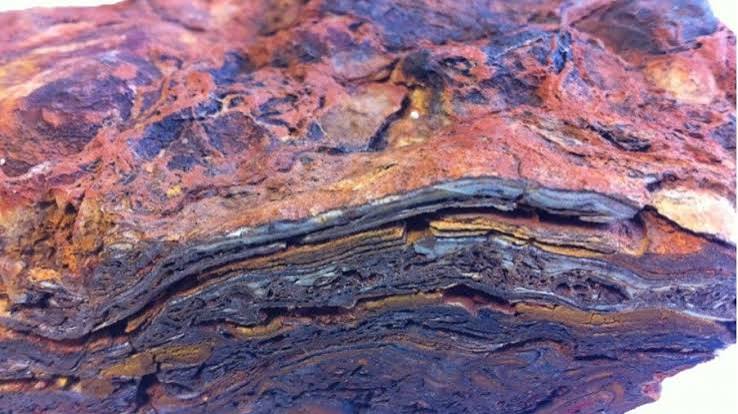
Geologists have directly dated a 3.5-billion-year-old carbon-rich chert from eastern India's Singhbhum Craton, uncovering pristine chemical traces of early microbial life. The finding provides robust, directly linked evidence that resilient microbial ecosystems thrived in volcanic, iron-rich oceans remarkably early in Earth's history.
NEW DELHI / JAMSHEDPUR — A scientific team led by researchers from the Geological Survey of India has uncovered compelling chemical evidence of ancient microbial life preserved within a 3.5-billion-year-old rock formation.
The specimen, a carbonaceous chert collected near Bhitardari village in the Singhbhum Craton of Jharkhand, offers unprecedented insight into the primordial biosphere. Published in the Proceedings of the National Academy of Sciences (PNAS), the breakthrough is uniquely significant because researchers were able to directly date the exact biological material using embedded volcanic zircon crystals, bypassing ambiguities that have long surrounded similar ancient finds.
Direct Dating and Chemical Signatures of Early Life
Unlike previous discoveries in Greenland, South Africa, or Western Australia—where ages were often estimated based on surrounding strata—the Singhbhum sample yielded precise radiometric metrics. Uranium-lead dating of needle-like zircon crystals trapped within the silica layers placed the rock's formation at approximately 3.497 billion years ago.
Using Raman spectroscopy and carbon isotope analysis, the research team examined alternating bands of dark, carbon-rich material and pale silica. The material displayed a strong depletion in carbon-13 relative to carbon-12, matching isotopic signatures left behind when living organisms fix carbon dioxide.
According to official study disclosures and geological reports:
Location: Bhitardari village, Singhbhum Craton, Jharkhand, India.
Age Determination: 3.497 billion years (±5 million years) via uranium-lead zircon dating.
Biological Indicator: Carbon isotope ratios characteristic of microbial carbon fixation.
Environment: Ancient marine settings influenced by active underwater volcanism, hydrothermal activity, and iron-rich waters.
Official Sources Section
Quote Section
According to statements released by study co-author Trisrota Chaudhury of the Geological Survey of India regarding the implications of the discovery:
"What we find most remarkable is that our study confirms primitive life thrived in a chemically extreme world 3.5 billion years ago. These microorganisms lived alongside active volcanism, in an ocean rich in iron and silica, proving that microbial ecosystems were already occupying dynamic environments remarkably early in Earth's history."
Why It Matters
For evolutionary biologists, geologists, and planetary scientists, establishing a direct link between ancient organic carbon and precise radiometric dates transforms our understanding of early Earth. The findings demonstrate that complex metabolic pathways and resilient microbial mats were active roughly 1.1 billion years after planet formation, proving that life adapted rapidly to harsh, volatile primordial conditions.
Key Facts at a Glance
Primary Material: Carbonaceous chert with layered microbial mat remnants.
Geological Setting: Singhbhum Craton, one of Earth's oldest surviving crustal blocks.
Analytical Techniques: Raman spectroscopy and uranium-lead mass spectrometry.
Significance: The oldest directly dated rock featuring robust chemical biosignatures.
FAQ Section
Why is this 3.5-billion-year-old rock considered unique by scientists?
Unlike older or contemporary discoveries where rock ages were inferred from surrounding layers, this specimen allowed researchers to directly date the carbon-bearing material using embedded zircon crystals.
What evidence points to the presence of life in the Bhitardari chert?
Isotopic analysis revealed a strong depletion of carbon-13 relative to carbon-12, mirroring the chemical patterns produced when living organisms fix carbon dioxide.
What kind of environment did these ancient microorganisms inhabit?
The microbes thrived in a volatile marine setting characterized by underwater hydrothermal vents, active volcanism, and silica-rich waters.
Where can researchers review the complete scientific study?
The official paper is published and accessible through the Proceedings of the National Academy of Sciences Portal.
Source: PNAS, Geological Survey of India, PIB India, ScienceAlert