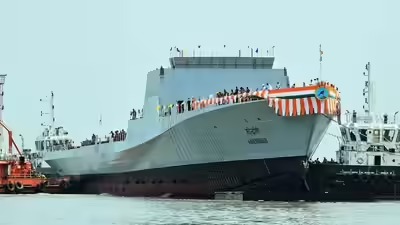
The Indian Navy has simultaneously commissioned three indigenously built warships INS Dunagiri, INS Sanshodhak, and INS Agray at the Syama Prasad Mookerjee Port in Kolkata. Built by GRSE with over 75% local components, the multi-role platforms provide distinct deep-sea, littoral anti-submarine, and hydrographic survey capabilities, solidifying India's maritime self-reliance.
KOLKATA, India — Prime Minister Narendra Modi officially commissioned three advanced, domestically manufactured naval vessels during a historic tri-commissioning ceremony at the Syama Prasad Mookerjee Port in Kolkata on June 21, 2026. The simultaneous induction of the stealth frigate INS Dunagiri, the large hydrographic survey vessel INS Sanshodhak, and the anti-submarine warfare shallow-water craft INS Agray represents a strategic milestone. This development ensures India's three new naval ships boost maritime firepower across the Indian Ocean Region (IOR) at a time of escalating geopolitical vulnerabilities and maritime trade disruptions.
Strategic Capabilities of the New Naval Platforms
The synchronized commissioning by the public sector undertaking Garden Reach Shipbuilders & Engineers (GRSE) provides the Indian Navy with three distinct, cutting-edge tactical capabilities deployed from a singular manufacturing pipeline. According to data released by the Ministry of Defence, each vessel is designed to counter specific threats in diverse operational environments:
INS Dunagiri (Project 17A Stealth Frigate): The largest and most heavily armed platform of the trio, this guided-missile frigate is optimized for deep-sea multi-dimensional warfare. It features an advanced radar suite, vertical launch systems, and is equipped with BrahMos supersonic surface-to-surface cruise missiles to dominate long-range surface engagements.
INS Sanshodhak (Survey Vessel Large): Commissioned appropriately on World Hydrography Day, this vessel acts as the scientific mapmaker of the deep ocean. Armed with Autonomous Underwater Vehicles (AUVs) and Remotely Operated Vehicles (ROVs), it is built to map underwater topography and secure safe navigation channels for civil and military fleets.
INS Agray (Anti-Submarine Warfare Shallow Water Craft): This Arnala-class vessel is specifically engineered for littoral operations. Armed with lightweight torpedoes and indigenous rocket launchers, its primary role is to detect, track, and neutralize hostile sub-surface threats in shallow coastal waters.
Shifting From a Defense Buyer to an Industrial Builder
The delivery of these warships showcases the maturing ecosystem of the "Make in India" and "Aatmanirbhar Bharat" defense frameworks. Naval records indicate that more than 75 percent of the structural materials, high-grade steel, weapons systems, and integrated electronics suites inside these vessels are entirely indigenous.
The technical design phase was steered by the Indian Navy's internal Warship Design Bureau (WDB). According to statements from defense analysts, the building process was optimized through integrated modular block construction, which slashed total build times for the Project 17A frigate line by nearly 33 percent compared to previous historical ship cycles.
Official Sources Section
According to regulatory filings and official press communiqués published by the Press Information Bureau (PIB) India on behalf of the Ministry of Defence, the manufacturing supply chain for these warships directly engaged over 200 domestic Micro, Small, and Medium Enterprises (MSMEs). This large-scale public procurement program has generated continuous engineering employment, sustaining approximately 4,000 direct shipyard roles and more than 10,000 secondary positions across local component manufacturing hubs.
Executive Statements
Speaking before an audience of naval commanders, defense attaches, and state dignitaries in Kolkata, Prime Minister Narendra Modi outlined India's expanding role as a primary net security provider in global waters:
"Nobody can ignore the importance of maritime power. No nation can become a great power without it. Oceans are linked to security, prosperity, and development. The recognition of our defense capabilities cannot be that of a buyer in a world market but of our self-reliance. The day we become a manufacturer, we will also be the decider."
Chief of the Naval Staff, Admiral Krishna Swaminathan, similarly emphasized the technological pace of the domestic shipbuilding sector:
"This tri-commissioning in Kolkata, coming just 17 months after independent India's first tri-commissioning in Mumbai, shows that India's warship-building capability is gaining new speed in modern technology, self-reliance, and self-confidence."
Why It Matters
The deployment of these highly integrated assets carries critical real-world implications for global trade, international investors, and maritime security:
Securing Global Sea Lanes: Over 90 percent of international trade moves across oceanic shipping corridors. Deploying advanced stealth frigates ensures the protection of vital subsea data cables and trade networks against regional piracy and drone threats.
Economic and Industrial Upskilling: By transitioning from a major arms importer to a domestic producer, state spending remains within the local economy, lifting the financial performance of listed defense entities and industrial subcontractors.
Resource Preservation: Enhanced hydrographic surveying ensures India can safely locate and responsibly monitor deep-sea minerals, alternative energy resources, and blue-economy assets in its Exclusive Economic Zone (EEZ).
Key Facts at a Glance
Event Milestone: First simultaneous tri-commissioning of three distinct surface warfare categories at a single Indian eastern port.
Indigenous Integration: All three newly introduced platforms feature over 75% indigenous components and systems.
Industrial Footprint: The construction cycle integrated parts from more than 200 domestic MSMEs, creating thousands of specialized manufacturing jobs.
Primary Missile Suite: INS Dunagiri is fitted with supersonic BrahMos anti-ship cruise missiles and multi-tier air defense arrays.
FAQ Section
Q: Which specific warships were inducted into the Indian Navy during this event?
A: The Indian Navy simultaneously commissioned three platforms: the stealth guided-missile frigate INS Dunagiri, the deep-sea hydrographic survey vessel INS Sanshodhak, and the anti-submarine shallow-water craft INS Agray.
Q: Where were these naval ships constructed?
A: All three naval vessels were designed natively and constructed by Garden Reach Shipbuilders & Engineers (GRSE) located in Kolkata, West Bengal.
Q: How does this tri-commissioning directly improve regional trade security?
A: The combined deployment provides anti-submarine protection, deep-sea surface defense, and updated hydrographic charts. This allows the navy to safeguard global commercial shipping lanes against asymmetric warfare, mining, and hostile naval presence.
Q: What is the significance of the indigenous content percentage in these vessels?
A: Possessing over 75% indigenous content reduces India's historical dependence on foreign component manufacturers. It protects critical supply chains during geopolitical crises and builds up the local engineering sector.
Sources: