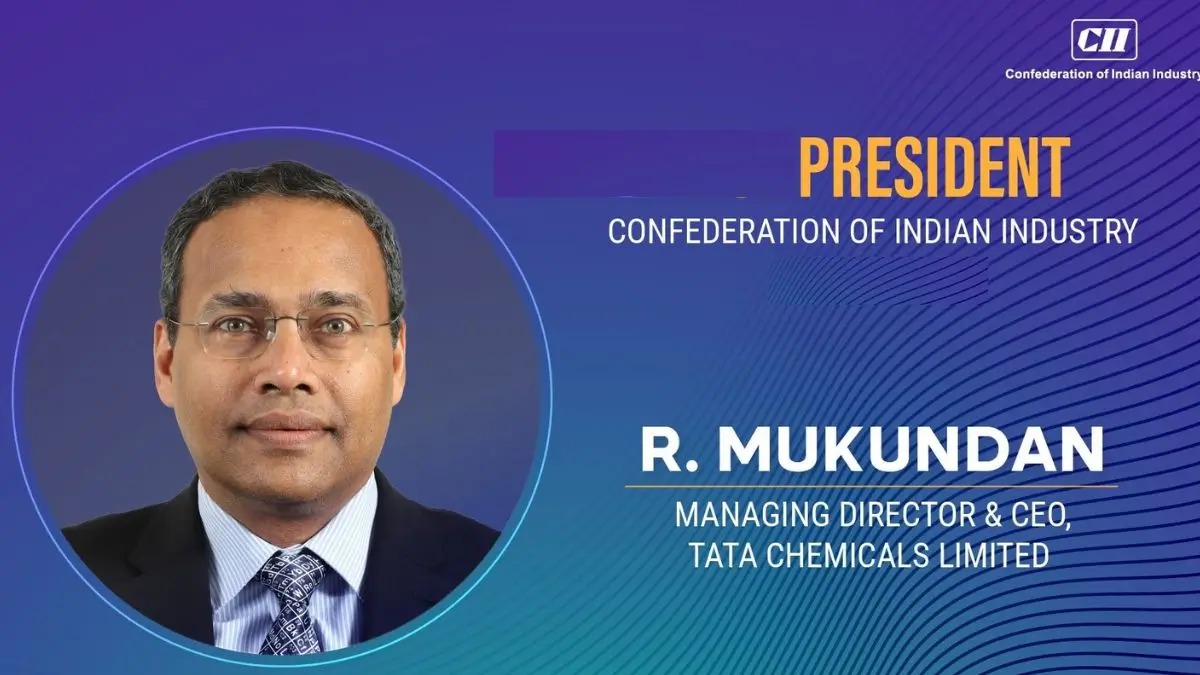
Confederation of Indian Industry (CII) President R. Mukundan has urged the government to implement deep structural reforms focused on improving the "speed of doing business" rather than deploying short-term fiscal stimulus. The proposed 16-point agenda highlights the need for federal "GST-type Councils" for power and land, higher utilization of free trade pacts, and modernizing industrial logistics to support long-term competitiveness.
NEW DELHI, India — The newly elected President of the Confederation of Indian Industry (CII), R. Mukundan, has called on the Central Government to bypass short-term fiscal packages and instead accelerate reforms to deeply integrate the domestic economy into global supply chains. Speaking on June 23, 2026, during his first comprehensive set of media interactions since assuming leadership of India's largest apex industry association, Mukundan presented a detailed 16-point next-generation reform agenda.
The industry chief emphasized that amidst ongoing geopolitical fragmentation and global technological disruptions, India's most effective economic buffer is a permanent reduction in local manufacturing and logistics friction.
Shifting Focus from Cost to Speed of Doing Business
A central pillar of the newly proposed CII framework is moving India’s manufacturing ecosystem past baseline metrics. Mukundan noted that while the initial waves of public policy successfully enhanced the "ease of doing business" and reduced generic compliance expenses, the next phase of global competitiveness relies entirely on the operational "speed of doing business".
The organization highlighted critical bottlenecks at physical logistics handovers—specifically where cargo transitions between maritime ports, rail corridors, and road transport lines. By removing administrative delays and structural gridlock at these transit nodes, Indian businesses can accelerate their delivery cycles to match international just-in-time logistics standards.
Deep Factor Reforms and the Proposed GST-Type Councils
To unlock rapid industrial expansion and support the national "Viksit Bharat" vision for 2047, the CII is urging deep interventions across core structural inputs: power, land, logistics, and infrastructure. Recognizing that many of these subjects are legally managed by individual state administrations rather than the federal government, Mukundan proposed a centralized governance shift:
Cross-Cutting Statutory Councils: Establishing a permanent, unified "GST-type Council" architecture for highly fragmented sectors, including agriculture and power utilities.
Federal Policy Synchronization: Bringing central ministers and state leadership together into a singular decision-making body to rapidly lower high domestic power costs and ease land acquisition processes for heavy manufacturing.
Industrial Cost Reductions: Creating a uniform factor framework across states to prevent internal tax competition and significantly lower base production overheads for local firms.
Prioritizing Free Trade Utilization Over Simple Signings
Addressing international commerce, the CII leadership noted that while negotiating new Free Trade Agreements (FTAs) expands market access, the true metric of national economic success lies in Free Trade Utilization (FTU). Using existing trade realities with global partners like South Korea as a primary example, Mukundan urged domestic companies to actively optimize open channels. This involves actively promoting "Brand India" abroad, systematically absorbing advanced foreign manufacturing technologies, and drawing long-term foreign direct investment back into localized industrial zones.
Furthermore, regarding highly anticipated US-India trade alignments, the apex body maintained that Indian exports must receive trade terms that are better than, or at least equal to, closest international peer nations.
Official Sources Section
According to official policy declarations released by the Confederation of Indian Industry (CII) and detailed interviews published by media houses including The Hindu and Livemint on June 23, 2026, the proposed 16-point agenda opposes further rounds of traditional fiscal stimulus. The industry body's research papers conclude that structural factor reforms deliver a self-sustaining, long-term stimulus that builds genuine market resilience without increasing public debt burdens.
Industry Statements and Executive Quotes
In an address detailing the private sector's investment pipeline, CII President R. Mukundan clarified the current state of domestic corporate capital expenditures:
"The private sector is indeed investing, and the biggest stimulus India needs right now would be deep structural reforms. These reforms act as an evergreen stimulus. They make the economy fitter and more resilient rather than providing temporary relief. We need fresh structural reforms to accelerate our journey to a $10 trillion economy."
Addressing widespread concerns regarding artificial intelligence and human capital, Mukundan reframed the ongoing technology transition:
"As far as AI is concerned, I think AI will be a force multiplier. We have 1.4 billion people who need access to good healthcare, good education, and good services. AI can democratize access to high-quality solutions for every citizen. The goal is to reshape training under the New Education Policy to ensure the nation's youth are entirely industry-ready."
Why It Matters
The strategic shift championed by the CII shifts the national economic conversation away from relying on government spending to drive growth. For global investors and corporate boards, implementing predictable factor reforms across power and logistics provides the operational certainty needed to shift high-value assembly lines to Indian soil. For smaller domestic enterprises (MSMEs), establishing collaborative state-center councils offers an institutional path to resolve persistent bottlenecks, cut input energy costs, and eliminate trade transit delays.
Key Facts at a Glance
Policy Pivot: CII advocates for next-generation structural reforms rather than fresh government fiscal stimulus.
Core Metric: Recommends moving the national industrial framework from "ease of doing business" to "speed of doing business".
Governance Innovation: Proposes creating "GST-type Councils" for cross-cutting sectors like power and agriculture.
Trade Integration: Urges a shift in focus toward Free Trade Utilization (FTU) to maximize the benefits of international trade deals.
Workforce Vision: Identifies artificial intelligence as a major efficiency multiplier to democratize access to healthcare and education.
FAQ Section
Q: Why is the CII opposing a new round of fiscal stimulus packages?
A: The industry body asserts that temporary financial injections provide only short-term relief. In contrast, deep structural reforms function as a permanent, self-sustaining stimulus that naturally lowers production costs and strengthens long-term economic resilience.
Q: What exactly does 'speed of doing business' mean for factories?
A: It refers to minimizing operational delays at crucial handover points across supply chains, such as shifting goods between ships, trains, and transport trucks, to eliminate logistics bottlenecks.
Q: How would a GST-type council benefit highly regulated sectors like power?
A: It would establish a unified platform where central and state leaders collaboratively make binding decisions. This removes local bureaucratic friction and streamlines resource allocation across different states.
Q: What is the difference between an FTA and Free Trade Utilization (FTU)?
A: A Free Trade Agreement (FTA) legally opens up trade access between nations. Free Trade Utilization (FTU) measures how effectively domestic companies actually use those open channels to boost exports, adopt technologies, and draw foreign investments.
Sources: