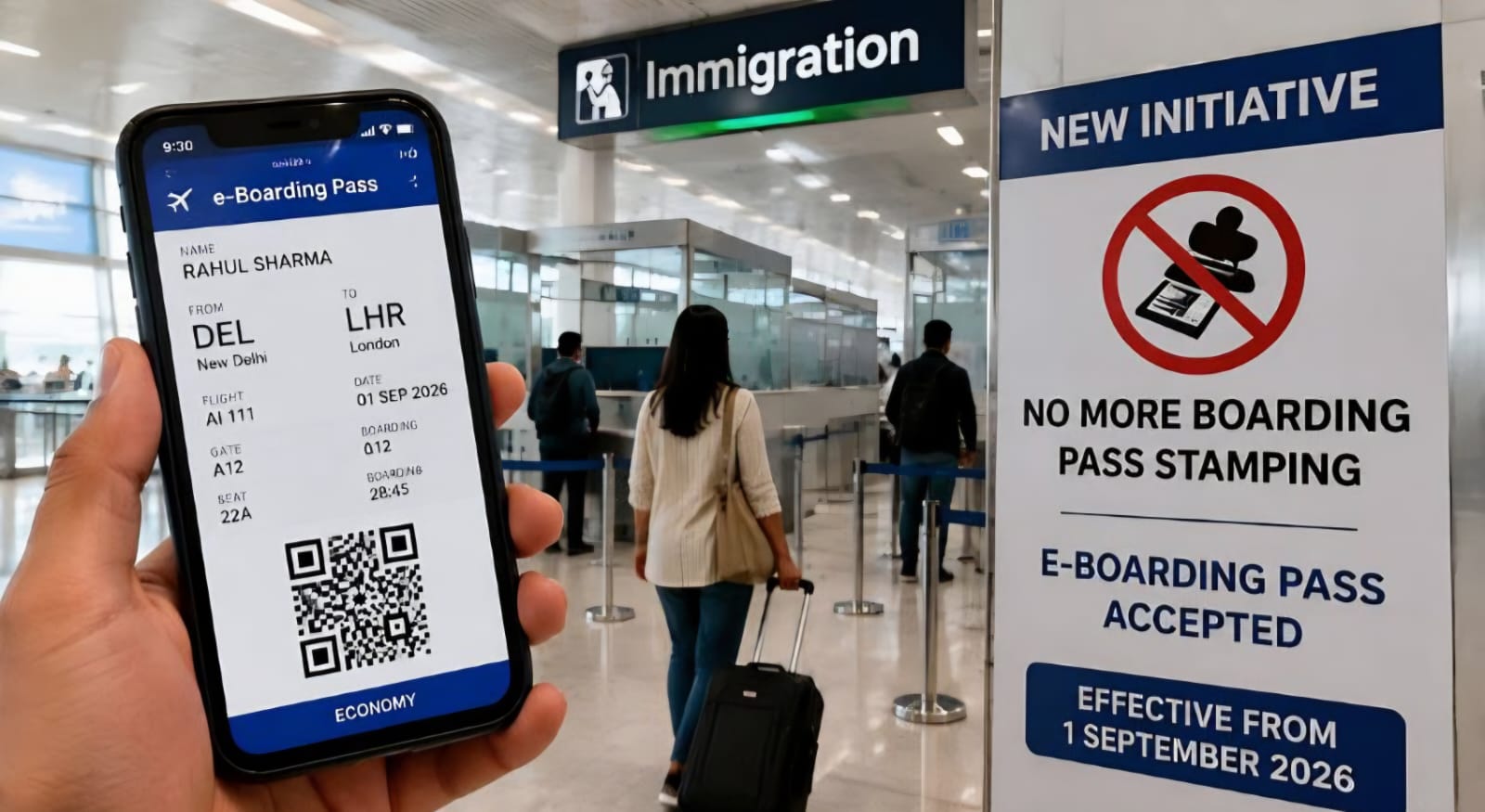
Beginning September 1, 2026, international travelers departing from Indian airports will no longer need physical boarding passes or ink stamps at immigration counters. The Bureau of Immigration now allows electronic boarding passes on smartphones, expediting processing and supporting digital integration across all international departure points.
NEW DELHI — The Bureau of Immigration (BoI), operating under the Ministry of Home Affairs, has officially eliminated the mandatory requirement for physical boarding passes and ink stamping at immigration counters for international departures, effective September 1, 2026.
The policy update, issued in a public advisory on August 24, 2026, allows international travelers departing from Indian airports to present electronic boarding passes on smartphones during departure checks. The decision removes a long-standing physical verification step, aligning immigration protocols with digital airport infrastructure across the country.
The initiative applies across all international airports in India, simplifying passenger processing for airlines, airport operators, and border security personnel.
Operational Guidelines and Smartphone Integration
Under the new operational rules, travelers departing India on international flights will no longer need to carry paper boarding passes solely for immigration endorsement.
E-Boarding Pass Acceptance: Passengers can present e-boarding passes generated via airline mobile applications or digital wallets at immigration desks.
Option for Physical Passes: Paper boarding passes obtained from check-in kiosks or airline counters will remain valid, but immigration officers will no longer apply ink seals.
Integration with FTI-TTP: Passengers enrolled in the Fast Track Immigration – Trusted Traveller Programme (FTI-TTP) can scan e-boarding passes directly at automated e-gates alongside biometrics for touchless departure.
System Efficiency: The Bureau of Immigration noted that legacy ink stamps occasionally smeared bar codes, creating scanning issues at boarding gates. Eliminating physical stamps reduces processing delays and paper waste.
Broader Digital Modernization in Indian Aviation
The change brings immigration procedures in line with security protocols established by the Central Industrial Security Force (CISF), which discontinued physical boarding pass stamping during passenger frisking several years ago.
The Ministry of Home Affairs and Ministry of Civil Aviation are expanding digital infrastructure across major hubs including New Delhi, Mumbai, Bengaluru, and Hyderabad. Authorities are also conducting pilot evaluations to transition passport entry and exit records to digital tracking, potentially reducing the need for physical passport page stamps for Indian citizens in future phases.
Directives have been distributed to airport concessionaires, international air carriers, and Foreigners Regional Registration Offices (FRRO) to ensure operational readiness before the September 1 deadline.
Official Sources
According to official announcements and administrative directives:
Bureau of Immigration (BoI): Official public advisory published by the Bureau of Immigration under the Ministry of Home Affairs.
Ministry of Home Affairs (MHA): Operational directives issued to security agencies via the Ministry of Home Affairs
Ministry of Civil Aviation (MoCA): Stakeholder coordination guidelines distributed through the Ministry of Civil Aviation
Official Statements
"International travellers can use e-boarding passes displayed on their smartphones during immigration clearance," stated the Bureau of Immigration in an official advisory issued on August 24, 2026. "FTI-TTP enrolled travellers can also use them at e-gates. Boarding passes will no longer be stamped during immigration clearance."
Why It Matters
The elimination of physical boarding pass stamping streamlines the departure procedure for millions of international passengers annually. By allowing digital boarding passes at immigration, the government reduces gate bottlenecks, cuts down on paper reliance, and accelerates processing times at peak travel hours across Indian international terminals.
Key Facts at a Glance
Effective Date: September 1, 2026, across all Indian international airports.
Key Change: Physical boarding pass requirement and ink stamping at immigration discontinued.
Digital Support: E-boarding passes on smartphones fully accepted at counters and FTI-TTP e-gates.
Paper Options: Physical boarding passes remain valid for passengers who prefer them, but will not be stamped.
Governing Body: Bureau of Immigration, Ministry of Home Affairs.
Frequently Asked Questions
Do I still need to print a physical boarding pass when flying internationally from India after September 1?
No. Passengers can use an electronic boarding pass saved on their smartphone. Printed boarding passes will still be accepted, but they will no longer receive an ink stamp from immigration officers.
Will immigration officers still stamp my physical passport?
Yes. The September 1 rule change applies specifically to boarding passes. Standard physical passport entry and exit stamping continues as usual while electronic passport tracking pilots are evaluated.
Does this new rule apply to all airports in India?
Yes. The Bureau of Immigration directive applies to all international airport departure points across India starting September 1, 2026.
How does this impact travelers using the FTI-TTP program?
Travelers registered under the Fast Track Immigration – Trusted Traveller Programme can scan their mobile e-boarding passes and complete facial biometric verification at automated e-gates without presenting paper documents.
Sources: Bureau of Immigration (BoI), Ministry of Home Affairs (MHA), Ministry of Civil Aviation (MoCA)