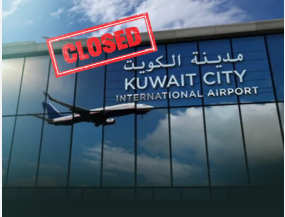
KUWAIT CITY – Kuwaiti authorities suspended all air traffic at Kuwait International Airport early Wednesday, June 3, 2026, after a series of Iranian drone and missile strikes hit the facility’s primary passenger terminal. The attack marks a dangerous escalation in the ongoing regional conflict between the United States and Iran, severely testing an April 8 ceasefire that had previously remained largely intact.
According to the Kuwaiti Ministry of Defence, the strikes targeted Terminal 1, resulting in "severe damage" to the building and wounding an undisclosed number of individuals. First responders were dispatched to the site, and arriving flights were diverted to alternative airports as civil aviation authorities declared the facility temporarily closed for safety and damage assessment.
Escalating Regional Tensions
The assault on the airport came amidst a wider exchange of fire across the Gulf. Earlier on Tuesday, U.S. Central Command (Centcom) reported that American forces had engaged Iranian assets, including a missile strike that disabled an Iranian tanker attempting to navigate toward Kharg Island. U.S. military officials also confirmed they conducted self-defense strikes against Iranian military facilities on Qeshm Island, reportedly targeting a ground control station in response to earlier aggression.
In a statement following the airport strike, Iran’s Islamic Revolutionary Guards Corps (IRGC) accused U.S. forces of initiating the overnight escalation by targeting an Iranian communications tower. The IRGC claimed that, in retaliation, they launched a series of missiles and drones toward regional military bases and the U.S. Fifth Fleet headquarters in Bahrain, although U.S. and Bahraini officials reported that those attacks were intercepted or failed to reach their intended targets.
Diplomatic and Security Fallout
Kuwaiti Defence Ministry spokesperson Brigadier General Saud Abdulaziz Al-Atwan condemned the strike as "criminal Iranian aggression," noting that the attack resulted in both physical destruction and human injuries. The incident has sent shockwaves through the Gulf, with neighboring nations and international allies calling for a unified regional response.
Anwar Gargash, a presidential advisor to the United Arab Emirates, characterized the incident as an attack on the stability of the entire region. "In light of Iran's repeated aggression against the sisterly states of Kuwait and Bahrain, a firm, unified, and cohesive Gulf stance is imperative," Gargash stated on social media.
Official Sources
Details regarding the airport closure and casualty reports were provided by the Kuwait General Civil Aviation Authority and the Kuwait Ministry of Defence. Information regarding the broader military engagement, including the U.S. naval operation and strikes on Qeshm Island, was confirmed by U.S. Central Command (Centcom).
Why It Matters
The strike on Kuwait International Airport represents one of the most severe challenges to regional stability since the onset of the current conflict. Beyond the immediate human toll and infrastructure damage, the closure of a major regional transport hub disrupts global supply chains and passenger movement. The incident jeopardizes the fragile ceasefire established in April and threatens to pull Gulf nations deeper into a direct confrontation between Washington and Tehran.
Key Facts at a Glance
Attack Date: Wednesday, June 3, 2026.
Target: Terminal 1 of Kuwait International Airport.
Casualties: Multiple individuals wounded; authorities have not released an exact count.
Status: All air traffic suspended; flights diverted to alternative regional airports.
Regional Context: The attack follows U.S. strikes on Iranian sites on Qeshm Island and the immobilization of an Iranian tanker in the Strait of Hormuz.
Frequently Asked Questions
Q: Is Kuwait International Airport currently open?
A: No, Kuwaiti civil aviation authorities have suspended all air traffic and diverted incoming flights until further notice due to significant damage at the terminal.
Q: Who is responsible for the attack?
A: Kuwaiti officials have directly blamed Iran, citing the use of Iranian drones and missiles. The IRGC has not formally confirmed the airport strike but acknowledged launching missile and drone attacks in the region.
Q: How many people were injured?
A: While the Kuwaiti Defence Ministry confirmed "a number of individuals" were wounded, they have not yet released a specific total or confirmed the severity of the injuries.
Q: Is this part of a wider conflict?
A: Yes, the strike is occurring amid an escalating series of military exchanges between the U.S. and Iran, further destabilizing the Gulf region and endangering critical civilian infrastructure.
Source: Kuwait General Civil Aviation Authority, U.S. Central Command (Centcom), Kuwait Ministry of Defence