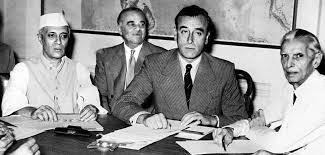
The Mountbatten Plan, announced on June 3, 1947, provided the framework for the partition of British India. By setting an expedited timeline for independence and the creation of India and Pakistan, the plan sought to resolve communal deadlock but triggered one of history's largest and most tragic mass migrations.
On June 3, 1947, Lord Louis Mountbatten, the last Viceroy of India, formally announced the British government’s blueprint for the transfer of power. This policy, known historically as the Mountbatten Plan, provided the roadmap for ending nearly two centuries of British colonial rule by partitioning the subcontinent along religious lines. The announcement ended months of deadlock between the Indian National Congress and the All-India Muslim League, setting a swift, irreversible timeline for independence and the creation of the dominions of India and Pakistan.
The Strategic Framework of the June 3 Plan
The Mountbatten Plan was formulated after extensive consultations with Indian political leaders to address the escalating communal tensions that threatened to engulf the country in civil war. The plan stipulated that the transfer of power would occur in August 1947, significantly advancing the initial deadline set by the British government.
Key provisions of the plan included:
Partitioning the Provinces: The provinces of Punjab and Bengal were to be partitioned based on contiguous majority areas of Muslims and non-Muslims.
Referendums: Referendums were to be held in the Northwest Frontier Province (NWFP) and the Sylhet district of Assam to determine their accession to either India or Pakistan.
Princely States: Rulers of the princely states were given the choice to accede to either dominion, based on geographical proximity and the will of their populations.
Boundary Commission: A commission was to be established to demarcate the exact borders between the two new nations.
Historical Context and Political Dynamics
By the spring of 1947, the political landscape in India had reached an impasse. The British government, under Prime Minister Clement Attlee, was eager to divest itself of the responsibilities of colonial administration in India due to economic exhaustion following World War II and the increasing inability to control communal unrest.
Lord Mountbatten arrived in India in March 1947 with a mandate to facilitate a swift departure. His negotiations with Jawaharlal Nehru, Sardar Vallabhbhai Patel, and Muhammad Ali Jinnah convinced him that a unified India was no longer viable given the deepening sectarian divide. The June 3 Plan was essentially a compromise that accepted the Muslim League’s demand for a separate nation, Pakistan, while ensuring that the transition process began immediately to prevent further instability.
Official Records and Documentation
The foundational documents and administrative records of the transfer of power are maintained by the British Library in its India Office Records collection. Additionally, the National Archives of India houses extensive correspondence, cabinet papers, and official notifications related to the implementation of the Mountbatten Plan.
Quote Section
According to officials and historical records documenting the transfer of power, the plan was presented as the only viable solution to avoid large-scale anarchy. Mountbatten famously stated during the press conference regarding the June 3 Plan that the decision to partition was not a choice between "unity and partition," but rather a "choice between partition and chaos."
Why It Matters
The legacy of the Mountbatten Plan remains central to the geopolitical reality of South Asia. The rapid execution of the plan—often criticized for its lack of foresight regarding the human cost of partition—led to one of the largest mass migrations in human history. Millions were displaced, and hundreds of thousands lost their lives in communal violence. For modern observers, the plan serves as a cautionary study in colonial withdrawal and the complex challenges of state-building in a post-imperial context.
Key Facts at a Glance
Announcement Date: June 3, 1947.
Core Objective: Expedited transfer of power and partition of British India.
Dominions Created: The Union of India and the Dominion of Pakistan.
Boundary Authority: The Radcliffe Commission was appointed to define the borders of Punjab and Bengal.
Independence Dates: Pakistan was granted independence on August 14, 1947, and India on August 15, 1947.
FAQ Section
Q: Why was the Mountbatten Plan considered "rushed"?
A: Lord Mountbatten advanced the date of independence to August 1947, months ahead of the original June 1948 deadline, to stabilize the rapidly deteriorating political situation.
Q: How were the boundaries decided?
A: The British government appointed Sir Cyril Radcliffe to lead a Boundary Commission, which drew the borders for the Punjab and Bengal provinces based on religious demographic data.
Q: Did the princely states have to join India or Pakistan?
A: Under the June 3 Plan, the rulers of the princely states were given the option to choose, though this process later led to long-standing territorial disputes in regions like Jammu and Kashmir.
Q: What was the primary motivation for the British to leave?
A: Post-WWII economic constraints and the administrative impossibility of maintaining order in a deeply divided, restive colony made a swift exit a strategic priority for London.
Source: The British Library, National Archives of India, Government of the United Kingdom