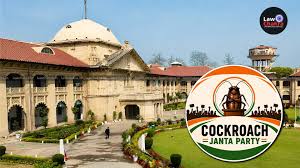
The Allahabad High Court has disposed of a PIL seeking a multi-agency probe into the viral "Cockroach Janta Party." The bench ruled that the petitioner, a Bengaluru resident, must approach a court with proper jurisdiction, as the case lacked a specific connection to Uttar Pradesh.
The Lucknow Bench of the Allahabad High Court on June 2, 2026, declined to entertain a public interest litigation (PIL) filed against the "Cockroach Janta Party" (CJP) and its founder, Abhijeet Dipke. A division bench comprising Justice Shekhar B. Saraf and Justice Abdhesh Kumar Chaudhary observed that the petition lacked any specific connection to the state of Uttar Pradesh and instructed the petitioner, S. Vignesh Shishir, to approach a court with the appropriate jurisdiction.
Background of the Legal Challenge
The Cockroach Janta Party emerged as a satirical political movement in mid-May 2026 following oral remarks made by Chief Justice of India (CJI) Surya Kant during Supreme Court proceedings. During a hearing on May 15, the CJI compared certain unemployed youth and those involved in "activism" to "cockroaches" and "parasites of society." While the CJI later clarified that his remarks were directed at individuals acquiring fraudulent degrees and not the nation’s youth, the comments sparked widespread outrage among Gen Z internet users.
Abhijeet Dipke, a Pune native currently residing in the United States, subsequently launched the CJP as a parody of the ruling Bharatiya Janata Party. The movement rapidly gained millions of followers on social media, tapping into youth frustrations regarding unemployment, education system failures, and political accountability.
Jurisdictional Grounds for Dismissal
The petition filed by Shishir, a resident of Bengaluru, sought a multi-agency probe—including the National Investigation Agency (NIA) and the Enforcement Directorate (ED)—into the activities of the CJP. He alleged that the movement was a foreign-funded "information warfare campaign" designed to incite public disorder and harm India’s national security. Furthermore, the plea requested the blocking of all social media handles associated with the movement.
During the hearing, the High Court bench noted that the petitioner is a permanent resident of Bengaluru and that the issues raised were of a national nature rather than being specific to Uttar Pradesh. Applying the doctrine of forum non conveniens, the court remarked that the petitioner should have first approached the Karnataka High Court. Following the bench's observations, the petitioner was granted leave to withdraw the plea and file a fresh petition before a court of competent jurisdiction.
Official Sources Section
The judicial proceedings and the bench's observations are documented in the records of the Allahabad High Court. Official information regarding the case—S. Vignesh Shishir v. Union of India—is available through judicial databases. Additional context regarding the origin of the controversy stems from public remarks recorded during Supreme Court of India proceedings on May 15, 2026.
Quote Section
According to officials, "The petitioner, being a resident of Bengaluru and raising an issue that is of national importance, should have first approached the Karnataka High Court, if he so desired. In the present writ petition, we do not find anything specific to the State of Uttar Pradesh, and accordingly, we are of the view that the writ petition is not maintainable before this Court due to forum non conveniens."
Why It Matters
The dismissal of this PIL highlights the ongoing legal struggle to define the boundaries between political satire and protected free speech in the digital age. As viral movements increasingly challenge traditional political discourse, the judiciary is often tasked with balancing the regulation of online "spectacles" with the preservation of democratic dissent. For digital creators and political activists, the court's emphasis on jurisdiction underscores the procedural hurdles involved in challenging cross-border, internet-based movements.
Key Facts at a Glance
Judicial Ruling: The Allahabad High Court (Lucknow Bench) dismissed the PIL on June 2, 2026, for lack of territorial jurisdiction.
The Petitioner: S. Vignesh Shishir, a resident of Bengaluru, filed the petition seeking an NIA and ED probe into the CJP.
The Movement: The "Cockroach Janta Party" is a viral, satirical political platform founded by Abhijeet Dipke in response to comments made by the CJI.
Allegations: The PIL claimed the movement was involved in "anti-national activities" and foreign-funded digital warfare.
FAQ Section
Q: Why was the PIL against the Cockroach Janta Party dismissed?
A: The court dismissed it based on the principle of forum non conveniens, noting that the petitioner is a resident of Bengaluru and the case had no specific nexus with Uttar Pradesh.
Q: Can the petitioner file the case again?
A: Yes, the High Court granted the petitioner liberty to withdraw the current plea and file a fresh petition before a court that has the appropriate jurisdiction, such as the Karnataka High Court.
Q: What is the Cockroach Janta Party?
A: It is a satirical digital-political movement formed by youth in response to CJI Surya Kant’s comments on May 15, 2026, which compared certain activists to "cockroaches."
Source: Allahabad High Court, Supreme Court of India, National Investigation Agency (NIA), Enforcement Directorate (ED)
!(https://upload.wikimedia.org/wikipedia/commons/thumb/6/6f/Allahabad_High_Court_Lucknow_Bench.jpg/640px-Allahabad_High_Court_Lucknow_Bench.jpg)