BENGALURU — The Indian Space Research Organisation (ISRO), now globally renowned for its high-tech precision lunar and planetary missions, laid its foundations on remarkable grassroots ingenuity. Decades before launching historical deep-space missions, ISRO engineers solved a critical technical impa...
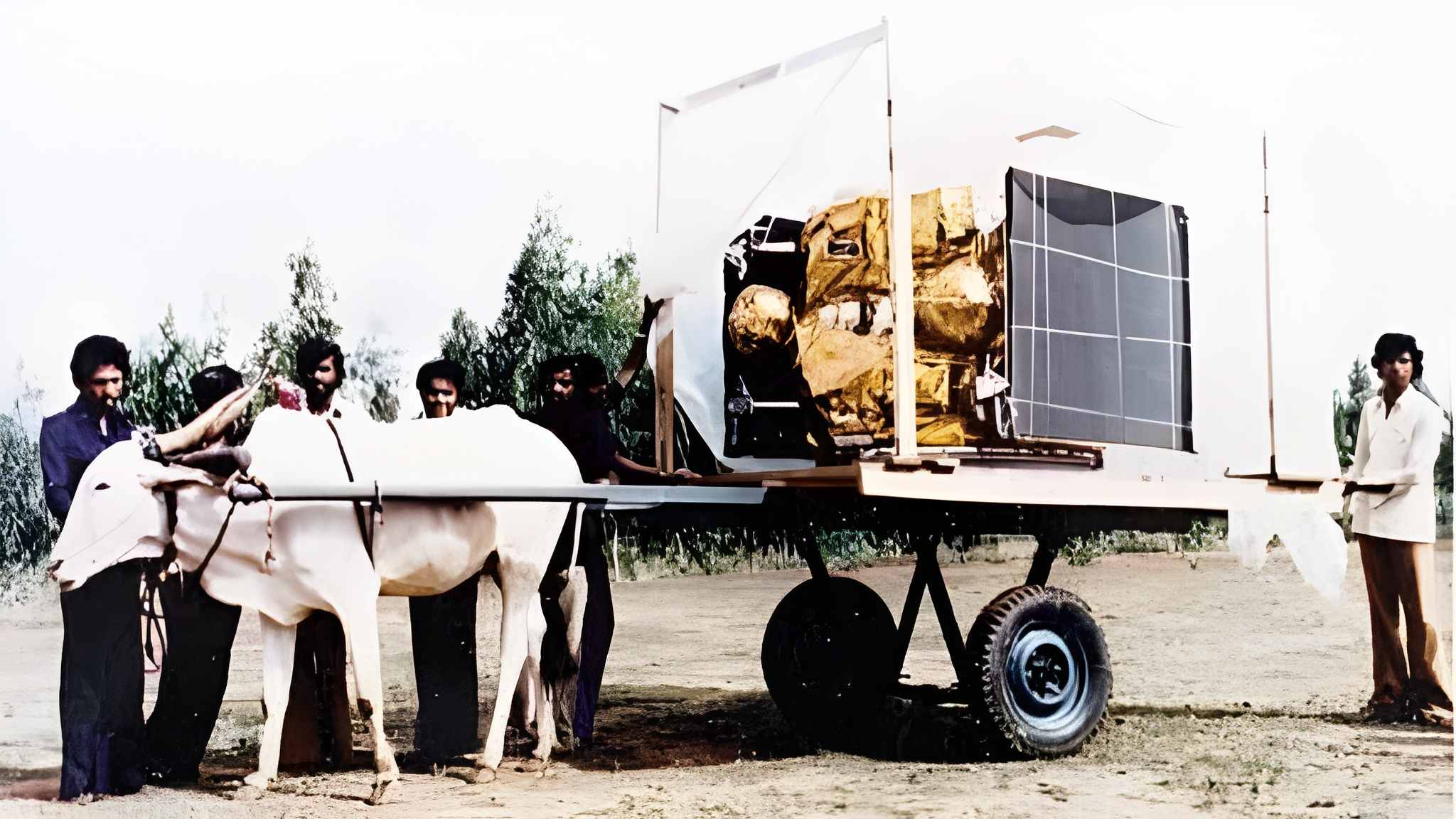
BENGALURU — The Indian Space Research Organisation (ISRO), now globally renowned for its high-tech precision lunar and planetary missions, laid its foundations on remarkable grassroots ingenuity. Decades before launching historical deep-space missions, ISRO engineers solved a critical technical impasse for the nation’s first experimental communication spacecraft using a wooden bullock cart. The historic 673-kilogram spacecraft, known as the Ariane Passenger Payload Experiment (APPLE), successfully launched 45 years ago, but its historic voyage famously began on rustic wheels. This development remains a core case study in adaptive engineering, highlighting how early infrastructure limitations paved the way for India's massive contemporary space economy.
The Non-Magnetic Workaround that Saved APPLE
During pre-launch preparations in Bengaluru, engineers detected severe telemetry, tracking, and control (TT&C) communication issues caused by an impedance mismatch in the satellite's antenna system. Correcting this malfunction required extensive live testing of the 1.2-meter cubical spacecraft under a thermal blanket.
However, ISRO lacked an enclosed, specialized antenna testing facility at the time. Testing the spacecraft on or near metal trucks would cause severe electromagnetic interference, completely corrupting the sensitive radar data.
To overcome this, senior space agency scientists designed an indigenous workaround. They rented a completely wooden, non-magnetic bullock cart from a local farmer for ₹150. By mounting the 673kg satellite onto the open wooden framework and wheeling it into an open field, engineers completely bypassed metal-induced signal distortion. This provided a flawless, interference-free setting that allowed technicians to fix the communication links within five hours.
From Industrial Sheds to Geostationary Orbit
The APPLE spacecraft was fully designed and manufactured within two years inside basic industrial sheds with minimal infrastructure. Following the successful open-field diagnostic tests, the spacecraft was transported to Kourou, French Guiana.
On June 19, 1981, the satellite launched into an elliptical transfer orbit aboard the European Space Agency's Ariane-1 rocket (Flight V-3). It was subsequently maneuvered into its final geostationary orbit position at 102 degrees East longitude using an internal solid-propellant apogee motor derived from India's home-grown SLV-3 rocket system.
Long-Term Economic and Citizen Impact
The operational success of APPLE fundamentally transformed India's domestic landscape:
Telecommunications: The satellite provided the raw infrastructure for early national television broadcasting, tele-education networks, and emergency radio networking.
Industrial Foundation: The hands-on experience gained in three-axis stabilization, station-keeping, and orbit-raising directly birthed the modern INSAT and GSAT satellite constellations.
Commercial Growth: These early milestones created the institutional capability that allows India's commercial space sector to actively attract billions in foreign direct investments and international satellite launch contracts.
Official Sources Section
According to historical records and formal program archives maintained by the Indian Space Research Organisation, the APPLE mission was specifically designed to give domestic teams hands-on capabilities in managing geostationary payloads. Documented accounts from former space program directors confirm that the choice of transport was an explicit, calculated engineering decision rather than a symptom of a budget deficit.
Quote Section
Reflecting on the mission's legacy, former ISRO officials stated that the unique test layout became a profound symbol of flexible problem-solving. International observers at the time, including reports from Newsweek, noted that the visual of a sophisticated spacecraft sitting atop a traditional ox-drawn cart highlighted a striking "collision of centuries" where ancient utility met cutting-edge space technology.
Why It Matters
The historical workaround demonstrates that complex technological bottlenecks do not always require expensive capital infrastructure. By utilizing a simple wooden asset to maintain electromagnetic neutrality, early engineers protected sensitive aerospace hardware and kept a critical national timeline on track, establishing a institutional culture of highly cost-effective innovation.
Key Facts at a Glance
The Payload: The Ariane Passenger Payload Experiment (APPLE) weighed approximately 673 kilograms and carried two C-band transponders.
The Cost: The rental fee for the non-magnetic wooden bullock cart used for antenna diagnostics was exactly ₹150.
The Launch: Deployed on June 19, 1981, from the Kourou Space Centre in French Guiana via an Ariane-1 rocket.
The Legacy: The experimental platform operated for nearly two years until its retirement on September 19, 1983, establishing the foundations for India's entire telecommunications grid.
Frequently Asked Questions
Why did ISRO use a bullock cart instead of a truck?
Metal trucks reflect radio waves and cause electromagnetic interference, which would corrupt the antenna calibration. The wooden bullock cart provided a completely non-magnetic test bed.
Was the bullock cart used because of a lack of funds?
No. While early budgets were modest, the cart was selected specifically for its technical property of being non-metallic, ensuring a clean testing environment in an open field.
What did the APPLE satellite achieve?
It gave India its first hands-on experience operating a three-axis stabilized geostationary communication satellite, laying the operational blueprint for the country's television, radio, and telecommunication networks.
Source: Indian Space Research Organisation Official APPLE Mission Profile, Historical Launch Archives of the European Space Agency (ESA).