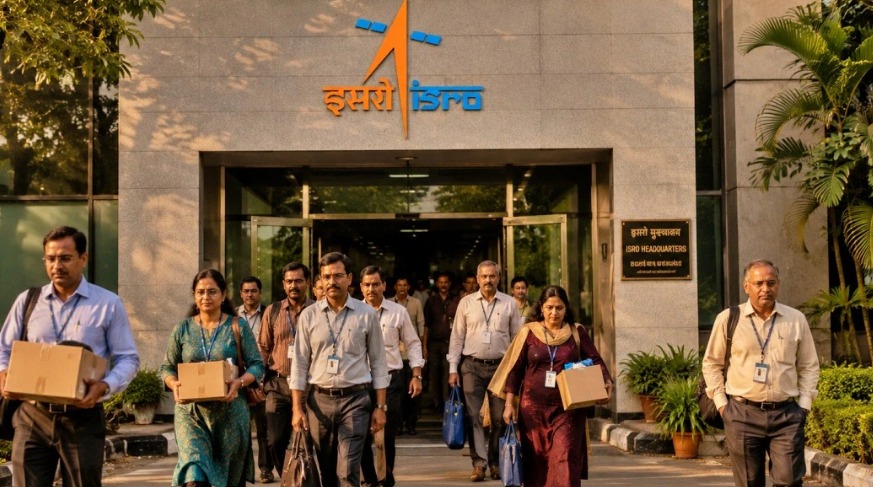
ISRO has tightened exit protocols for scientists working on critical national space programs like Gaganyaan. Following over 100 recent resignations, the Department of Space now requires high-level review for all departure requests to ensure mission continuity, amid growing competition for aerospace talent from India’s expanding private space sector.
New government directive requires special approval for scientists leaving critical projects, aiming to ensure continuity for Gaganyaan and other national programs.
The Department of Space (DoS) has implemented stricter procedures for processing voluntary retirement and resignation requests from Indian Space Research Organisation (ISRO) scientists. This policy shift comes amid a noticeable rise in staff departures, with reports indicating that over 100 personnel have exited the organization in recent months.
Revised Exit Procedures for ISRO Personnel
Under a July 14, 2026, Office Memorandum (OM), the government has revoked the routine authority previously held by centre directors to accept resignations and voluntary retirement applications from Group 'A' Scientific and Technical personnel.
Historically, under a 2020 administrative order, centre directors were empowered to approve such departures for staff up to the rank of Scientist/Engineer-SG. The new directive mandates that any resignation or voluntary retirement request from scientists linked to the Gaganyaan mission—India's ambitious human spaceflight program—or other projects of "national importance" cannot be accepted as a routine matter.
Instead, these requests must now be forwarded to the Department of Space, accompanied by clear recommendations from the respective centre directors, for a final, high-level decision.
Context: Balancing Talent Retention and Mission Continuity
The government’s decision is rooted in concerns over project timelines. With Gaganyaan, Chandrayaan-4, and the Bharatiya Antariksh Station in the pipeline, officials emphasize that project continuity is paramount.
The aerospace industry in India has expanded significantly since 2020, when the government opened the space sector to private participation. The growth of private space startups has increased competition for highly skilled talent, leading some former ISRO scientists to transition into the private sector.
While some observers suggest the turnover highlights issues within the internal promotion system or workplace culture, Union Minister of State Jitendra Singh has downplayed concerns of a systemic crisis. "As many go, that many will come—the project shouldn't suffer," the Minister stated, noting that ISRO’s work culture often involves ongoing collaboration with experienced personnel, including those who have retired.
Why It Matters
The tightening of these rules directly impacts the pace at which India executes its strategic space roadmap. By requiring central oversight, the government aims to prevent "brain drain" from critical units, such as the Vikram Sarabhai Space Centre (VSSC) and the UR Rao Satellite Centre (URSC), ensuring that the technical expertise required for high-stakes missions remains within the state-run agency during pivotal development phases.
Key Facts at a Glance
New Protocol: Resignations for scientists on key projects now require Department of Space approval rather than local centre approval.
Scope: The policy affects Group 'A' Scientific and Technical personnel, specifically those tied to missions like Gaganyaan.
Trigger: The decision follows reports of over 100 scientists and engineers leaving ISRO in recent months.
Duration: Restrictions on routine acceptance of resignations will remain in place until the relevant missions are realized.
FAQ Section
1. Does this ban ISRO scientists from ever resigning?
No. It does not ban resignations but changes the process, removing the "routine" acceptance of requests for scientists working on critical national projects.
2. Why was this policy implemented now?
The Department of Space stated that a "spate" of recent departures was impacting the implementation of high-priority missions.
3. Which missions are affected by these new rules?
The rules specifically cite the Gaganyaan mission and other projects deemed to be of "national importance".
4. What happens if a scientist submits a resignation?
Centre directors must forward the request to the Department of Space with their formal recommendations for a final decision by the competent authority.
Official Sources
Department of Space (DoS): Office Memorandum issued July 14, 2026.
Ministry of State (Space): Public statements provided by Union Minister of State Jitendra Singh regarding staffing and mission continuity.
Indian Space Research Organisation (ISRO): Internal procedural directives relayed to centre directors and heads of units.