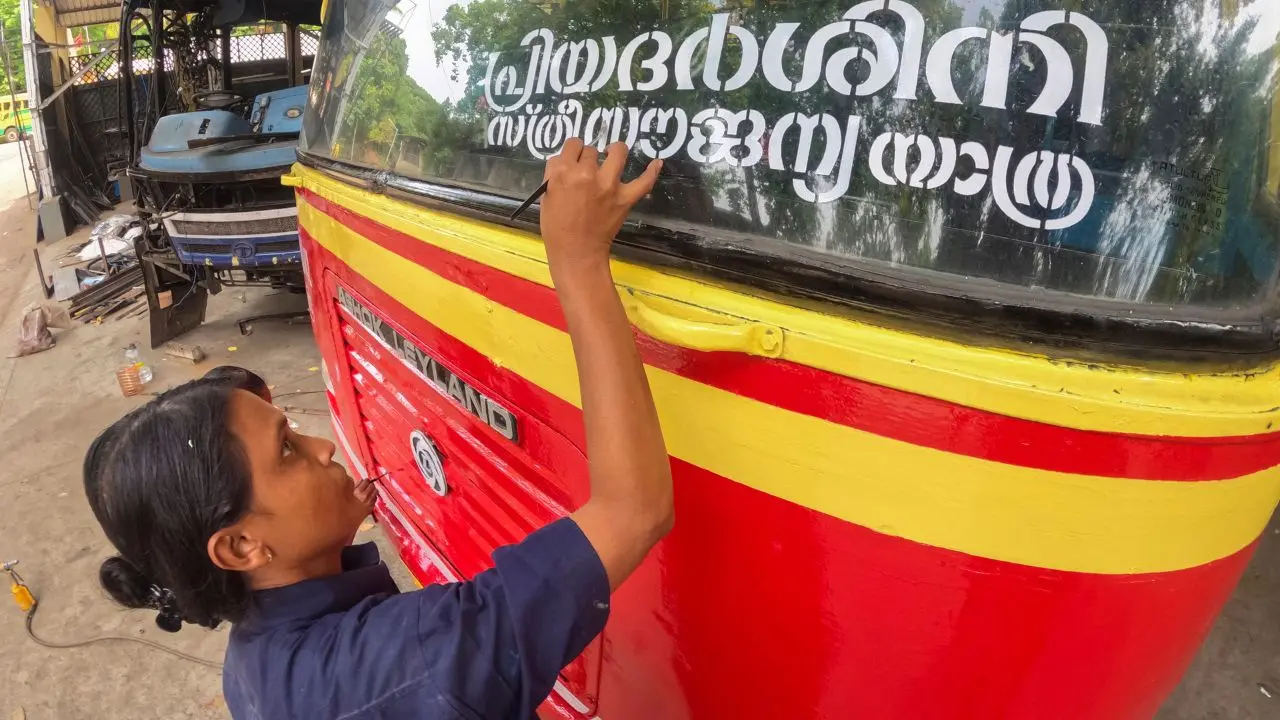
The United Democratic Front (UDF) government in Kerala has officially rolled out the "Priyadarshini" scheme, providing free state-run bus travel for women and transgender persons across its ordinary fleet. Launched by Chief Minister V.D. Satheesan, the initiative is estimated to benefit lakhs of daily commuters at an annual state cost of ₹800 crore.
THIRUVANANTHAPURAM — Kerala’s newly elected Congress-led United Democratic Front (UDF) government officially launched its flagship "Priyadarshini" welfare scheme on Monday, June 15, 2026, granting free bus travel across the state to all women and transgender passengers. Chief Minister V.D. Satheesan inaugurated the landmark public transit program at the Thampanoor Central Bus Station by flagging off an inaugural ordinary service managed entirely by an all-women crew.
The extensive rollout fulfills the first major campaign pledge under the coalition's "Indira Guarantees," which were announced nationally during the recent assembly election cycle. Designed to ease severe inflationary pressures on working-class households, the state-funded subsidy program went into immediate operational effect across thousands of public routes.
State Fleet Transition and Zero-Fare Ticket Protocols
Under the initial framework approved by the state cabinet, the free transit concession is explicitly restricted to ordinary class operations within the state-run Kerala State Road Transport Corporation (KSRTC). Transport Minister C.P. John confirmed that the policy applies directly to 3,125 active ordinary vehicles out of the corporation's total operational fleet. These vehicles primarily handle localized, intra-district, and short-distance rural-to-urban commuter corridors.
The administrative execution of the Priyadarshini network has been structured to bypass cumbersome registration barriers:
No Documentation Required: Commuters are not required to produce regional identity cards, income statements, or residency certificates to claim the benefit.
Universal Accessibility: The zero-fare mandate applies universally to all female and transgender passengers, including out-of-state workers and traveling tourists.
Mandatory Zero-Value Tickets: Passengers must declare their final stop to conductors, who will then issue a mandatory zero-value ticket via Electronic Ticket Machines (ETMs) to log travel metrics for government data auditing.
The data collected from these digital tickers will allow the finance ministry to accurately calculate monthly compensation claims to prevent expanding KSRTC's historic debt margins.
Financial Allocations and Political Opposition
The massive welfare expansion carries significant economic consequences for Kerala's state treasury. Chief Minister Satheesan stated during his inaugural address that the program would require a dedicated state expenditure between ₹750 crore and ₹800 crore annually. The administration explicitly guarantees that the entire financial burden will be fully absorbed by direct budgetary infusions from the state government, shielding the financially strained KSRTC from carrying any extra operational debt.
Despite widespread public praise from commuter groups, the scheme has faced substantial pushback from political rivals and private commerce groups. The opposition CPI(M) boycotted the official launch ceremony, claiming the government watered down its poll promise by restricting the benefits strictly to ordinary services while excluding premium long-distance routes.
Simultaneously, the Bharatiya Janata Party (BJP) held local demonstrations accusing the coalition of creating unfair regional disparities. They pointed out that while southern hubs like Thiruvananthapuram maintain a dense grid of KSRTC ordinary routes, northern districts like Malappuram rely almost entirely on private stage carriers where the free ticket is invalid.
Private Fleet Fallout and Regional Disparities
The exclusion of private local buses from the initial rollout has triggered urgent meetings within the Kerala Private Bus Operators Association. Association representatives warn that the zero-fare state incentive will destroy private transit margins along overlapping paths where state-run and private vehicles compete directly.
Addressing these regional infrastructure imbalances, Transport Minister C.P. John noted that the first 100 days will serve as an evaluation period. The government is actively exploring options to lease private buses or establish wet-lease agreements to extend the program to rural constituencies that lack sufficient KSRTC infrastructure.
Official Sources Section
Operational declarations, transit categories, and route schedules are governed by the Kerala State Road Transport Corporation (KSRTC) Portal. Budgetary adjustments, treasury calculations, and financial allocations are managed directly through the official Kerala State Government Finance Department.
Quote Section
"This initiative is not an act of generosity or political charity, but a carefully designed welfare measure with massive socio-economic benefits," stated Chief Minister V.D. Satheesan during the Thampanoor launch event.
"According to officials at the transport ministry, the state government will provide around ₹800 crore annually to the corporation to ensure this expansion does not weaken KSRTC's internal fiscal turnaround strategies."
Why It Matters
The rollout of the Priyadarshini public transit initiative has immediate practical importance for household financial management across Kerala. According to state economic data, regular commuters such as daily wage earners, domestic helpers, and university students are projected to save between ₹800 and ₹1,000 per month on travel costs. By eliminating routine transportation bills, the program frees up disposable household income, which helps boost independent purchasing power and improve female workforce participation numbers across rural and semi-urban job markets.
Key Facts at a Glance
Welfare Commitment: The "Priyadarshini" free bus travel scheme fulfills the first key "Indira Guarantee" enacted by the newly formed UDF administration.
Target Audience: The policy provides unrestricted free travel to all women and transgender passengers regardless of age, income, or native residency.
Fleet Coverage: The initial phase activates zero-fare benefits across 3,125 ordinary-class KSRTC buses handling localized, short-distance routes.
Fiscal Commitment: The Kerala state treasury will provide an estimated annual budget of ₹750 crore to ₹800 crore to fully offset the network's ticket costs.
Frequently Asked Questions (FAQ)
Which specific buses are covered under the Priyadarshini scheme?
The scheme is valid exclusively on KSRTC "Ordinary" services, which include city ordinary, limited-stop ordinary, fair-stage ordinary, town-to-town, point-to-point, and Gramavandi services. It does not apply to fast passenger, superfast, or luxury fleets.
Do passengers need to register or apply for a special travel card?
No registration, online application, or physical identity card is required. Passengers simply board an eligible bus and request a zero-value ticket from the conductor.
Is the free travel benefit restricted only to residents of Kerala?
No. The scheme is open to all women and transgender individuals boarding covered KSRTC routes within the state, including domestic travelers, daily interstate workers, and international tourists.
Are children allowed to travel for free under this program?
The free travel rules apply to adult women and transgender passengers. If a woman is traveling with young boys between the ages of 5 and 11, a standard half-ticket fare must still be purchased for them.
Source: