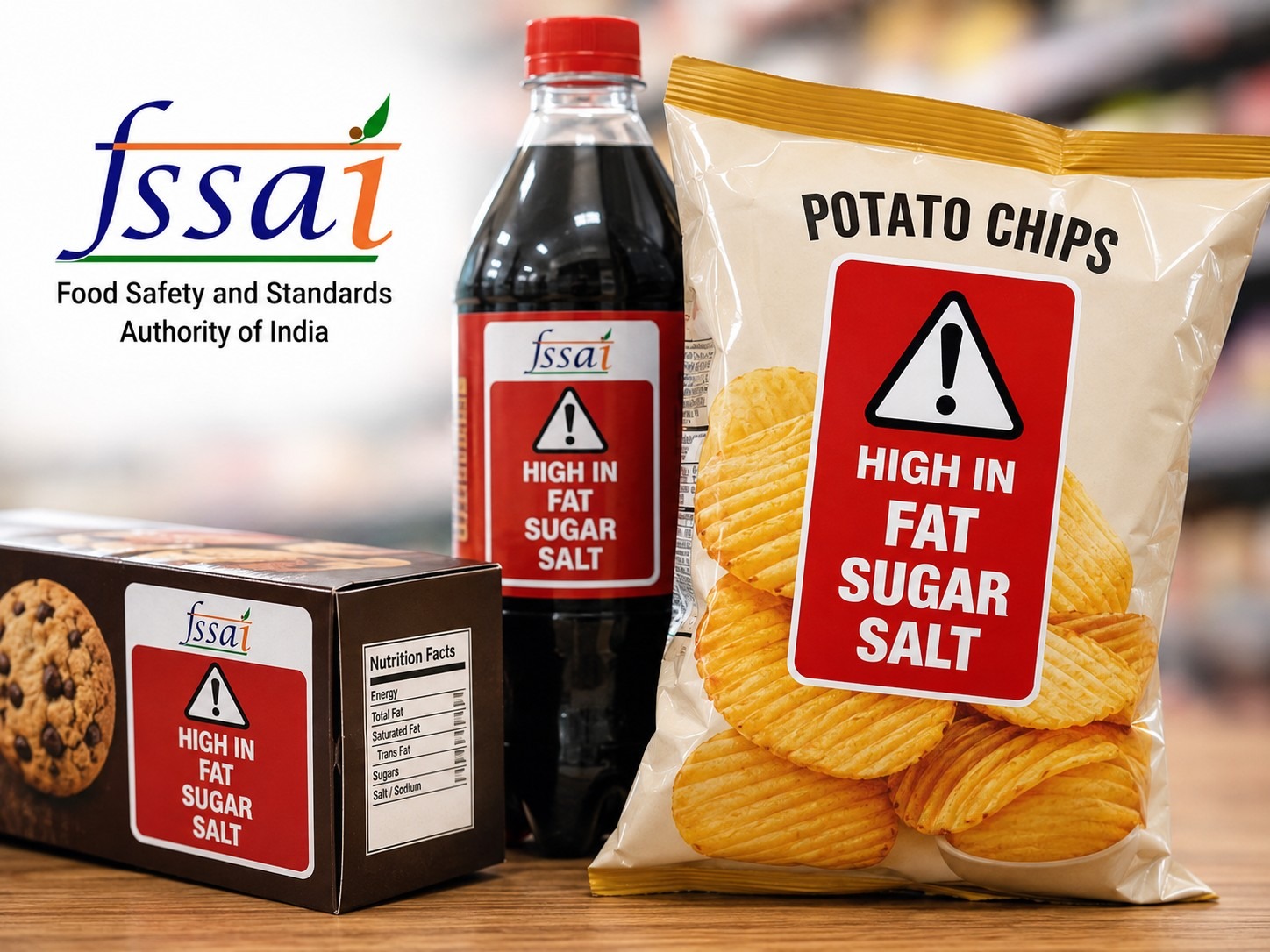
India's packaged food industry has launched its first legal challenge against the $\text{FSSAI}$'s proposed front-of-pack warning label thresholds. Filed in the Supreme Court, the action argues that strict 100-gram benchmarks unfairly target traditional foods, prompting calls for a scientifically reviewed per-serve calculation framework ahead of judicial evaluations.
India's packaged food industry has initiated formal legal opposition against proposed front-of-pack health warning label thresholds, citing potential economic disruption.
New Delhi — Food producers in India have filed an official court submission urging a comprehensive review of planned health warning label thresholds on packaged food items. Submitted to the Supreme Court by the All India Food Processors' Association ($\text{AIFPA}$), the legal filing marks the first direct industry challenge to the framework introduced by the Food Safety and Standards Authority of India ($\text{FSSAI}$). The regulatory proposal mandates a red-colored hexagonal warning label on products exceeding specific thresholds for added sugar, salt, or saturated fat. Industry representatives contend that the proposed limits fail to reflect normal consumer-consumption patterns and domestic dietary contexts.
Industry Objections and Threshold Calculations
According to official court filings and association statements, the core industry concern centers on the 100-gram benchmark utilized to determine whether a product requires a warning flag. Under the current $\text{FSSAI}$ guidelines, solid items containing added sugar exceeding 3% by weight or fat exceeding 4.2% would attract red warning symbols. Industry executives argue that applying a flat 100-gram rule—rather than a per-serve calculation similar to international frameworks—would improperly penalize condiments, traditional snacks (namkeen), and confectionery items that are consumed in small portions.
Public health advocates have presented contrasting criticisms, arguing that the requirement for a product to breach thresholds in at least two nutrient categories creates loopholes that may exempt certain unhealthy items. The legal battle unfolds as India pursues an extensive food safety crackdown encompassing regulatory compliance audits and manufacturing inspections nationwide.
Impact on Manufacturers, Consumers, and Markets
For food manufacturing enterprises, implementing the proposed labeling rules without modifications could necessitate widespread product reformulations and package redesigns, potentially affecting consumer perception across domestic and export markets. For institutional investors and retail brands, regulatory certainty remains vital as the Supreme Court prepares to review the competing arguments from industry bodies and public health advocates.
Official Sources Section
Details concerning the legal filings, threshold metrics, and regulatory guidelines are based on court submissions and announcements from the All India Food Processors' Association, policy frameworks issued by the Food Safety and Standards Authority of India, and proceedings reviewed by the Supreme Court of India.
Quote Section
According to officials, the thresholds require further scientific examination so that the regulatory framework is placed on a robust and internationally consistent footing.
Why It Matters
Establishing balanced front-of-pack labeling standards ensures that consumers receive clear nutritional guidance while preventing undue commercial burdens on traditional food processors and domestic manufacturing supply chains.
Key Facts at a Glance
The All India Food Processors' Association filed a legal objection in the Supreme Court of India challenging proposed warning label thresholds.
The disputed $\text{FSSAI}$ guidelines propose red hexagonal warnings for products exceeding limits on sugar, salt, or fat.
Industry stakeholders argue for per-serve calculations instead of the current 100-gram benchmark.
Regulatory compliance reviews are ongoing across domestic food processing sectors.
FAQ Section
What is the primary grievance of food producers regarding the new warning labels?
Industry associations argue that the proposed thresholds and 100-gram benchmark are excessively strict and would improperly penalize traditional food items consumed in small quantities.
Which regulatory body proposed the front-of-pack warning label system?
The framework was introduced by the Food Safety and Standards Authority of India ($\text{FSSAI}$).
Where is the legal challenge being reviewed?
The dispute is currently under judicial review by the Supreme Court of India.
Source: All India Food Processors' Association, Food Safety and Standards Authority of India, Supreme Court of India