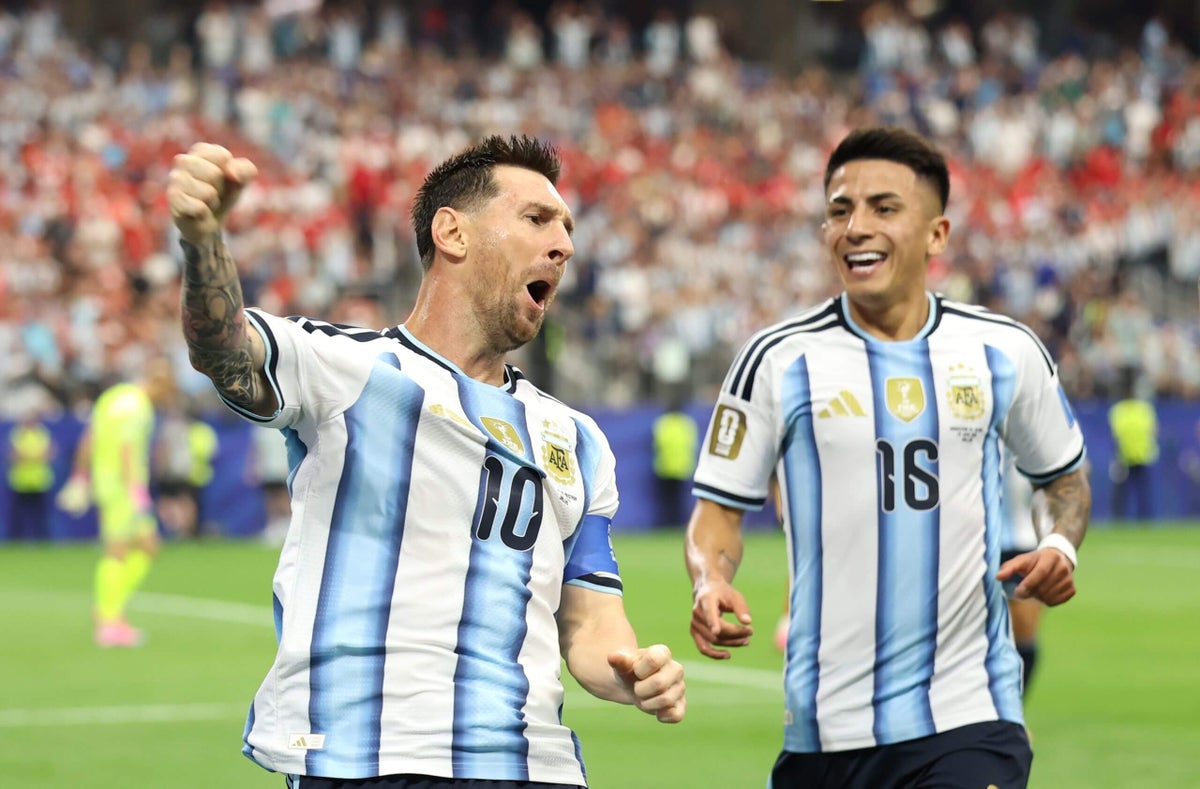
Argentina captain Lionel Messi has broken the all-time FIFA World Cup goalscoring record, netting a brilliant brace in a 2-0 victory over Austria at Dallas Stadium. Overcoming an early penalty miss, Messi reached 18 career tournament goals, surpassing Miroslav Klose and Marta while booking Argentina's spot in the Round of 32.
ARLINGTON, Texas — Argentina captain Lionel Messi officially secured the all-time FIFA World Cup goalscoring record on Monday, netting a decisive brace in a 2-0 Group J victory over Austria. The match, held at the Dallas Stadium before a capacity crowd, saw the 38-year-old playmaker overcome an early penalty miss to score his 17th and 18th career World Cup goals. The historic performance pushed him past Germany’s Miroslav Klose (16 men's goals) and Brazil’s Marta (17 women's goals), making him the most prolific goalscorer in the history of international football's showpiece event. The victory guarantees the defending champions a spot in the Round of 32 knockout stage with one group match remaining.
Legendary Playmaker Rebounds from Penalty Heartbreak to Make History
The highly anticipated match began with immediate drama in the eighth minute. Argentina forward Lautaro Martínez was brought down inside the penalty area by the Austrian defense, prompting the referee to award a spot-kick following a brief video assistant referee (VAR) confirmation.
Messi stepped up to take the penalty but uncharacteristically dragged his low effort wide of the left post, extending an unwanted personal metric as the player with both the most penalties taken (7) and missed (3) in World Cup history.
However, the Argentine talisman quickly redeemed himself. In the 38th minute, defender Facundo Medina delivered a sharp low cross into the final third. A clever dummy by midfielder Thiago Almada allowed the ball to bypass the initial defensive line, finding Messi, who calmly slotted a first-time, low strike past Austrian goalkeeper Alexander Schlager into the bottom-left corner.
The breakthrough strike marked his 17th career World Cup goal, moving him out of a tie with Klose to claim sole possession of the men's international record.
Tactical Stoppage-Time Brace Seals Argentina’s Knockout Spot
A highly physical second half saw head coach Ralf Rangnick’s Austrian side deploy a relentless high-pressing scheme, heavily marshaled by veteran defender David Alaba. Seeking an equalizer on his 100th international appearance, midfielder Marcel Sabitzer narrowly missed a long-range effort, while the Austrian midfield heavily congested the central lanes to limit Messi's space.
Sensing the shifting momentum, Argentina manager Lionel Scaloni introduced defensive reinforcements in the 81st minute, subbing on Leandro Paredes and Nicolás Tagliafico. The defensive blockade successfully absorbed the pressure, setting up a dramatic counter-attack deep into stoppage time.
In the 95th minute, secondary substitute Julián Álvarez broke loose on the left wing. While his initial attempt was saved by Schlager, the rebound fell to Messi. Navigating a cluster of four tracking defenders, Messi forced his second shot past Kevin Danso on the goal line to finalize the score at 2-0 and bring his career tournament total to 18 goals.
Historical Context and Statistical Milestones
The record-breaking night occurred exactly 40 years to the day after Diego Maradona scored his iconic "Hand of God" and "Goal of the Century" goals against England during the 1986 World Cup in Mexico.
A Record-Breaking Campaign
Messi's statistical output during the 2026 North American tournament has reshaped multiple historic leaderboards:
Outright Leader: 18 total World Cup goals, surpassing Miroslav Klose (16) and Marta (17).
Consecutive Consistency: Became only the third player in history to score in six consecutive World Cup matches, matching Just Fontaine (1958) and Jairzinho (1970).
Longevity Standards: Extended his own all-time record for the most FIFA World Cup appearances by a player, marking his 28th match.
Match Winner: Surpassed Klose for the most individual World Cup matches won by a player, securing his 18th career victory.
Official Sources Section
The verified match statistics, historical milestones, and tactical changes detailed in this report are sourced from official post-match summaries provided by the FIFA Tournament Media Portal. Player performance configurations and individual discipline logs were verified via data registries compiled by the Argentine Football Association (AFA) and official international tracking systems published by the Olympic Channel's sports desk.
Official Statements
"To be honest, I'm really happy about the win, especially as it's such a crucial victory, hard-fought and well-earned, but one that gives us peace of mind for what lies ahead," stated Lionel Messi in a post-match interview distributed by FIFA. "This is the World Cup; it was a very evenly matched, very intense match, and we're happy to have picked up six points and to have already qualified."
Reflecting on the monumental milestone, Argentina coach Lionel Scaloni expressed his admiration during his post-match press conference: "What Lionel continues to do defies traditional sports logic. To break a record of this magnitude, after missing an early penalty, shows the immense mental strength he brings to this team. We are privileged to witness history unfold, but our main focus remains the collective objective of defending our world title."
Why It Matters
For global football fans and sports historians, Messi's milestone solidifies his legacy inside the sport's premier tournament, establishing an operational benchmark that may stand for generations. However, the record faces an immediate threat from French captain Kylian Mbappé, who sits on 14 World Cup goals ahead of France's upcoming fixture against Iraq, setting up a high-stakes statistical race throughout the remainder of the 2026 tournament.
For institutional investors, sports marketing agencies, and television networks, the massive audience metrics generated by Messi's pursuit of history validate the commercial premium commanded by the expanded 48-team tournament format. Media platforms like Zee5, which recently secured South Asian broadcasting rights, stand to reap substantial advertising revenue as international viewership spikes surrounding Argentina's knockout stage matches.
Key Facts at a Glance
The Record: Lionel Messi is now the all-time leading scorer in FIFA World Cup history with 18 goals.
The Match: Argentina defeated Austria 2-0 at Dallas Stadium to officially qualify for the Round of 32.
The Milestones: Messi surpassed Miroslav Klose’s men's record (16) and Marta’s all-time tournament record (17).
Tournament Form: The brace follows a hat-trick against Algeria, bringing Messi's 2026 tournament tally to five goals.
FAQ Section
How many goals has Lionel Messi scored in total at the FIFA World Cup?
Following his brace against Austria, Lionel Messi has scored a total of 18 goals across his six career FIFA World Cup appearances.
Whose goalscoring records did Lionel Messi break during the match?
Messi broke the men's all-time record of 16 goals previously held by Germany's Miroslav Klose, as well as the absolute all-time tournament record of 17 goals held by Brazilian women's legend Marta.
What is Argentina's current standing in the 2026 FIFA World Cup?
With consecutive victories over Algeria (3-0) and Austria (2-0), Argentina has earned six points in Group J, securely qualifying for the Round of 32 knockout stage with one group match left against Jordan.
Who is the closest active player capable of challenging Messi's new record?
France's captain Kylian Mbappé is the closest active challenger, currently sitting on 14 career World Cup goals with additional matches left to play in the 2026 tournament.
Source: FIFA Official Match Center, Argentine Football Association Media Registry, International Olympic Committee Sports Bureau.